
Bench Press Muscles Worked: Complete Anatomy Guide
Discover exactly which muscles the bench press works. Learn about primary movers, secondary muscles, and stabilizers, plus how variations change muscle activation.
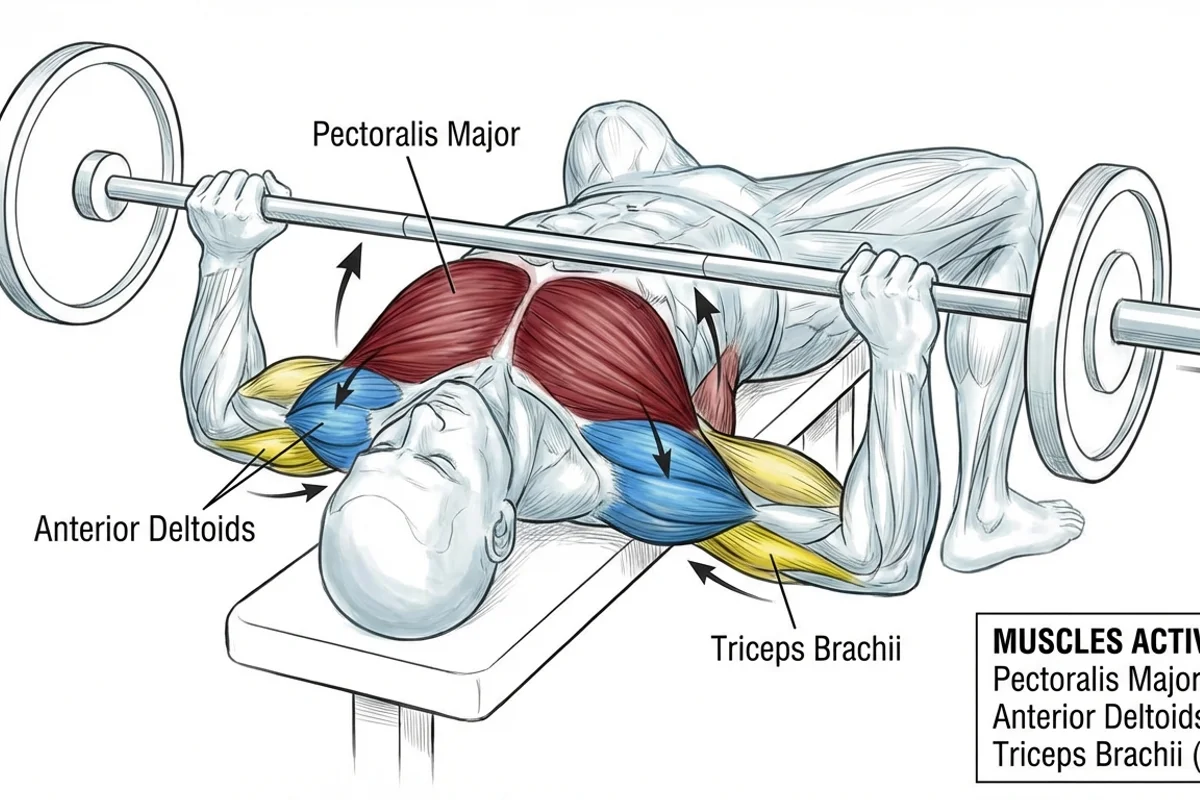
The bench press is one of the most effective compound exercises for building upper body strength and muscle mass. Understanding which muscles are involved helps you optimize your training and troubleshoot weak points.
Quick Answer: What Muscles Does the Bench Press Work?
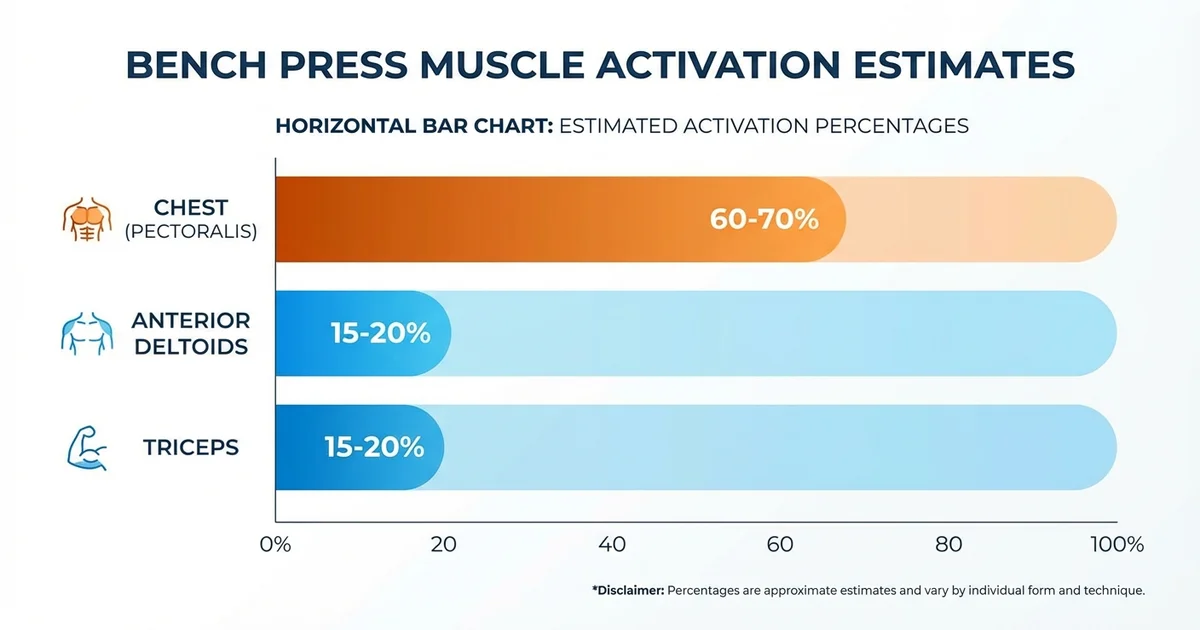
Primary Muscles (60-70% of work):
- Pectoralis Major (chest)
Secondary Muscles (20-30% of work):
- Anterior Deltoids (front shoulders)
- Triceps Brachii (back of upper arms)
Stabilizer Muscles:
- Rotator cuff
- Core/abs
- Lats (during descent)
- Serratus anterior
Primary Muscles: The Pectoralis Major
The chest muscles do the majority of the work during the bench press. The pectoralis major has two distinct heads:
Sternal Head (Lower Chest)
The larger portion of the pec major, originating from the sternum and ribs. This head is most active during flat and decline bench press variations.
Clavicular Head (Upper Chest)
The upper portion, originating from the clavicle. This head receives more activation during incline bench press movements.
How Grip Width Affects Chest Activation
Research shows that grip width significantly impacts pec activation:
- Wide grip: Maximizes chest stretch and activation
- Medium grip: Balanced activation across all pressing muscles
- Narrow grip: Reduces chest involvement, shifts work to triceps
For maximum chest development, use a grip at least 1.5x shoulder width.
Secondary Muscles
Anterior Deltoids (Front Shoulders)
The front deltoids assist throughout the pressing motion. They're particularly active during:
- The bottom portion of the lift
- Incline bench variations (higher activation)
- Narrower grip widths
If you feel bench press primarily in your shoulders, you may need to improve your technique or reduce the weight.
Triceps Brachii
The triceps extend the elbow during the lockout portion of the bench press. They contribute approximately 15-20% of the total force production.
Tricep involvement increases with:
- Closer grip widths
- The lockout phase of the lift
- Higher bench angles (decline)
Stabilizer Muscles
Rotator Cuff
The four rotator cuff muscles (supraspinatus, infraspinatus, teres minor, subscapularis) stabilize the shoulder joint throughout the movement. Proper scapular retraction is essential for rotator cuff health.
Core/Abs
Your core muscles brace to maintain spinal stability and transfer force from your legs through your torso. A strong core allows for better leg drive and overall stability.
Lats (Latissimus Dorsi)
The lats play a crucial role during the descent, controlling the bar path and keeping the elbows in proper position. Cue: "Bend the bar" to engage your lats.
Serratus Anterior
Located on the side of your ribcage, the serratus anterior helps protract and stabilize your shoulder blades at lockout.
Muscle Activation by Bench Variation
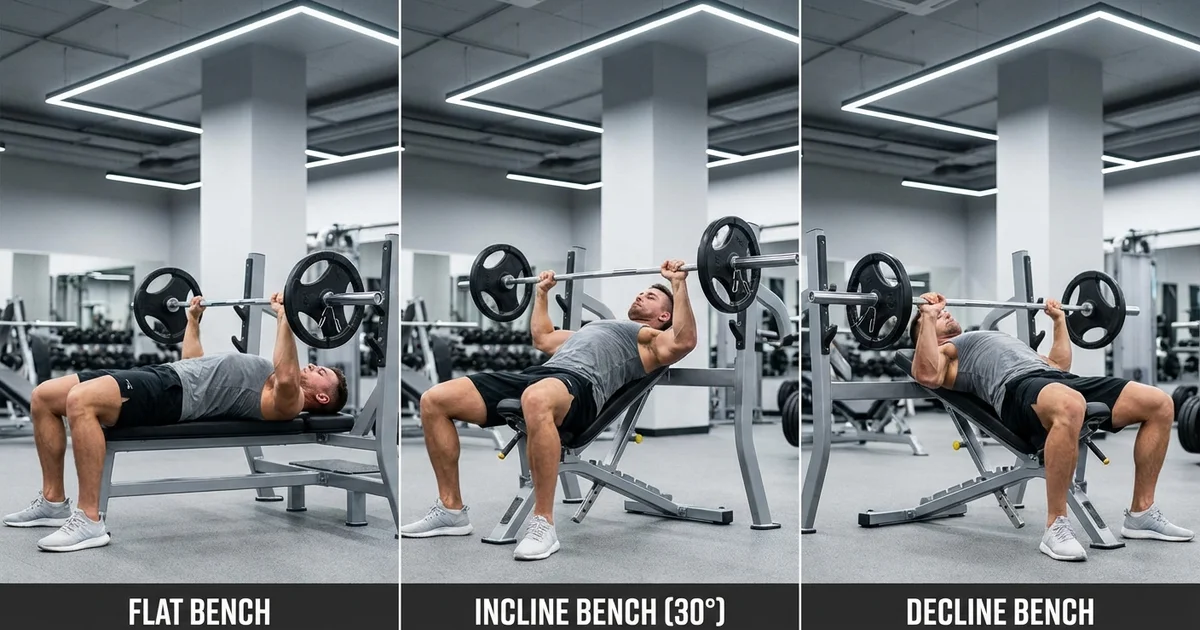
Different bench press variations emphasize different muscles:
Flat Bench Press
| Muscle | Activation Level |
|---|---|
| Pectoralis Major (sternal) | High |
| Pectoralis Major (clavicular) | Moderate |
| Anterior Deltoid | Moderate |
| Triceps | Moderate |
Best for: Overall chest development and strength
Incline Bench Press (30-45°)
| Muscle | Activation Level |
|---|---|
| Pectoralis Major (sternal) | Moderate |
| Pectoralis Major (clavicular) | High |
| Anterior Deltoid | High |
| Triceps | Moderate |
Best for: Upper chest emphasis, shoulder development
Decline Bench Press
| Muscle | Activation Level |
|---|---|
| Pectoralis Major (sternal) | Very High |
| Pectoralis Major (clavicular) | Low |
| Anterior Deltoid | Low |
| Triceps | High |
Best for: Lower chest isolation, reduced shoulder stress
Close-Grip Bench Press
| Muscle | Activation Level |
|---|---|
| Pectoralis Major (sternal) | Moderate |
| Pectoralis Major (clavicular) | Moderate |
| Anterior Deltoid | Moderate |
| Triceps | Very High |
Best for: Tricep development, lockout strength
How to Target Specific Muscles
Maximize Chest Activation
- Use a wider grip (1.5-2x shoulder width)
- Focus on squeezing the chest at the top
- Lower the bar to the lower chest
- Maintain a slight arch and scapular retraction
- Use a controlled tempo with pause at the bottom
Maximize Tricep Activation
- Use a closer grip (shoulder width or narrower)
- Keep elbows closer to your sides
- Focus on the lockout portion
- Consider decline bench variations
Minimize Shoulder Stress
- Don't flare elbows past 75 degrees
- Keep shoulder blades retracted
- Avoid touching too high on the chest
- Use decline variations if you have shoulder issues
Common Muscle-Related Issues
"I Only Feel It In My Shoulders"
This usually indicates:
- Poor scapular retraction
- Bar touching too high on chest
- Elbows flaring too wide
- Weak chest muscles relative to shoulders
Fix: Work on technique and add isolated chest work (flyes, cable crossovers).
"I Only Feel It In My Triceps"
This usually indicates:
- Grip too narrow
- Not enough chest stretch at the bottom
- Lockout-dominant technique
Fix: Widen your grip and focus on the stretch at the bottom.
"My Chest Is Lagging"
Add direct chest work:
- Dumbbell flyes
- Cable crossovers
- Incline variations
- Pause reps with chest focus
The Science Behind Muscle Activation
EMG (electromyography) studies show:
- The pec major produces the most force during the bottom half of the lift
- Tricep activation peaks during the top half (lockout)
- Wider grips increase pec activation by 10-15%
- Incline angles of 30-45° maximize upper pec activation
Understanding these patterns helps you troubleshoot weak points in your bench press.
Calculate Your Bench Press Calories
Curious about the energy demands of your bench press training? Use our Bench Press Calorie Calculator to see how many calories you burn during your workouts.
Related Guides
- How to Bench Press - Master proper form
- Bench Press Variations Guide - Explore all variations
- Common Bench Press Mistakes - Avoid these errors
- How to Increase Your Bench Press - Build strength