
Chest Press Machine Muscles Worked: Complete Anatomy Guide
Discover exactly which muscles the chest press machine works. Learn about primary movers, secondary muscles, and how grip variations change muscle activation.
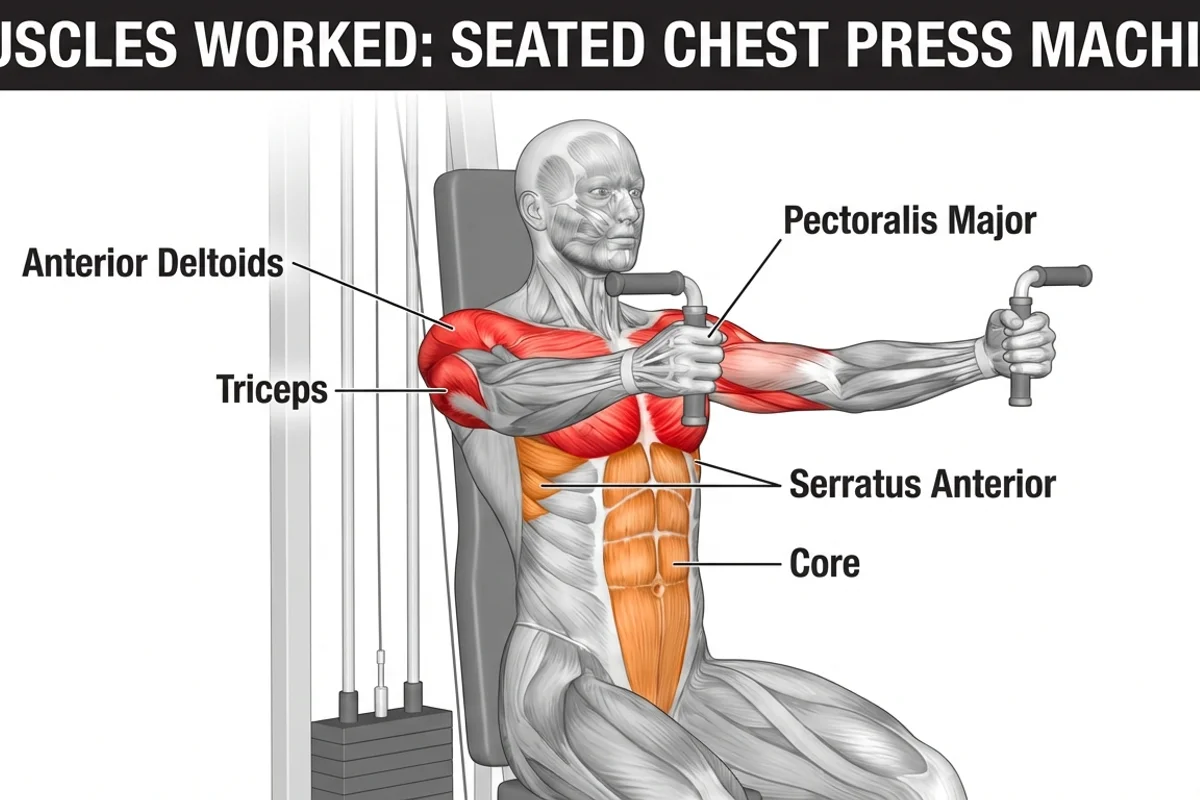
The chest press machine is one of the most popular gym machines for building upper body pushing strength. Understanding which muscles are involved helps you optimize your training and compare it to free weight alternatives.
Quick Answer: What Muscles Does the Chest Press Work?
Primary Muscles (60-70% of work):
- Pectoralis Major (chest)
- Anterior Deltoids (front shoulders)
- Triceps Brachii (back of arms)
Secondary Muscles (20-30% of work):
- Serratus Anterior (side of ribcage)
- Core muscles (minimal)
Stabilizer Muscles:
- Rotator cuff (minimal due to machine guidance)
- Upper back (isometric)
Primary Muscles: The Pressing Muscles
Pectoralis Major (Chest)
The chest is the primary mover during chest press:
Sternal Head (Lower/Middle Chest)
- Larger portion of the pec
- Most active in flat chest press
- Works during the pressing phase
Clavicular Head (Upper Chest)
- Upper portion near collarbone
- More active in incline chest press
- Works to bring arms forward
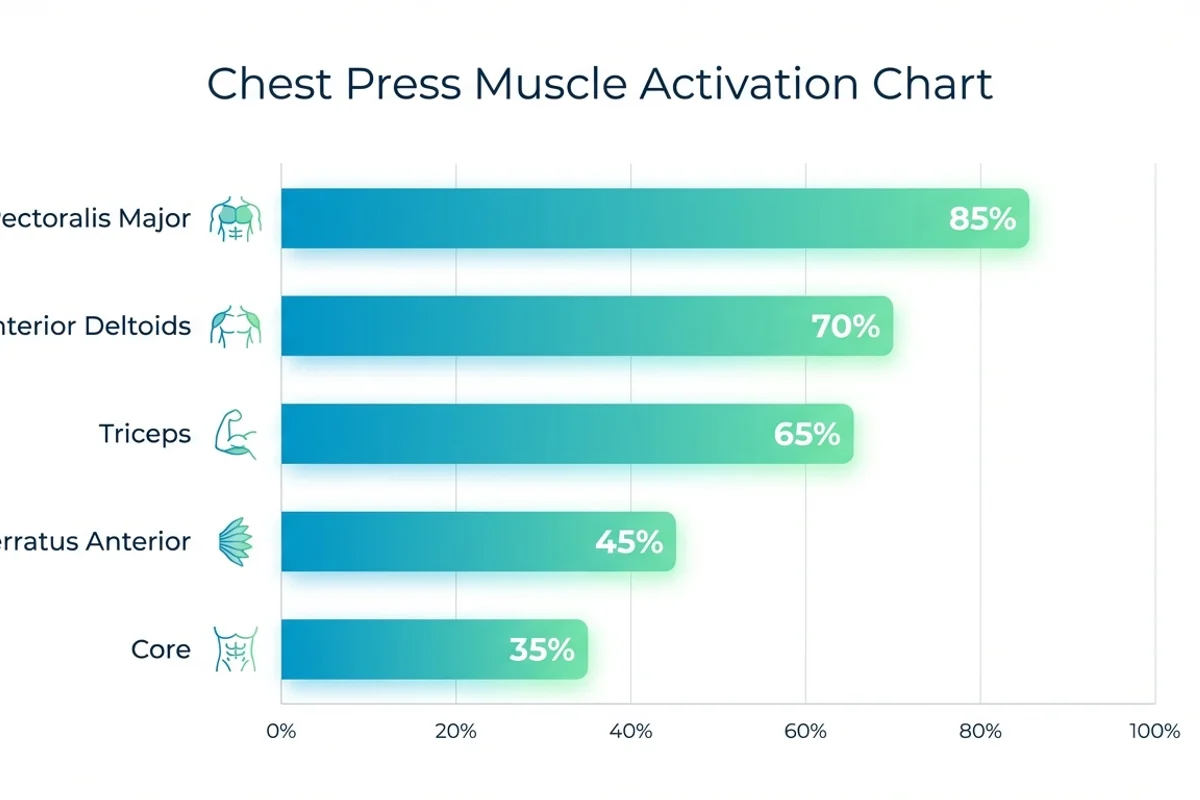
Activation level: Very High (85%)
Anterior Deltoids (Front Shoulders)
Your front shoulders assist significantly:
- Help initiate the press
- Support the chest muscles
- Work throughout the movement
Activation level: High (70%)
Triceps Brachii
The triceps lock out your elbows:
- Long head
- Lateral head
- Medial head
Role: Extend the arms during the final portion of each rep.
Activation level: Moderate-High (65%)
Secondary Muscles
Serratus Anterior
Located on the side of your ribcage:
- Protracts shoulder blades at lockout
- Stabilizes scapula during pressing
- Important for shoulder health
Activation level: Moderate (45%)
Core Muscles
Your core engages minimally due to back support:
- Rectus abdominis
- Obliques
Note: Much less core activation than bench press due to seated position.
Activation level: Low (35%)
Muscle Activation by Grip and Angle
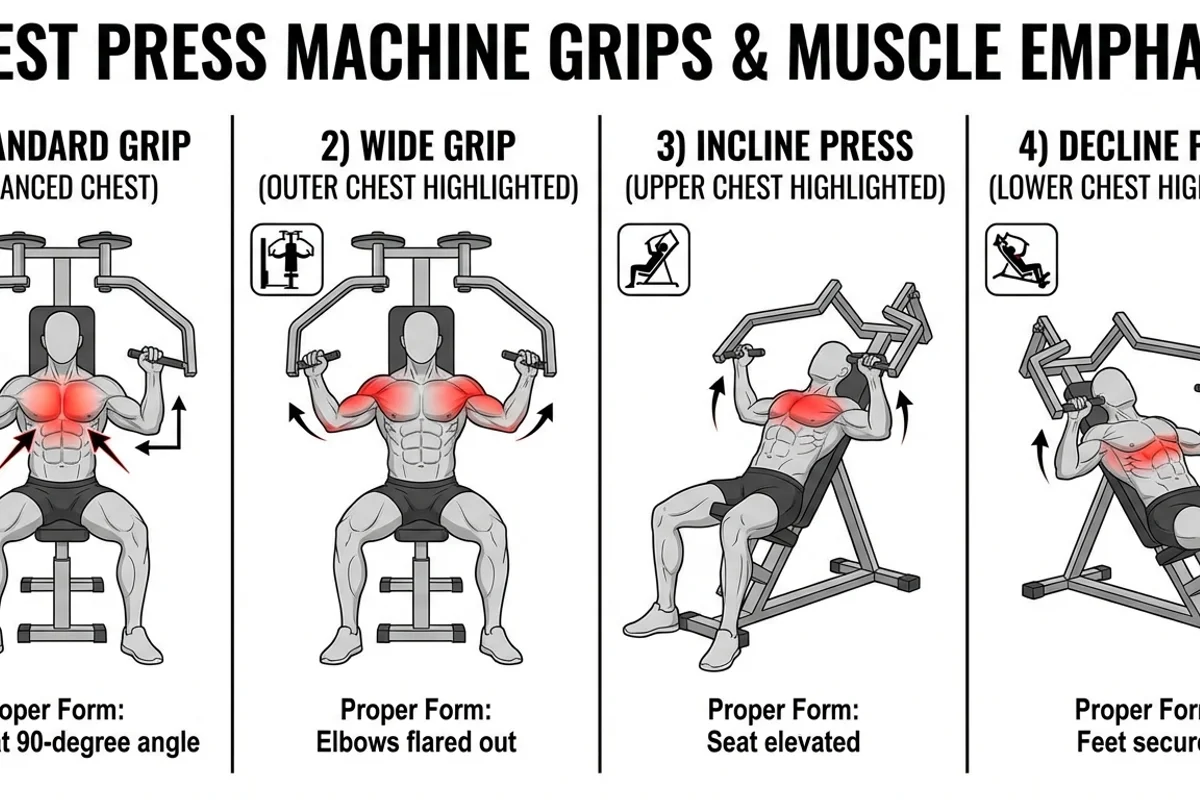
Standard Grip (Horizontal)
| Muscle | Activation Level |
|---|---|
| Pectoralis Major (sternal) | Very High |
| Anterior Deltoids | High |
| Triceps | Moderate-High |
| Serratus Anterior | Moderate |
Best for: Overall chest development, general strength
Wide Grip
| Muscle | Activation Level |
|---|---|
| Pectoralis Major (outer) | Very High |
| Anterior Deltoids | Moderate |
| Triceps | Moderate |
| Serratus Anterior | High |
Best for: Chest width, outer pec development
Narrow Grip
| Muscle | Activation Level |
|---|---|
| Triceps | Very High |
| Pectoralis Major (inner) | High |
| Anterior Deltoids | High |
| Serratus Anterior | Moderate |
Best for: Tricep emphasis, inner chest
Incline Chest Press
| Muscle | Activation Level |
|---|---|
| Pectoralis Major (clavicular) | Very High |
| Anterior Deltoids | Very High |
| Triceps | Moderate-High |
Best for: Upper chest development, shoulder involvement
Decline Chest Press
| Muscle | Activation Level |
|---|---|
| Pectoralis Major (sternal) | Maximum |
| Triceps | High |
| Anterior Deltoids | Moderate |
Best for: Lower chest emphasis, reduced shoulder stress
How to Target Specific Muscles
Maximize Chest Activation
- Use a wider grip
- Focus on squeezing chest at the end
- Use controlled tempo (2-3 seconds each way)
- Keep shoulder blades slightly retracted
- Don't lock out completely to maintain tension
Maximize Tricep Activation
- Use a narrower grip
- Focus on the lockout portion
- Keep elbows closer to body
- Use decline angle if available
- Add pause at full extension
Maximize Shoulder Activation
- Use incline chest press
- Use moderate grip width
- Let elbows come slightly higher
- Focus on the initial push phase
Minimize Shoulder Stress
- Use decline or flat angle
- Keep elbows at 45-degree angle
- Don't overstretch at the bottom
- Avoid flaring elbows to 90 degrees
Chest Press vs. Bench Press: Muscle Comparison
| Factor | Chest Press Machine | Bench Press |
|---|---|---|
| Chest Activation | ●●●●○ (80%) | ●●●●● (90%) |
| Tricep Activation | ●●●●○ | ●●●●○ |
| Stabilizer Work | ●○○○○ | ●●●●● |
| Core Engagement | ●○○○○ | ●●●○○ |
| Safety | ●●●●● | ●●●○○ |
| Progressive Overload | ●●●○○ | ●●●●● |
Key takeaway: Chest press is safer and easier to learn, but bench press provides more stabilizer activation and functional strength.
Common Muscle-Related Issues
"I Only Feel It In My Shoulders"
This usually indicates:
- Seat too high or low
- Gripping too narrow
- Elbows flaring too wide
- Not retracting shoulder blades
Fix: Adjust seat height, widen grip, keep elbows at 45°, pull shoulders back.
"My Triceps Get Tired First"
This usually indicates:
- Grip too narrow
- Locking out completely on each rep
- Chest muscles are weak
Fix: Widen grip, don't fully lock out, add isolated chest work.
"I Can't Feel My Chest"
This usually indicates:
- Mind-muscle connection issue
- Going too fast
- Not enough stretch at bottom
- Seat positioned incorrectly
Fix: Slow down, pause at bottom, adjust seat so handles are at chest level.
"The Movement Feels Awkward"
This usually indicates:
- Seat height incorrect
- Machine not adjusted properly
- Grip width doesn't match anatomy
Fix: Handles should be at mid-chest level when seated, adjust grip width.
Benefits of Chest Press Machine
Advantages Over Free Weights
- Safer for beginners - No balance required
- No spotter needed - Can train to failure safely
- Consistent path - Fixed movement pattern
- Easier progressive overload - Weight stack increments
- Injury rehab friendly - Controlled range of motion
Disadvantages vs. Free Weights
- Less stabilizer activation - Fixed path
- Less functional carryover - Non-natural movement
- Limited range of motion - Machine constraints
- Fixed movement path - May not suit all body types
- Less core engagement - Back support
When to Use Chest Press Machine
Best for:
- Beginners learning to push
- Training to failure without a spotter
- Injury rehabilitation
- Pre-exhausting chest before compound movements
- High-volume training days
- Older adults or those with balance issues
Consider free weights when:
- Building overall functional strength
- Training for sports performance
- Maximum muscle activation is the goal
- You have good form and experience
Calculate Your Chest Press Calories
Curious about the energy demands of your chest press training? Use our Chest Press Calorie Calculator to see how many calories you burn during your workouts.
Related Guides
- Bench Press Muscles Worked - Free weight comparison
- Push-Up Muscles Worked - Bodyweight alternative
- Chest Workout Calories Burned - Full workout analysis
- Bench Press vs Chest Press Calories - Calorie comparison