
Push-Up Muscles Worked: Complete Anatomy Guide
Discover exactly which muscles push-ups work. Learn about primary movers, secondary muscles, and stabilizers, plus how variations change muscle activation.
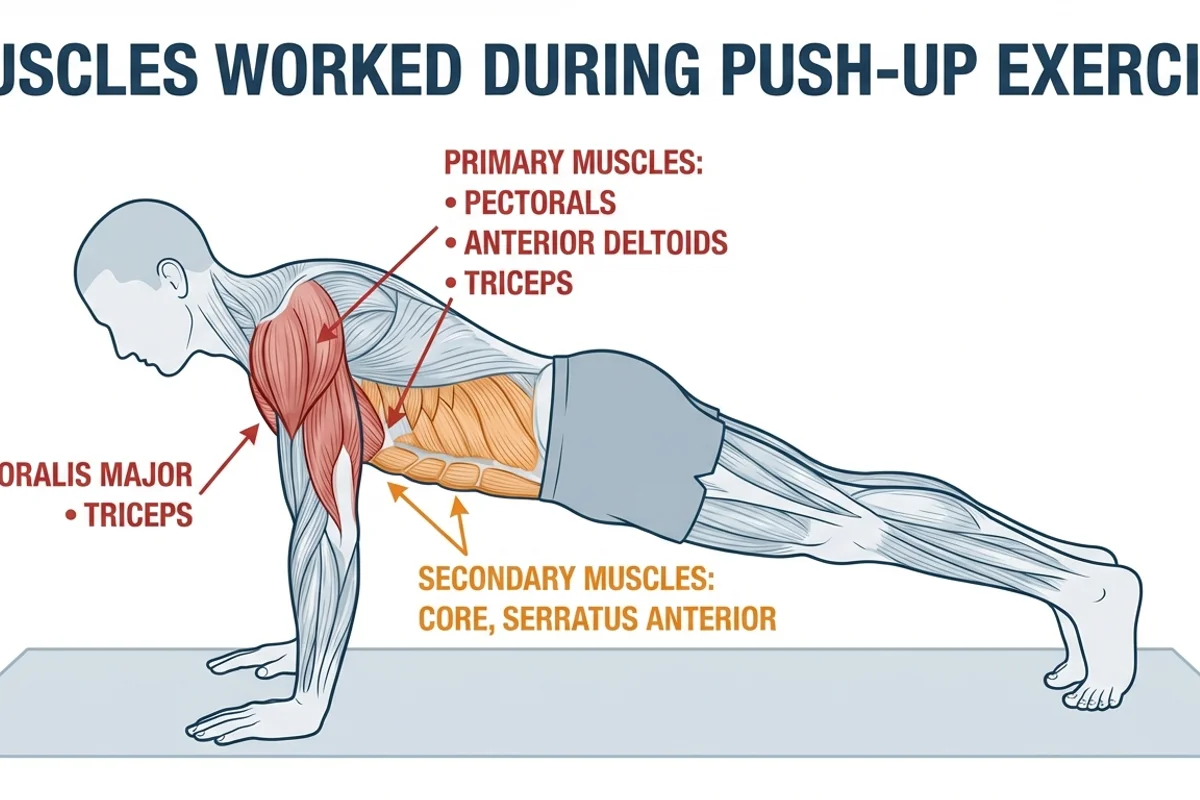
The push-up is one of the most effective bodyweight exercises for building upper body strength and muscle. Understanding which muscles are involved helps you optimize your training and choose the right variations.
Quick Answer: What Muscles Do Push-Ups Work?
Primary Muscles (60-70% of work):
- Pectoralis Major (chest)
- Anterior Deltoids (front shoulders)
- Triceps Brachii (back of arms)
Secondary Muscles (20-30% of work):
- Serratus Anterior (side of ribcage)
- Core muscles (abs and obliques)
- Forearms
Stabilizer Muscles:
- Rotator cuff
- Rhomboids
- Lower back (erector spinae)
- Glutes and quads (body alignment)
Primary Muscles: The Pushing Muscles
Pectoralis Major (Chest)
The chest is the primary mover during push-ups:
Sternal Head (Lower/Middle Chest)
- Larger portion of the pec
- Most active in standard push-ups
- Works during the pushing phase
Clavicular Head (Upper Chest)
- Upper portion near collarbone
- More active in decline push-ups
- Works to bring arms across body
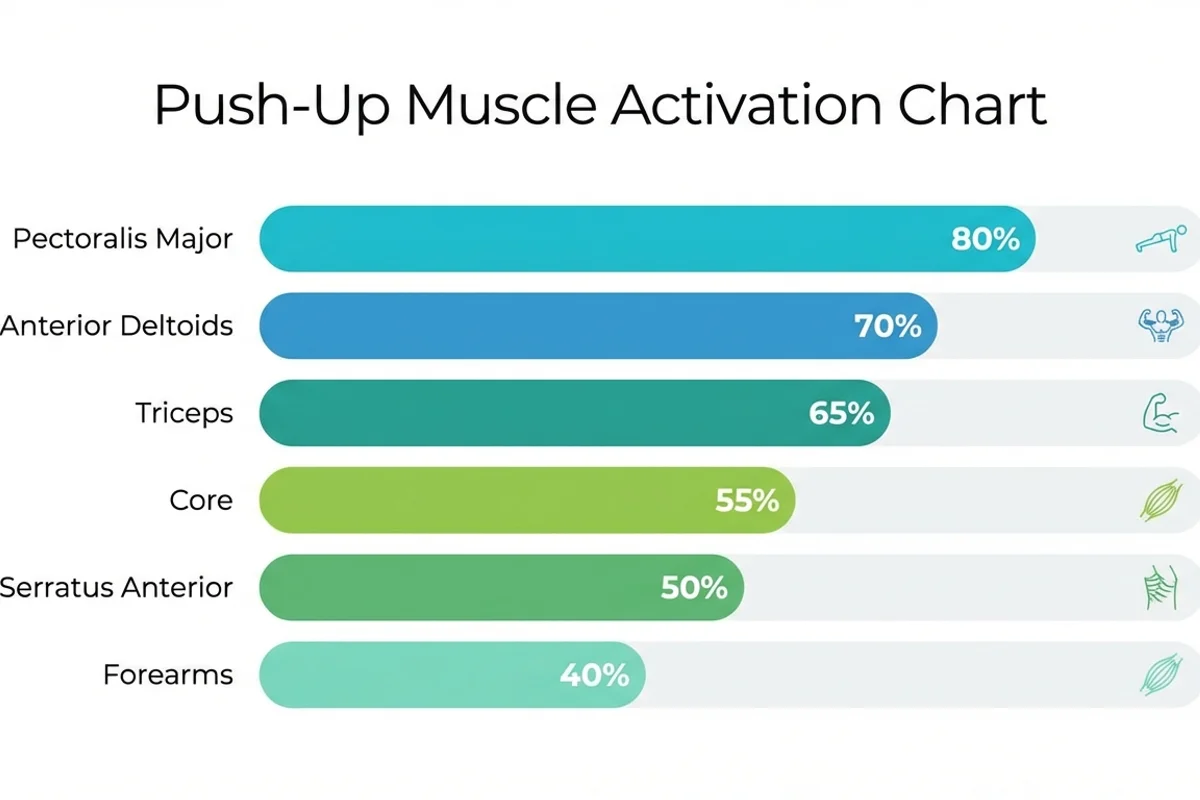
Activation level: High (80%)
Anterior Deltoids (Front Shoulders)
Your front shoulders assist throughout the movement:
- Help initiate the push
- Support the chest muscles
- More active with narrower hand positions
Activation level: High (70%)
Triceps Brachii
The triceps extend your elbows during the pushing phase:
- Long head
- Lateral head
- Medial head
Role: Lock out the arms at the top of each rep.
Activation level: Moderate-High (65%)
Secondary Muscles
Serratus Anterior
Located on the side of your ribcage, the serratus protracts your shoulder blades:
- Pushes shoulder blades forward at lockout
- Creates the "plus" at the top of the push-up
- Important for shoulder health
Activation level: Moderate (50%)
Core Muscles
Your entire core works to maintain a rigid body position:
- Rectus abdominis (abs)
- Internal and external obliques
- Transverse abdominis (deep core)
Role: Prevent sagging or piking of the hips.
Activation level: Moderate (55%)
Forearms
Your forearms stabilize your wrists and grip the floor:
- Wrist flexors
- Wrist extensors
- Help maintain wrist position
Activation level: Moderate (40%)
Muscle Activation by Push-Up Variation
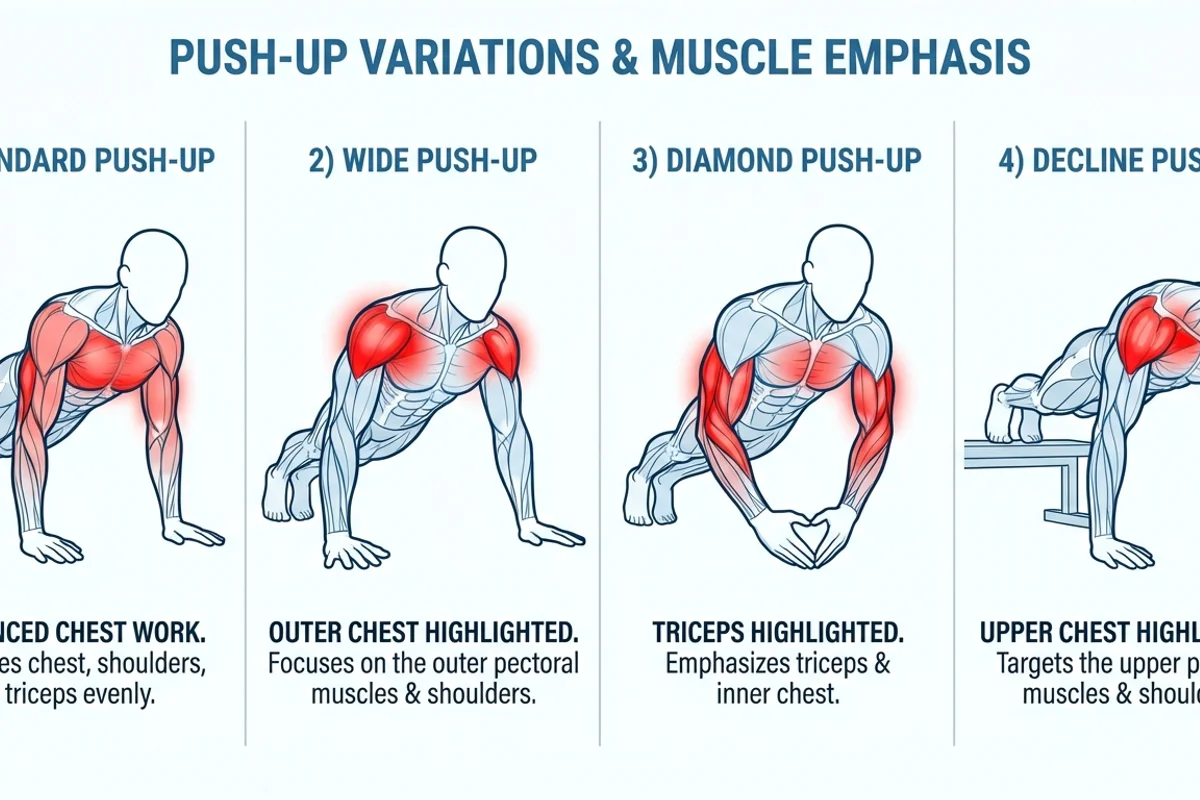
Different push-up variations target different muscles:
Standard Push-Up
| Muscle | Activation Level |
|---|---|
| Pectoralis Major | High |
| Anterior Deltoids | High |
| Triceps | Moderate-High |
| Core | Moderate |
| Serratus Anterior | Moderate |
Best for: Overall upper body development, general fitness
Wide Push-Up
| Muscle | Activation Level |
|---|---|
| Pectoralis Major (outer) | Very High |
| Anterior Deltoids | Moderate |
| Triceps | Moderate |
| Core | Moderate |
Best for: Chest emphasis, wider chest development
Diamond (Close-Grip) Push-Up
| Muscle | Activation Level |
|---|---|
| Triceps | Very High |
| Pectoralis Major (inner) | High |
| Anterior Deltoids | High |
| Core | High |
Best for: Tricep development, inner chest
Decline Push-Up (Feet Elevated)
| Muscle | Activation Level |
|---|---|
| Pectoralis Major (upper) | Very High |
| Anterior Deltoids | Very High |
| Triceps | High |
| Core | High |
Best for: Upper chest emphasis, shoulder development
Incline Push-Up (Hands Elevated)
| Muscle | Activation Level |
|---|---|
| Pectoralis Major (lower) | High |
| Triceps | Moderate |
| Anterior Deltoids | Moderate |
| Core | Low |
Best for: Beginners, lower chest focus, reduced difficulty
Pike Push-Up
| Muscle | Activation Level |
|---|---|
| Anterior Deltoids | Very High |
| Upper Pectorals | High |
| Triceps | High |
| Serratus Anterior | High |
Best for: Shoulder development, handstand progression
How to Target Specific Muscles
Maximize Chest Activation
- Use a wider hand position (1.5x shoulder width)
- Lower slowly with control (3-4 seconds)
- Touch chest to floor or go below parallel
- Focus on squeezing chest at the top
- Use pause reps at the bottom
Maximize Tricep Activation
- Use diamond or close-grip hand position
- Keep elbows close to your body
- Focus on the lockout portion
- Use slow eccentrics
- Add pause at the top
Maximize Shoulder Activation
- Use pike push-ups or decline variations
- Position hands slightly narrower
- Keep elbows at 45-degree angle
- Add archer push-ups for unilateral work
- Progress toward handstand push-ups
Maximize Core Activation
- Maintain perfect plank position
- Don't let hips sag or pike
- Add instability (hands on ball)
- Use slower tempo
- Add push-up plus (extra protraction at top)
Common Muscle-Related Issues
"I Only Feel It In My Arms"
This usually indicates:
- Hands positioned too narrow
- Elbows flaring out too much
- Not going deep enough
- Chest muscles are weak
Fix: Widen hand position, keep elbows at 45°, go full depth, add chest flyes.
"My Shoulders Hurt"
This usually indicates:
- Elbows flaring to 90°
- Hands positioned too wide
- Shoulder blades not engaged
- Going too deep with poor form
Fix: Keep elbows at 45°, retract shoulder blades, reduce depth if needed.
"I Can't Feel My Chest"
This usually indicates:
- Mind-muscle connection issue
- Too much tricep dominance
- Not enough chest stretch at bottom
- Going too fast
Fix: Slow down tempo, pause at bottom, focus on chest squeeze, use wider grip.
"My Wrists Hurt"
This usually indicates:
- Poor wrist flexibility
- Hands angled incorrectly
- Too much weight on heel of palm
Fix: Use push-up handles, warm up wrists, distribute weight evenly.
The Science Behind Muscle Activation
EMG (electromyography) studies show:
- Standard push-ups activate 61-66% of max chest muscle activation
- Diamond push-ups show highest tricep activation (73%)
- Wide push-ups maximize pec stretch but slightly reduce overall activation
- Decline push-ups shift emphasis to upper chest and shoulders
- Adding instability (like rings) increases core activation by 20-30%
Understanding these patterns helps you choose the right variation for your goals.
Push-Ups vs. Bench Press
| Factor | Push-Ups | Bench Press |
|---|---|---|
| Chest Activation | High (61-66%) | Very High (85-95%) |
| Stabilizer Work | Very High | Low |
| Core Engagement | High | Low |
| Equipment Needed | None | Bench + Bar |
| Progressive Overload | Harder | Easy |
| Joint Safety | Safer | Higher Risk |
Both exercises are valuable - push-ups offer more functional carryover while bench press allows easier progressive overload.
Calculate Your Push-Up Calories
Curious about the energy demands of your push-up training? Use our Push-Up Calorie Calculator to see how many calories you burn during your workouts.
Related Guides
- Bench Press Muscles Worked - Compare to weighted pressing
- How Many Calories Do Push-Ups Burn? - Complete calorie guide
- Chest Press Muscles Worked - Machine alternative