
Sit-Up Muscles Worked: Complete Anatomy Guide
Discover exactly which muscles sit-ups and crunches work. Learn about primary movers, secondary muscles, and how variations change muscle activation.
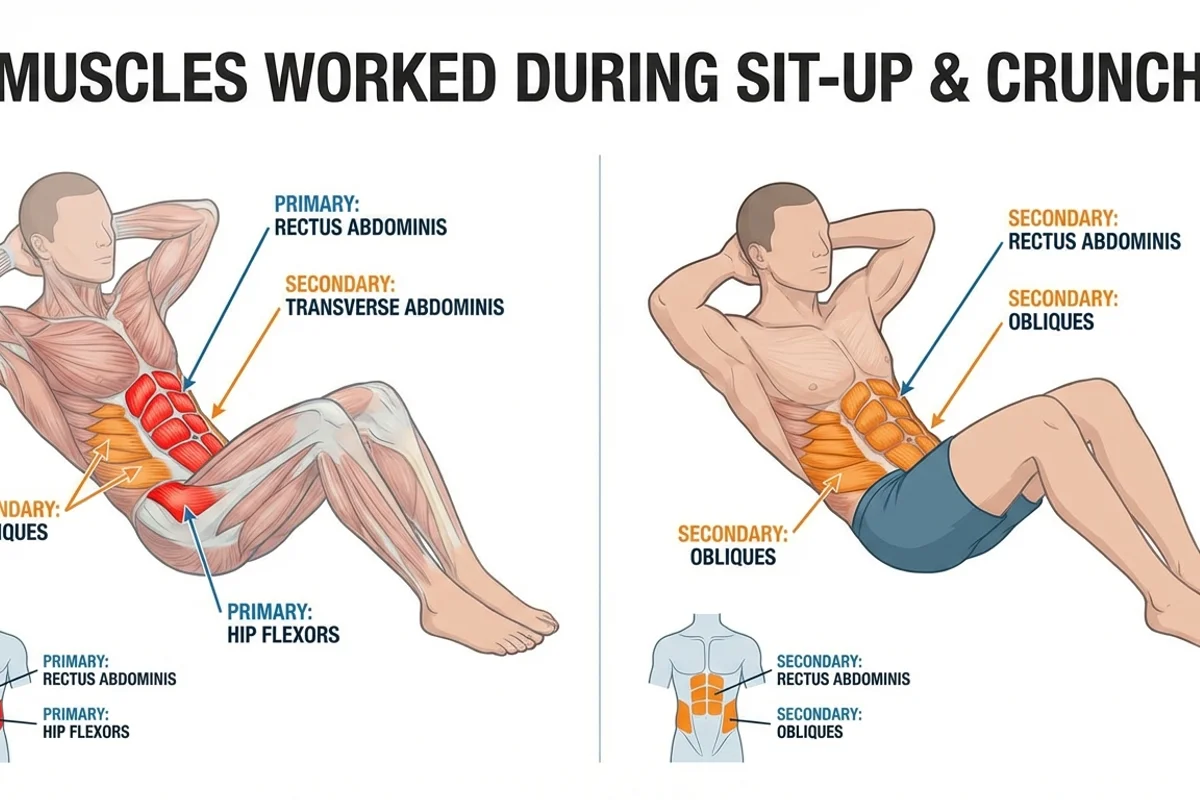
Sit-ups and crunches are classic core exercises that have been used for decades. Understanding which muscles are involved helps you optimize your training and choose the right variations for your goals.
Quick Answer: What Muscles Do Sit-Ups Work?
Primary Muscles (60-70% of work):
- Rectus Abdominis (six-pack muscle)
- Hip Flexors (iliopsoas)
Secondary Muscles (20-30% of work):
- Internal and External Obliques
- Transverse Abdominis (deep core)
Stabilizer Muscles:
- Lower back (erector spinae)
- Neck muscles
- Quadriceps (for anchoring)
Primary Muscles: The Core Movers
Rectus Abdominis
The "six-pack" muscle runs vertically from your ribs to pelvis:
Upper Region
- More active during crunches
- Brings ribs toward pelvis
Lower Region
- More active during reverse movements
- Brings pelvis toward ribs
Role: Flex the spine, bringing chest toward hips.
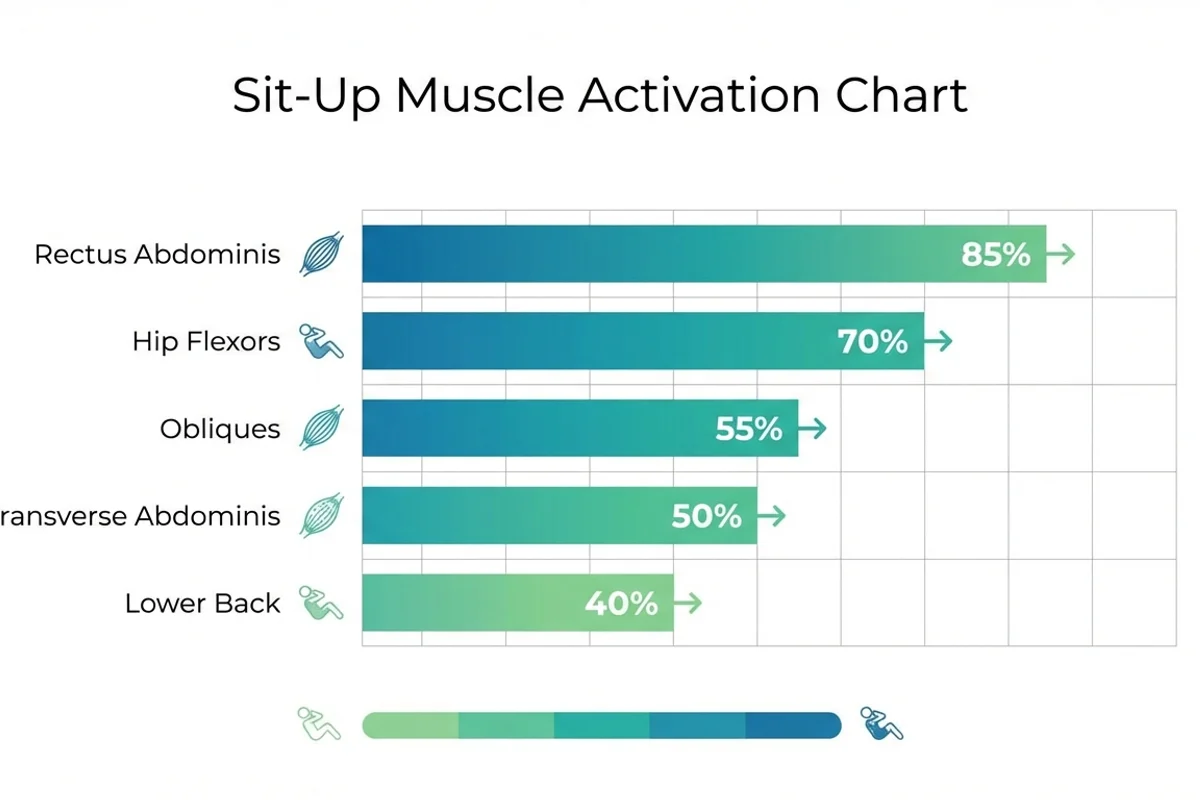
Activation level: Very High (85%)
Hip Flexors (Iliopsoas)
The hip flexors are heavily involved in full sit-ups:
- Psoas major
- Iliacus
- Rectus femoris
Role: Flex the hip, lifting torso from 45° to upright position.
Activation level: High (70%)
Note: This is why full sit-ups can cause lower back issues - excessive hip flexor engagement.
Secondary Muscles
Obliques
Your side abdominal muscles work to stabilize and assist rotation:
External Obliques
- Help with rotation and lateral flexion
- Active in twisting variations
Internal Obliques
- Work opposite to external obliques
- Assist in trunk stability
Activation level: Moderate (55%)
Transverse Abdominis
The deepest abdominal muscle:
- Wraps around your midsection like a corset
- Provides core stability
- Engages when bracing
Role: Stabilize the spine and compress abdominal contents.
Activation level: Moderate (50%)
Erector Spinae (Lower Back)
Your lower back muscles work eccentrically:
- Control the lowering phase
- Prevent excessive spinal flexion
Activation level: Low-Moderate (40%)
Muscle Activation by Exercise Variation
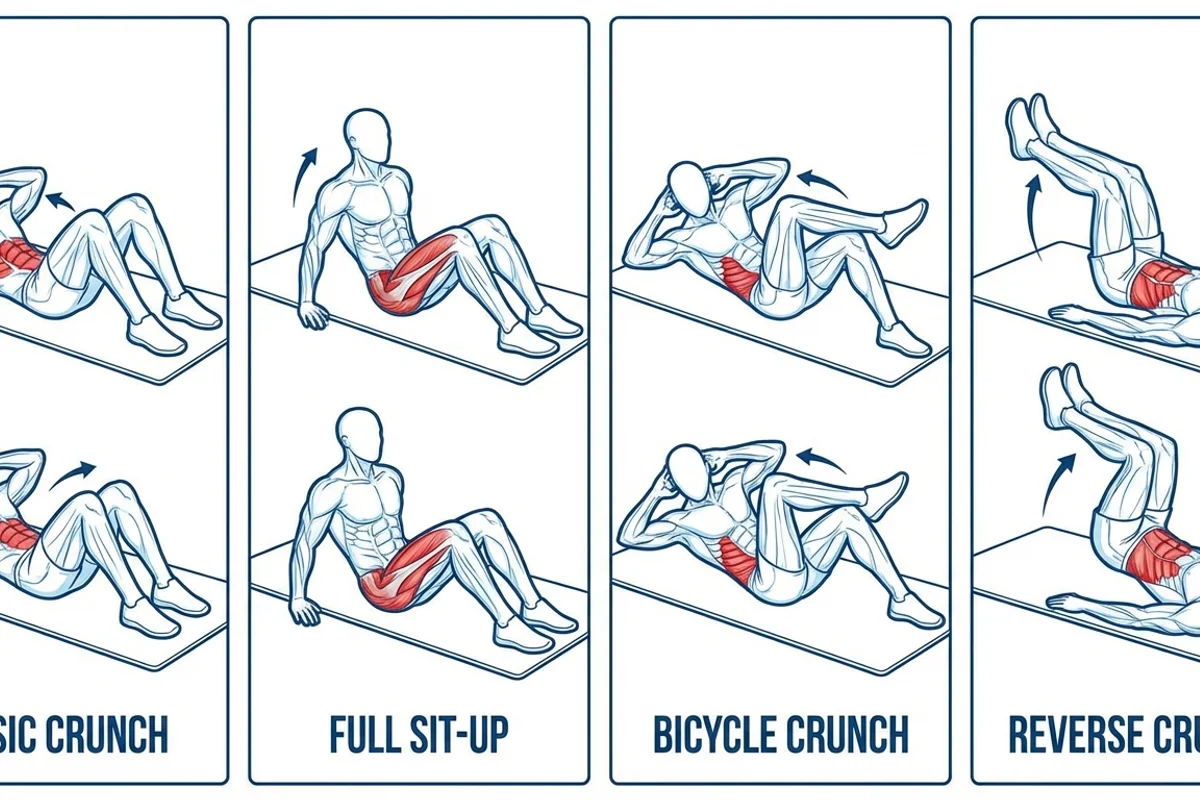
Basic Crunch
| Muscle | Activation Level |
|---|---|
| Rectus Abdominis (upper) | Very High |
| Hip Flexors | Low |
| Obliques | Moderate |
| Transverse Abdominis | Moderate |
Best for: Upper ab isolation, spine-safe option
Full Sit-Up
| Muscle | Activation Level |
|---|---|
| Rectus Abdominis | High |
| Hip Flexors | Very High |
| Obliques | Moderate |
| Lower Back | Moderate |
Best for: Full range of motion (use caution with lower back issues)
Bicycle Crunch
| Muscle | Activation Level |
|---|---|
| Obliques | Very High |
| Rectus Abdominis | High |
| Hip Flexors | Moderate |
| Transverse Abdominis | High |
Best for: Oblique development, rotational strength
Reverse Crunch
| Muscle | Activation Level |
|---|---|
| Rectus Abdominis (lower) | Very High |
| Hip Flexors | High |
| Obliques | Moderate |
Best for: Lower ab emphasis, hip flexor engagement
Dead Bug
| Muscle | Activation Level |
|---|---|
| Transverse Abdominis | Very High |
| Rectus Abdominis | Moderate |
| Hip Flexors | Moderate |
Best for: Core stability, lower back safe
How to Target Specific Muscles
Maximize Upper Abs
- Use crunches instead of full sit-ups
- Focus on bringing ribs to pelvis
- Don't come up too high
- Hold the contraction at the top
- Use slow, controlled movements
Maximize Lower Abs
- Use reverse crunches or leg raises
- Focus on tilting pelvis toward ribs
- Keep lower back pressed to floor
- Use hanging variations for advanced training
- Add hollow body holds
Maximize Oblique Activation
- Use bicycle crunches
- Add rotation to movements
- Try side planks and side crunches
- Include Russian twists
- Use cable woodchops
Minimize Hip Flexor Involvement
- Use crunches instead of sit-ups
- Keep feet unanchored
- Don't come up past 30-45 degrees
- Focus on spinal flexion, not hip flexion
- Try dead bugs or plank variations
Sit-Ups vs. Crunches: What's the Difference?
| Factor | Full Sit-Up | Crunch |
|---|---|---|
| Range of Motion | Full (90°+) | Partial (30°) |
| Hip Flexor Involvement | Very High | Low |
| Ab Isolation | Moderate | High |
| Lower Back Stress | Higher | Lower |
| Calories Burned | More | Less |
| Functional | More | Less |
Recommendation: Use crunches for ab isolation, sit-ups for functional fitness (if your back allows).
Common Muscle-Related Issues
"I Feel Sit-Ups In My Hip Flexors"
This usually indicates:
- Using full sit-up instead of crunch
- Feet anchored under something
- Coming up too high
- Hip flexors dominating the movement
Fix: Switch to crunches, don't anchor feet, stop at 30-45 degrees.
"My Neck Hurts"
This usually indicates:
- Pulling on neck with hands
- Cervical flexion instead of spinal flexion
- Neck muscles compensating
Fix: Place hands beside ears (not behind head), keep space between chin and chest.
"My Lower Back Hurts"
This usually indicates:
- Excessive hip flexor engagement
- Lower back arching during movement
- Weak core stability
- Too many reps with poor form
Fix: Switch to crunches or dead bugs, reduce volume, strengthen transverse abdominis.
"I Can't Feel My Abs"
This usually indicates:
- Going too fast
- Using momentum
- Hip flexors doing the work
- Mind-muscle connection issue
Fix: Slow down, pause at contraction, reduce range of motion, try isometric holds.
The Science Behind Muscle Activation
EMG studies reveal:
- Crunches activate rectus abdominis ~65% of maximum
- Full sit-ups activate hip flexors more than abs
- Bicycle crunches show highest oblique activation
- Ab roller shows highest overall ab activation
- Unanchored feet reduce hip flexor involvement by 30%
Do Sit-Ups Burn Belly Fat?
Short answer: No exercise can spot-reduce belly fat.
However, sit-ups do:
- Burn calories (contributing to overall fat loss)
- Build ab muscle (which may show through when lean)
- Improve core strength and posture
- Support other exercises that burn more calories
For fat loss, combine ab exercises with cardio and calorie deficit.
Calculate Your Sit-Up Calories
Curious about the energy demands of your ab training? Use our Sit-Up Calorie Calculator to see how many calories you burn during your workouts.
Related Guides
- Sit-Up Calorie Calculator
- Do Sit-Ups Burn Belly Fat? - Fat loss truth
- Push-Up Muscles Worked - Upper body comparison
- Burpee Muscles Worked - Full body alternative