
Burpee Muscles Worked: Complete Anatomy Guide
Discover exactly which muscles burpees work. Learn about this full-body exercise targeting your chest, shoulders, legs, and core, plus how variations change activation.
The burpee is one of the most effective full-body exercises ever created. This compound movement works nearly every major muscle group while delivering intense cardiovascular benefits. Understanding the muscle activation helps you appreciate why burpees are so challenging and effective.
Quick Answer: What Muscles Do Burpees Work?
Primary Muscles (High Activation):
- Quadriceps (front thighs)
- Core muscles (abs and obliques)
- Pectoralis Major (chest)
- Anterior Deltoids (front shoulders)
- Glutes
Secondary Muscles (Moderate Activation):
- Hamstrings
- Triceps
- Calves
- Hip Flexors
Stabilizer Muscles:
- Rotator cuff
- Erector spinae (lower back)
- Forearms
Muscles by Movement Phase
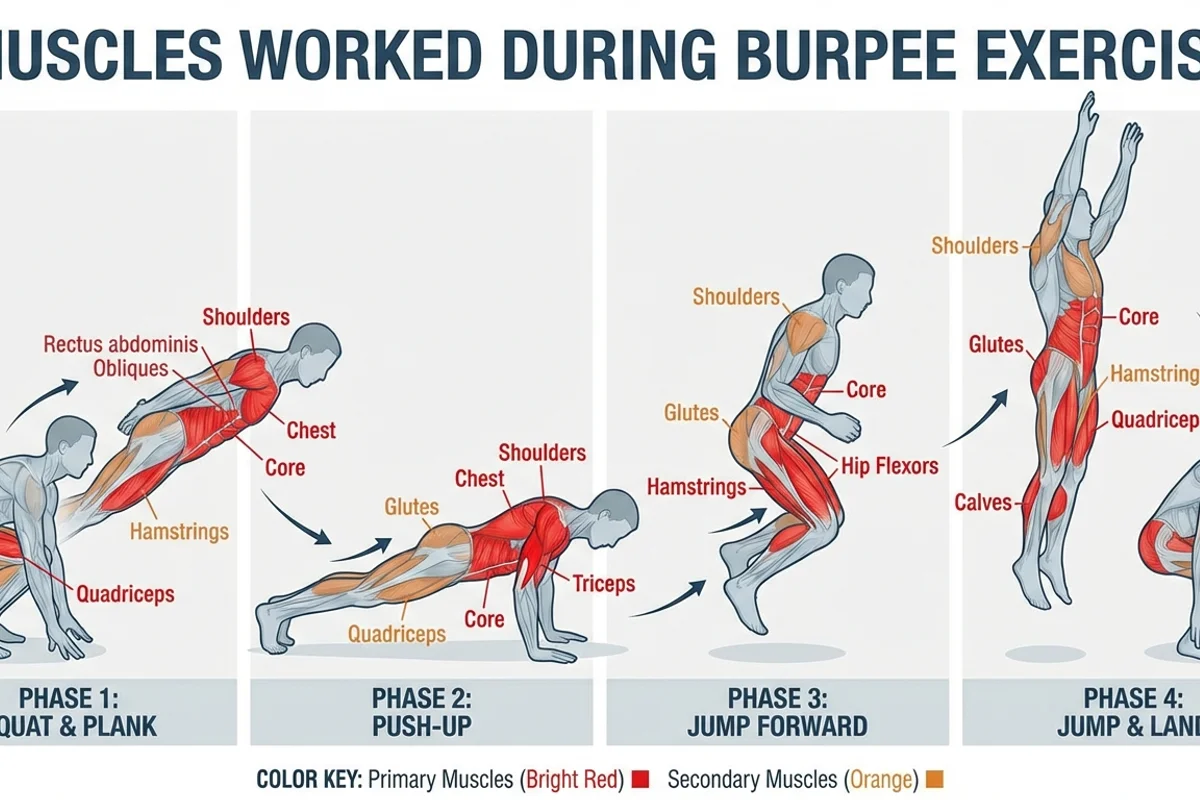
The burpee has four distinct phases, each targeting different muscles:
Phase 1: Squat Down
Primary: Quadriceps, Glutes, Hamstrings Secondary: Core (bracing)
This phase is essentially a bodyweight squat, loading your lower body as you drop your hips.
Phase 2: Kick Back to Plank
Primary: Core, Hip Flexors, Shoulders Secondary: Chest (isometric), Triceps (isometric)
This explosive hip extension requires significant core engagement to control the movement.
Phase 3: Push-Up (if included)
Primary: Chest, Anterior Deltoids, Triceps Secondary: Core, Serratus Anterior
The push-up phase transforms the burpee into an upper body builder.
Phase 4: Jump Up
Primary: Quadriceps, Glutes, Calves Secondary: Hamstrings, Core
The explosive jump requires triple extension of ankles, knees, and hips.
Primary Muscles in Detail
Quadriceps
Your quads work during both the squat and jump phases:
- Rectus femoris
- Vastus lateralis
- Vastus medialis
- Vastus intermedius
Role: Extend knees during squat and power the jump.
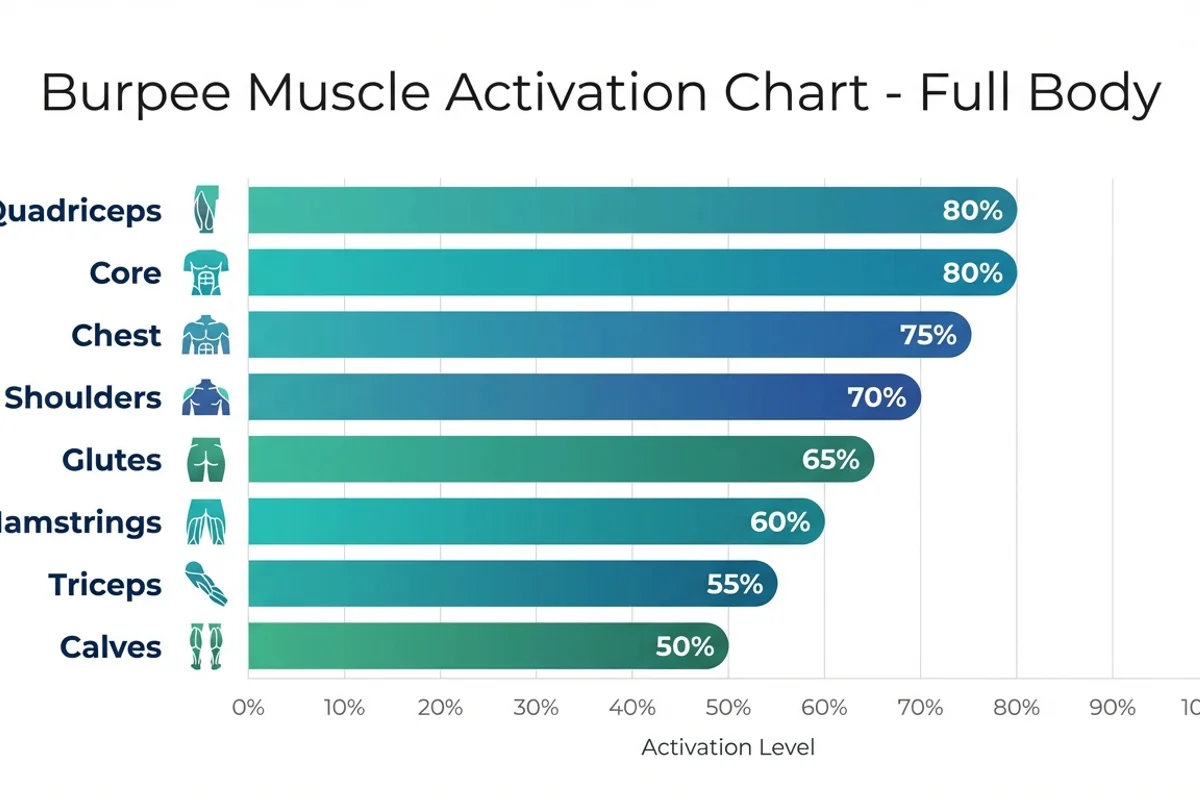
Activation level: Very High (80%)
Core Muscles
Your entire core engages throughout the movement:
- Rectus abdominis
- Internal and external obliques
- Transverse abdominis
Role: Stabilize spine, transfer force between upper and lower body.
Activation level: Very High (80%)
Pectoralis Major (Chest)
The chest works during the push-up phase:
- Horizontal adduction of the arms
- Pushing body away from floor
Activation level: High (75%)
Shoulders (Deltoids)
Your shoulders work throughout the entire movement:
- Anterior deltoids during push-up
- All heads during landing and stabilization
Activation level: High (70%)
Glutes
Your glutes power both the squat and jump:
- Hip extension during squat up
- Explosive hip extension during jump
Activation level: Moderate-High (65%)
Muscle Activation by Variation
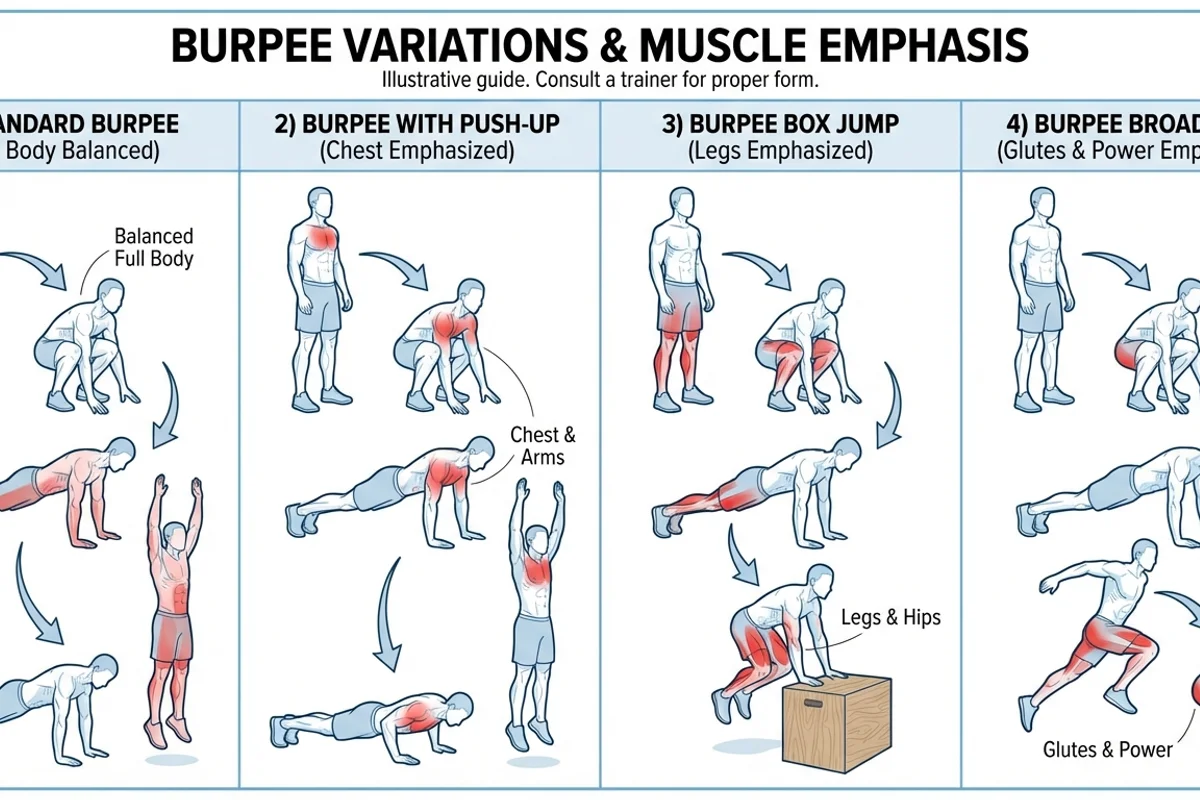
Standard Burpee (No Push-Up)
| Muscle | Activation Level |
|---|---|
| Quadriceps | Very High |
| Core | High |
| Glutes | High |
| Shoulders | Moderate |
| Chest | Low |
Best for: Beginners, cardio focus, higher volume
Burpee with Push-Up
| Muscle | Activation Level |
|---|---|
| Quadriceps | Very High |
| Core | Very High |
| Chest | High |
| Shoulders | High |
| Triceps | High |
| Glutes | High |
Best for: Full body strength, muscle building
Burpee Box Jump
| Muscle | Activation Level |
|---|---|
| Quadriceps | Maximum |
| Glutes | Very High |
| Calves | Very High |
| Core | High |
| Hamstrings | High |
Best for: Lower body power, explosive strength
Burpee Broad Jump
| Muscle | Activation Level |
|---|---|
| Glutes | Maximum |
| Hamstrings | Very High |
| Quadriceps | Very High |
| Core | Very High |
| Calves | High |
Best for: Horizontal power, athletic performance
Burpee Pull-Up
| Muscle | Activation Level |
|---|---|
| Latissimus Dorsi | Very High |
| Biceps | High |
| Core | Very High |
| Quadriceps | High |
| Chest | High |
Best for: Upper body emphasis, advanced athletes
How to Target Specific Muscles
Maximize Leg Activation
- Add a jump squat instead of regular jump
- Include box jump variations
- Use broad jumps for glute emphasis
- Slow down the squat phase
- Add weighted vest
Maximize Chest and Arms
- Always include the push-up
- Add a clap push-up for power
- Use slow, controlled push-up phase
- Try decline burpees (feet elevated)
- Add burpee to pull-up
Maximize Core Activation
- Maintain tight core throughout
- Add mountain climbers in plank position
- Include a tuck jump at the end
- Try single-leg burpees
- Use slower, more controlled movements
Maximize Cardio Effect
- Increase speed
- Minimize rest between reps
- Use continuous movement
- Add to HIIT circuits
- Try Tabata-style burpee workouts
Common Muscle-Related Issues
"My Shoulders Get Tired First"
This usually indicates:
- Weak shoulder endurance
- Poor plank form
- Hands too far forward
- Not enough chest involvement
Fix: Strengthen shoulders separately, improve plank position, hands under shoulders.
"My Lower Back Hurts"
This usually indicates:
- Hips sagging in plank position
- Weak core engagement
- Landing with arched back
- Too much speed, not enough control
Fix: Engage core harder, keep hips level in plank, control the landing.
"I Can't Keep Up the Pace"
This usually indicates:
- Poor cardiovascular conditioning
- Inefficient movement pattern
- Going too fast initially
- Breath holding
Fix: Build cardio base, practice technique, pace yourself, breathe rhythmically.
"My Wrists Hurt"
This usually indicates:
- Landing too hard
- Poor wrist flexibility
- Weight on heel of palm
- Fingers not spread
Fix: Land softly, warm up wrists, distribute weight evenly, spread fingers.
Why Burpees Are So Effective
Full-Body Engagement
Burpees work more muscle groups than almost any other exercise:
- Upper body: Chest, shoulders, triceps
- Core: Abs, obliques, lower back
- Lower body: Quads, glutes, hamstrings, calves
High Calorie Burn
Burpees burn approximately:
- 10-15 calories per minute
- 100-150 calories per 10-minute session
- More than most isolation exercises
Functional Movement
Burpees train:
- Getting up from the ground (practical)
- Explosive power (athletic)
- Coordination (sport-specific)
- Cardiovascular endurance (health)
The Science Behind Muscle Activation
Research shows:
- Burpees elicit ~75-85% of maximum heart rate
- Core activation is continuous throughout movement
- Quad activation peaks during jump phase
- Chest activation during push-up rivals bench press intensity
- Metabolic demand is higher than running at similar heart rates
Calculate Your Burpee Calories
Curious about the energy demands of your burpee training? Use our Burpee Calorie Calculator to see how many calories you burn during your workouts.
Related Guides
- Jumping Jacks vs Burpees Calories - Exercise comparison
- Push-Up Muscles Worked - Upper body focus
- Squat Muscles Worked - Lower body anatomy
- CrossFit Muscles Worked - Similar training style