
Squat Benefits and Muscles Worked: Complete Guide
Discover all the benefits of squats and which muscles they work. Complete breakdown of squat anatomy, benefits, and proper form.
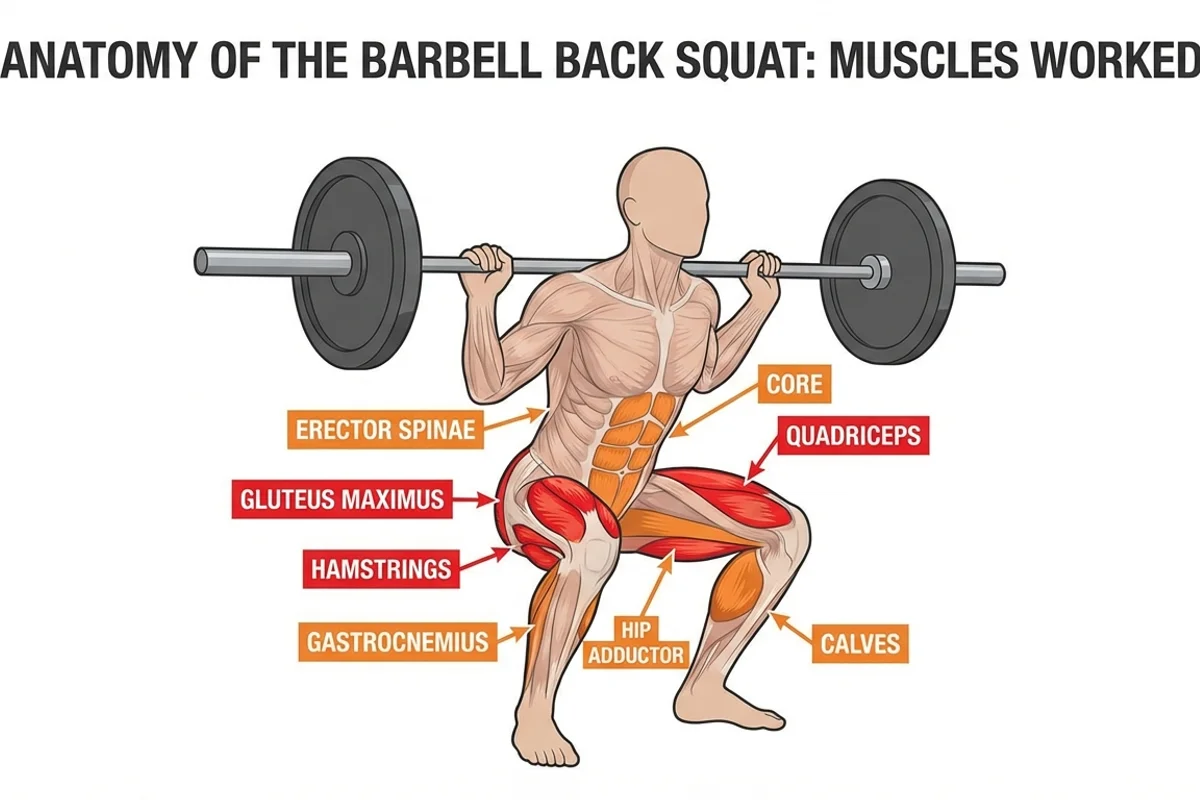
Squats are the king of lower body exercises, working multiple large muscle groups simultaneously while providing benefits that extend far beyond strength training.
Understanding which muscles squats target and their full range of benefits helps you maximize results from this foundational movement.
Primary Muscles Worked
Quadriceps (Front Thighs)
The main movers during squat ascent:
- Rectus femoris
- Vastus lateralis
- Vastus medialis
- Vastus intermedius
Role: Extend the knee during the upward phase
Gluteus Maximus (Glutes)
The largest muscle in the body:
- Primary hip extensor
- More activation with deeper squats
- Increases power and stability
Role: Extend the hip and provide power from the bottom position
Hamstrings (Back Thighs)
Work synergistically with quads:
- Biceps femoris
- Semitendinosus
- Semimembranosus
Role: Assist hip extension and stabilize the knee
Secondary Muscles Worked
Core Muscles
- Rectus abdominis
- Obliques (internal and external)
- Transverse abdominis
- Erector spinae (lower back)
Role: Stabilize the spine and maintain upright posture
Hip Adductors
- Adductor magnus
- Adductor longus
- Adductor brevis
Role: Stabilize legs and assist in the upward phase
Calves
- Gastrocnemius
- Soleus
Role: Ankle stability and balance
Muscle Activation by Squat Depth
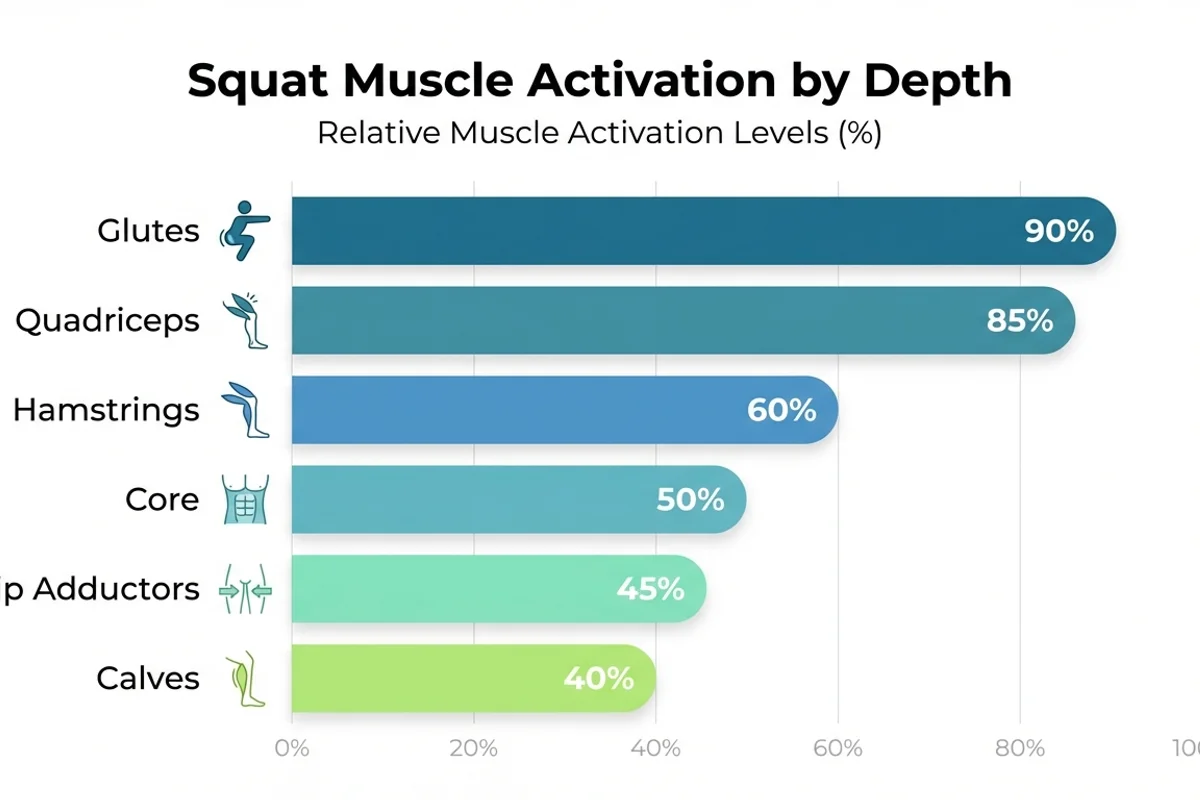
| Depth | Quads | Glutes | Hamstrings |
|---|---|---|---|
| Quarter squat | 40% | 20% | 15% |
| Parallel | 70% | 50% | 40% |
| Below parallel | 80% | 75% | 55% |
| Full depth | 85% | 90% | 60% |
Key insight: Deeper squats significantly increase glute activation.
10 Key Benefits of Squats
1. Build Lower Body Strength
Squats develop functional strength in the largest muscle groups, improving performance in sports and daily activities.
2. Burn Calories Efficiently
Working multiple large muscles burns significant calories:
- 5-8 calories per minute
- 100+ calories per 30-minute workout
For exact numbers, use our Squat Calorie Calculator.
3. Improve Athletic Performance
Squat strength translates to:
- Faster sprinting
- Higher jumping
- More powerful movements
4. Enhance Mobility
Regular squatting maintains and improves:
- Hip flexibility
- Ankle mobility
- Overall lower body range of motion
5. Strengthen Bones
Weight-bearing exercise like squats increases bone density, reducing osteoporosis risk.
6. Boost Metabolism
Building leg muscle increases basal metabolic rate (BMR), burning more calories at rest.
7. Improve Posture
Strong glutes and core from squatting support better spinal alignment.
8. Support Daily Function
Squatting patterns appear in everyday activities:
- Sitting and standing
- Picking up objects
- Climbing stairs
9. Reduce Injury Risk
Strong leg muscles and proper squat mechanics protect:
- Knees
- Lower back
- Hips
10. Release Anabolic Hormones
Heavy squats trigger release of:
- Testosterone
- Growth hormone
- IGF-1
Benefits by Squat Variation
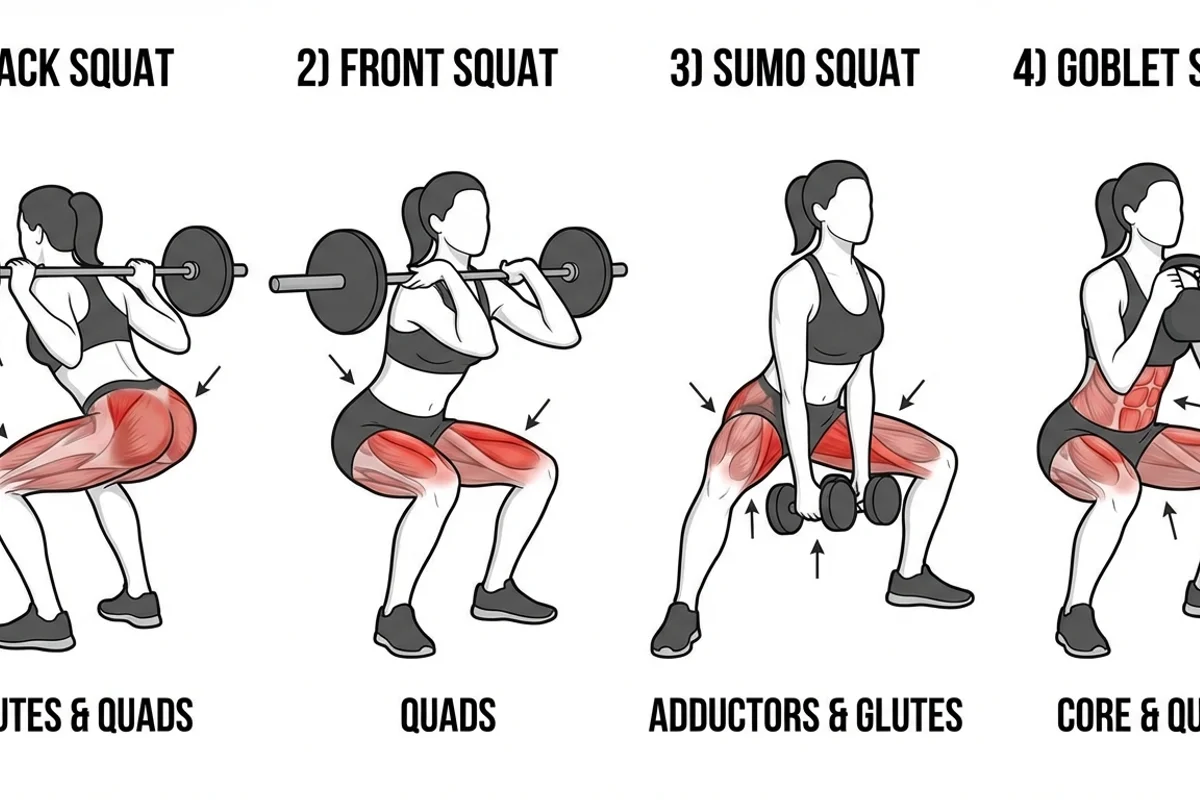
| Variation | Primary Benefit | Best For |
|---|---|---|
| Bodyweight | Mobility, endurance | Beginners |
| Goblet | Form, core engagement | Learning |
| Back squat | Maximum strength | Powerlifting |
| Front squat | Quad emphasis, core | Athletes |
| Sumo squat | Adductor emphasis | Hip mobility |
| Bulgarian split | Single-leg strength | Balance |
Proper Squat Form
Setup
- Feet shoulder-width apart (or slightly wider)
- Toes pointed slightly outward (15-30°)
- Weight distributed across whole foot
Descent
- Initiate by pushing hips back
- Keep chest up, back neutral
- Knees track over toes
- Descend until thighs are parallel or lower
Ascent
- Drive through whole foot
- Squeeze glutes at top
- Keep core braced throughout
Common Squat Mistakes
| Mistake | Risk | Fix |
|---|---|---|
| Knees caving in | Knee injury | Push knees out over toes |
| Heels rising | Balance issues | Improve ankle mobility |
| Rounding back | Spine injury | Keep chest up, brace core |
| Half reps | Reduced benefits | Go to full depth |
How Often Should You Squat?
| Goal | Frequency | Sets × Reps |
|---|---|---|
| General fitness | 2-3×/week | 3 × 10-15 |
| Strength | 2-3×/week | 4 × 5-8 |
| Muscle building | 2-3×/week | 4 × 8-12 |
| Endurance | 3-4×/week | 3 × 15-20 |
Calculate Your Squat Workout
For precise calorie burn and workout planning, use our Squat Calorie Calculator.
Related Guides
- How Many Calories Do Squats Burn? - Complete guide
- How to Do Squats Properly - Form guide
- Squat Variations and Calories - All variations
- Are Squats Good for Weight Loss? - Fat loss guide
- Squats vs Lunges - Exercise comparison