
Rowing Machine Muscles Worked: Complete Anatomy Guide
Discover exactly which muscles the rowing machine works. Learn about this full-body cardio exercise that targets your legs, back, arms, and core simultaneously.
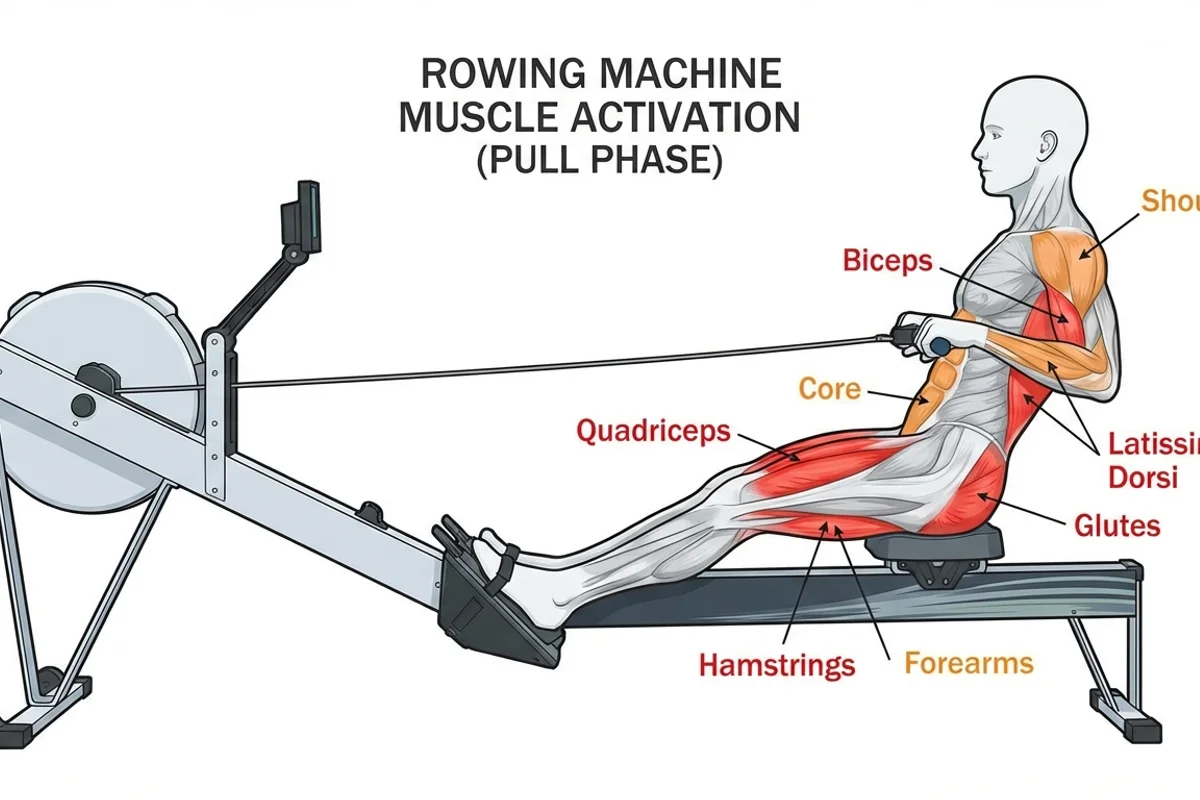
The rowing machine (ergometer) is one of the most effective full-body cardio machines available. Unlike many cardio options that primarily target legs, rowing engages approximately 86% of your muscles in every stroke.
Quick Answer: What Muscles Does the Rowing Machine Work?
Primary Muscles (High Activation):
- Quadriceps (leg drive)
- Glutes (hip extension)
- Latissimus Dorsi (pulling)
- Hamstrings (leg drive)
- Biceps (arm pull)
Secondary Muscles (Moderate Activation):
- Core muscles
- Shoulders (deltoids)
- Forearms (grip)
- Calves
- Trapezius
Stabilizer Muscles:
- Erector spinae (lower back)
- Rhomboids
- Rotator cuff
The Four Phases of Rowing
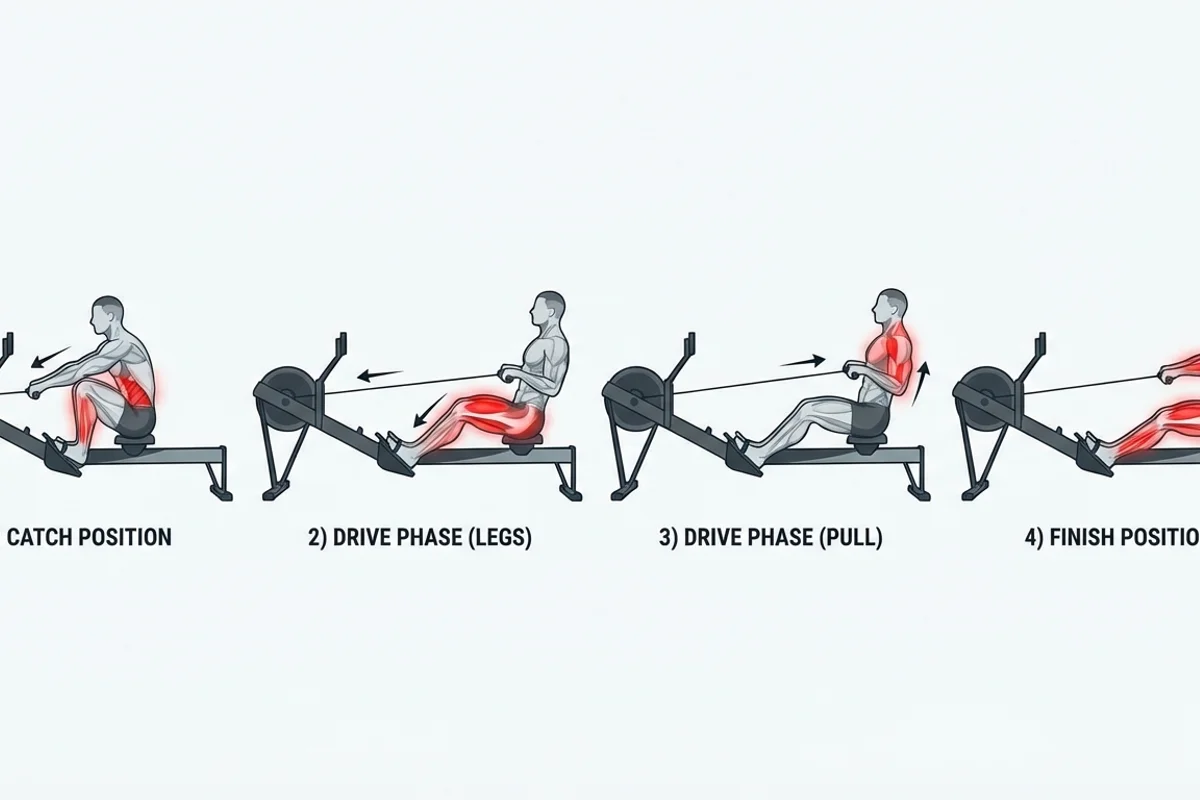
Understanding the rowing stroke phases helps you maximize muscle activation:
Phase 1: The Catch
Position: Knees bent, arms extended, body forward Primary muscles: Core (bracing), hip flexors, tibialis anterior Goal: Compressed, ready position
Phase 2: The Drive (Legs)
Action: Push with legs while arms stay extended Primary muscles: Quadriceps, glutes, hamstrings Contribution: 60% of power comes from legs
Phase 3: The Drive (Body & Arms)
Action: Lean back, pull handle to chest Primary muscles: Erector spinae, lats, biceps, rear deltoids Contribution: 20% body swing, 20% arm pull
Phase 4: The Finish
Position: Legs extended, handle at lower chest, slight lean back Primary muscles: Lats, biceps, core (maintaining position) Goal: Complete the stroke with control
Primary Muscles in Detail
Quadriceps
Your quads generate the initial power of each stroke:
- Rectus femoris
- Vastus lateralis
- Vastus medialis
- Vastus intermedius
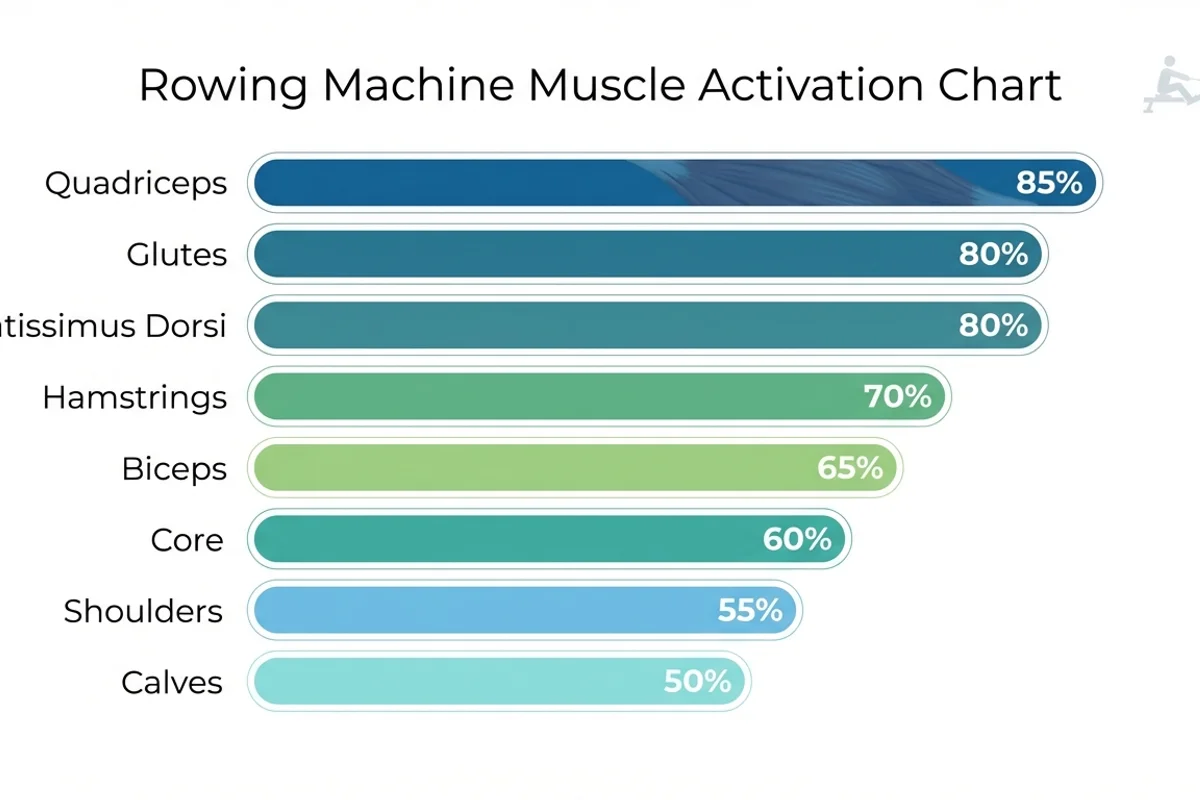
When active: Drive phase (pushing against foot plates) Activation level: Very High (85%)
Latissimus Dorsi (Lats)
Your lats are the primary pulling muscles:
- Pull the handle toward your body
- Major contributor to upper body power
When active: Drive phase (arm pull) Activation level: Very High (80%)
Glutes
Your glutes extend the hips during the drive:
- Gluteus maximus (primary)
- Gluteus medius (stability)
When active: Mid-drive as hips open Activation level: Very High (80%)
Hamstrings
The hamstrings assist leg drive and hip extension:
- Biceps femoris
- Semitendinosus
- Semimembranosus
When active: Throughout leg drive Activation level: High (70%)
Biceps
Your biceps complete the arm pull:
- Biceps brachii
- Brachialis
When active: Final pull to chest Activation level: Moderate-High (65%)
Muscle Activation by Rowing Phase
| Phase | Primary Muscles | Activation |
|---|---|---|
| Catch | Core, hip flexors | Moderate |
| Leg Drive | Quads, glutes, hamstrings | Maximum |
| Body Swing | Erector spinae, core | High |
| Arm Pull | Lats, biceps, rear delts | High |
| Finish | All muscles (holding) | Moderate |
| Recovery | Hip flexors, core | Low |
How to Target Specific Muscles
Maximize Leg Activation
- Focus on powerful leg drive
- Keep arms straight during initial push
- Think "legs, body, arms" sequence
- Push through entire foot
- Increase resistance/drag factor
Maximize Back Activation
- Lead with the chest during body swing
- Squeeze shoulder blades at the finish
- Pull handle to lower chest, not neck
- Use controlled arm recovery
- Focus on lat engagement
Maximize Core Activation
- Maintain strong posture throughout
- Don't over-lean at catch or finish
- Brace core during drive phase
- Control the recovery phase
- Avoid hunching shoulders
Common Form Mistakes That Reduce Muscle Activation
Opening Back Too Early
Problem: Reduces leg power, overloads back Fix: Keep arms straight until legs are nearly extended
Pulling with Arms First
Problem: Reduces overall power output Fix: Sequence: legs → body → arms
Hunching Shoulders
Problem: Reduces lat activation, strains neck Fix: Keep shoulders down and back
Rushing the Recovery
Problem: Reduces muscle engagement, poor rhythm Fix: Recovery should take twice as long as drive
Rowing vs. Other Cardio Machines
| Muscle Group | Rowing | Treadmill | Elliptical | Bike |
|---|---|---|---|---|
| Quadriceps | ●●●●● | ●●●●● | ●●●● | ●●●●● |
| Hamstrings | ●●●● | ●●●● | ●●●● | ●●● |
| Glutes | ●●●●● | ●●●● | ●●●● | ●●●● |
| Lats | ●●●●● | ○ | ●● | ○ |
| Biceps | ●●●● | ○ | ●● | ○ |
| Core | ●●●● | ●●● | ●●● | ●● |
Key advantage: Rowing provides significant upper body work that other cardio machines lack.
Benefits of Full-Body Engagement
Higher Calorie Burn
Working 86% of muscles means:
- 600-1000 calories per hour
- Higher metabolic demand
- More efficient workouts
Balanced Muscle Development
Unlike leg-only cardio:
- Develops upper and lower body
- Improves posture (back strength)
- Reduces muscle imbalances
Low Impact
Despite full-body engagement:
- No impact on joints
- Suitable for all fitness levels
- Good for injury rehabilitation
Calculate Your Rowing Calories
Curious about your energy expenditure? Use our Rowing Machine Calorie Calculator for precise estimates based on your workout intensity.
Related Guides
- Does Rowing Burn Belly Fat? - Fat loss guide
- Rowing vs Running Weight Loss - Comparison
- 30 Minute Rowing Calorie Calculator
- Concept2 Calorie Calculator - Erg specific