
Deadlift Muscles Worked: Complete Anatomy Guide
Discover exactly which muscles the deadlift works. Learn about primary movers, secondary muscles, and stabilizers, plus how variations change muscle activation.
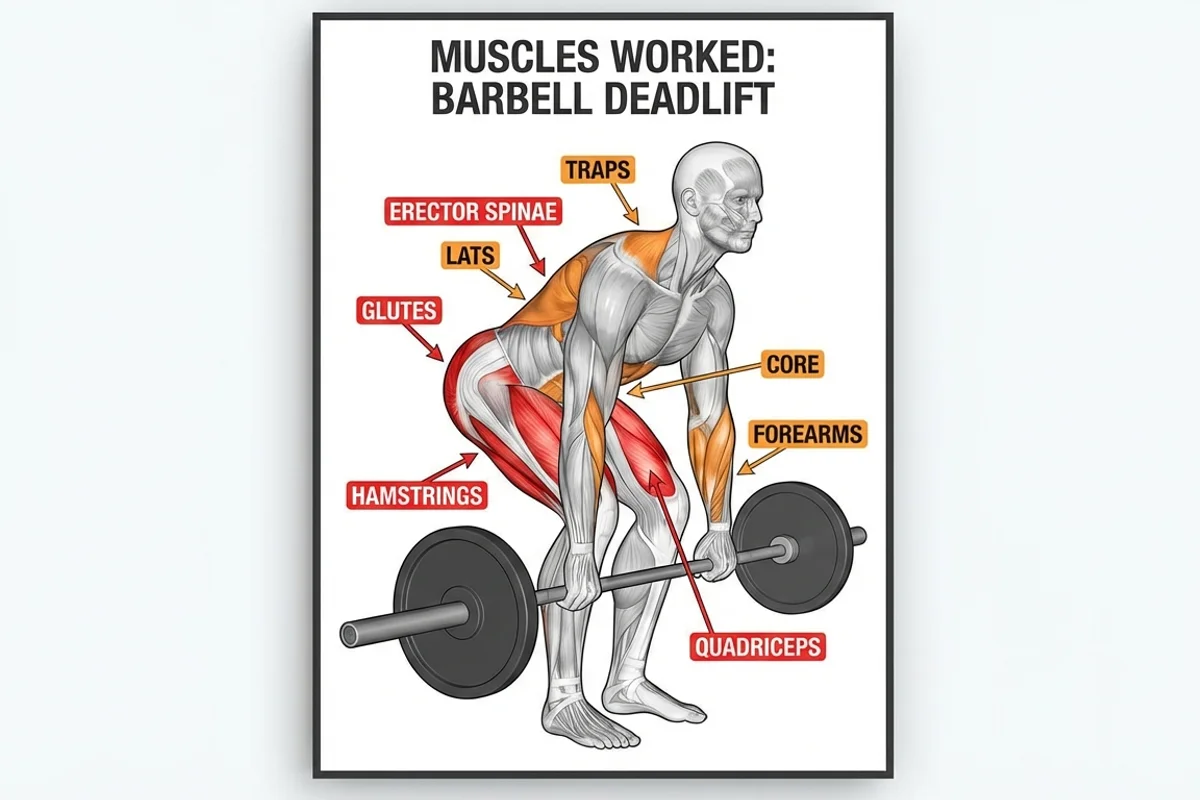
The deadlift is one of the most effective compound exercises for building total body strength and muscle mass. Understanding which muscles are involved helps you optimize your training and troubleshoot weak points.
Quick Answer: What Muscles Does the Deadlift Work?
Primary Muscles (70-80% of work):
- Gluteus Maximus (glutes)
- Hamstrings
- Erector Spinae (lower back)
- Quadriceps
Secondary Muscles (20-30% of work):
- Latissimus Dorsi (lats)
- Trapezius (traps)
- Forearms and grip muscles
- Core/abs
Stabilizer Muscles:
- Rhomboids
- Rear deltoids
- Deep core muscles
- Hip stabilizers
Primary Muscles: The Posterior Chain
The deadlift primarily targets your posterior chain - the muscles running along the back of your body from your calves to your upper back.
Gluteus Maximus (Glutes)
The largest muscle in the body is heavily activated during the deadlift:
- Powers hip extension from the bottom position
- Maximum activation occurs as you lock out
- Deeper hip angles increase glute involvement
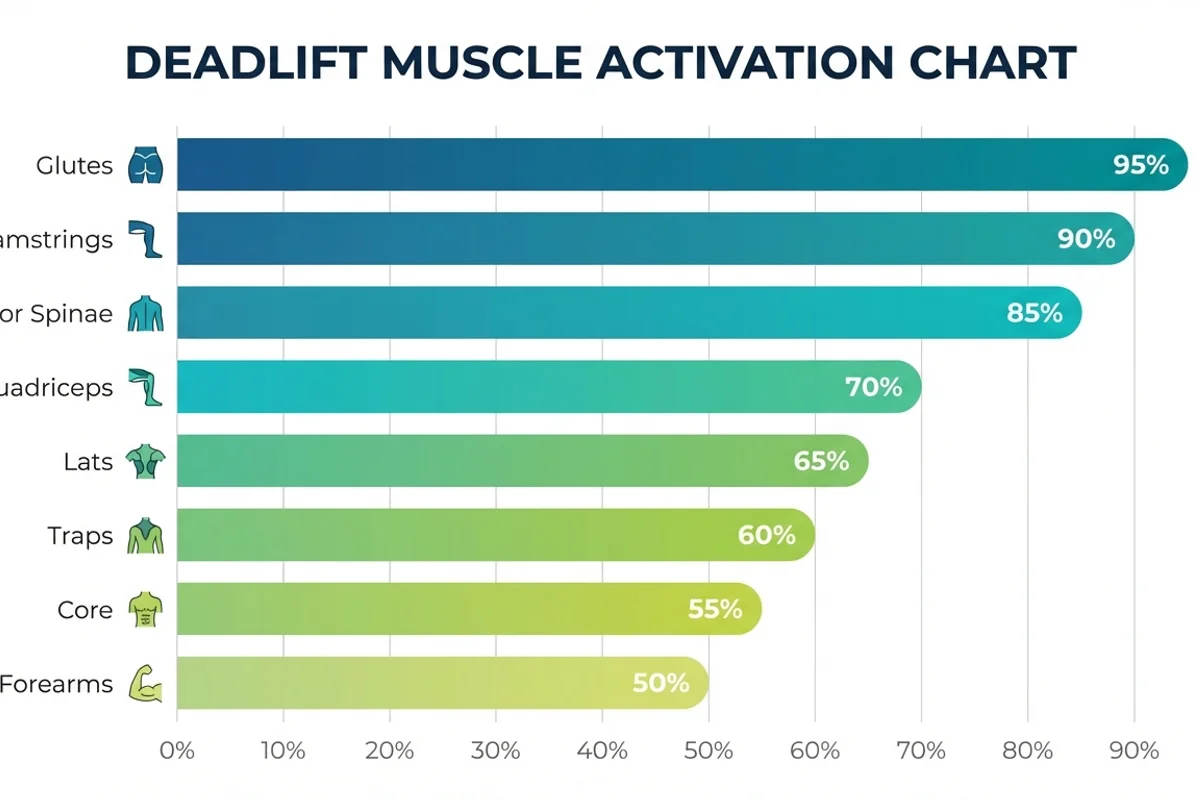
Activation level: Very High (95%)
Hamstrings
Your hamstrings work throughout the entire lift:
- Biceps femoris (outer hamstring)
- Semitendinosus
- Semimembranosus
Role: Assist hip extension and control knee flexion during the eccentric (lowering) phase.
Activation level: Very High (90%)
Erector Spinae (Lower Back)
The spinal erectors run along your spine and work isometrically to maintain spinal position:
- Iliocostalis
- Longissimus
- Spinalis
Role: Maintain a neutral spine throughout the lift, preventing rounding.
Activation level: High (85%)
Quadriceps
The quads are more active than many realize, especially in the initial drive off the floor:
- Rectus femoris
- Vastus lateralis
- Vastus medialis
- Vastus intermedius
Role: Extend the knee during the first half of the lift.
Activation level: Moderate-High (70%)
Secondary Muscles
Latissimus Dorsi (Lats)
Your lats keep the bar close to your body:
- Engage by "bending the bar" around your legs
- Prevent the bar from drifting forward
- Transfer force from lower to upper body
Activation level: Moderate-High (65%)
Trapezius (Traps)
The traps work to stabilize your shoulder girdle:
- Upper traps support the load
- Middle and lower traps retract the shoulder blades
- Heavy deadlifts build significant trap mass
Activation level: Moderate (60%)
Forearms and Grip
Your grip is often the limiting factor in deadlifts:
- Flexor digitorum profundus
- Flexor digitorum superficialis
- Brachioradialis
Activation level: Moderate-High (50-70% depending on load)
Core Muscles
Your entire core braces to protect your spine:
- Rectus abdominis
- Obliques (internal and external)
- Transverse abdominis
Role: Create intra-abdominal pressure and maintain spinal stability.
Muscle Activation by Deadlift Variation
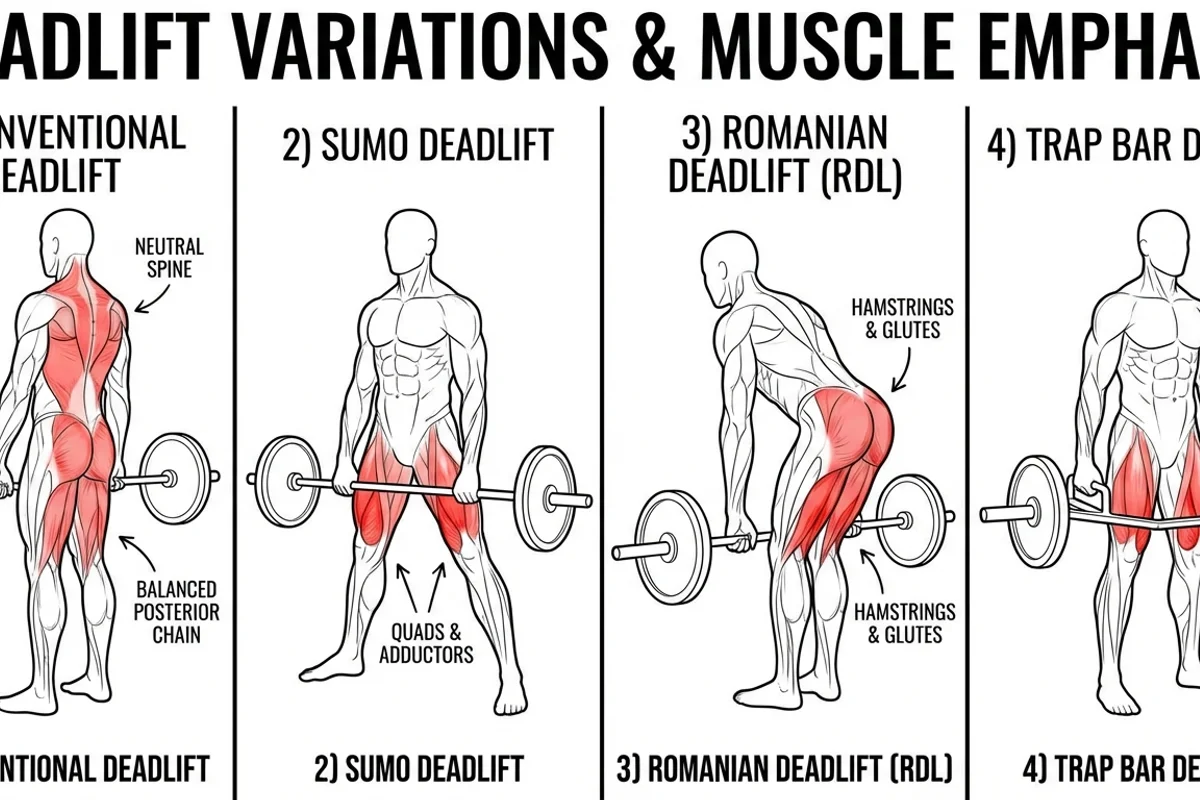
Different deadlift variations emphasize different muscles:
Conventional Deadlift
| Muscle | Activation Level |
|---|---|
| Glutes | Very High |
| Hamstrings | Very High |
| Erector Spinae | High |
| Quadriceps | Moderate-High |
| Lats | Moderate |
Best for: Overall posterior chain development, maximum strength
Sumo Deadlift
| Muscle | Activation Level |
|---|---|
| Quadriceps | Very High |
| Hip Adductors | Very High |
| Glutes | High |
| Hamstrings | Moderate |
| Erector Spinae | Moderate |
Best for: Quad emphasis, lifters with long torsos, reduced lower back stress
Romanian Deadlift (RDL)
| Muscle | Activation Level |
|---|---|
| Hamstrings | Maximum |
| Glutes | Very High |
| Erector Spinae | High |
| Quadriceps | Low |
Best for: Hamstring development, hip hinge pattern, athletic performance
Trap Bar Deadlift
| Muscle | Activation Level |
|---|---|
| Quadriceps | Very High |
| Glutes | High |
| Hamstrings | Moderate-High |
| Erector Spinae | Moderate |
Best for: Beginners, athletes, reduced lower back stress
How to Target Specific Muscles
Maximize Glute Activation
- Use a wider stance (sumo or semi-sumo)
- Focus on hip extension at lockout
- Squeeze glutes hard at the top
- Use pause deadlifts at the bottom
- Add hip thrusts as an accessory
Maximize Hamstring Activation
- Use Romanian deadlifts as main variation
- Keep legs straighter (slight knee bend)
- Focus on the stretch at the bottom
- Use slow eccentrics (3-4 seconds down)
- Add stiff-leg variations
Maximize Back Development
- Use conventional stance
- Focus on "bending the bar"
- Keep chest up throughout
- Add deficit deadlifts
- Use snatch-grip variations for upper back
Minimize Lower Back Stress
- Use trap bar or sumo stance
- Maintain perfect neutral spine
- Don't round upper or lower back
- Use belt for heavy sets
- Strengthen core with accessories
Common Muscle-Related Issues
"My Lower Back Gets Too Tired"
This usually indicates:
- Weak spinal erectors
- Rounding during the lift
- Starting position too far from bar
- Insufficient core bracing
Fix: Strengthen back with rows, add RDLs at lighter weight, practice bracing technique.
"I Don't Feel My Glutes"
This usually indicates:
- Stance too narrow
- Not driving hips through at lockout
- Over-reliance on back extension
- Weak mind-muscle connection
Fix: Use wider stance, add pause reps, incorporate hip thrusts, squeeze at top.
"My Grip Gives Out First"
This usually indicates:
- Grip strength is limiting factor
- Bar is too thick or chalky
- Poor grip positioning
Fix: Train grip separately, use chalk, consider straps for back-focused work, use hook grip.
"My Quads Are Sore After Deadlifts"
This is normal and indicates:
- Good leg drive off the floor
- Proper knee extension
- Especially common with conventional stance
Note: If you want more quad work, switch to trap bar or sumo variations.
The Science Behind Muscle Activation
EMG (electromyography) studies show:
- Glute activation peaks at lockout (highest hip extension)
- Hamstring activation is highest during the initial pull
- Erector spinae work isometrically throughout
- Trap bar deadlifts reduce spinal loading by ~10% vs conventional
- Sumo deadlifts show ~25% more quad activation than conventional
Understanding these patterns helps you select the right variation for your goals.
Calculate Your Deadlift Calories
Curious about the energy demands of your deadlift training? Use our Deadlift Calorie Calculator to see how many calories you burn during your workouts.
Related Guides
- Squat Muscles Worked - Complete squat anatomy
- Bench Press Muscles Worked - Upper body compound
- Deadlift Calorie Calculator - Calorie guide
- Leg Press Muscles Worked - Machine alternative