
Leg Press Muscles Worked: Complete Anatomy Guide
Discover exactly which muscles the leg press works. Learn about primary movers, secondary muscles, and how foot placement changes muscle activation.
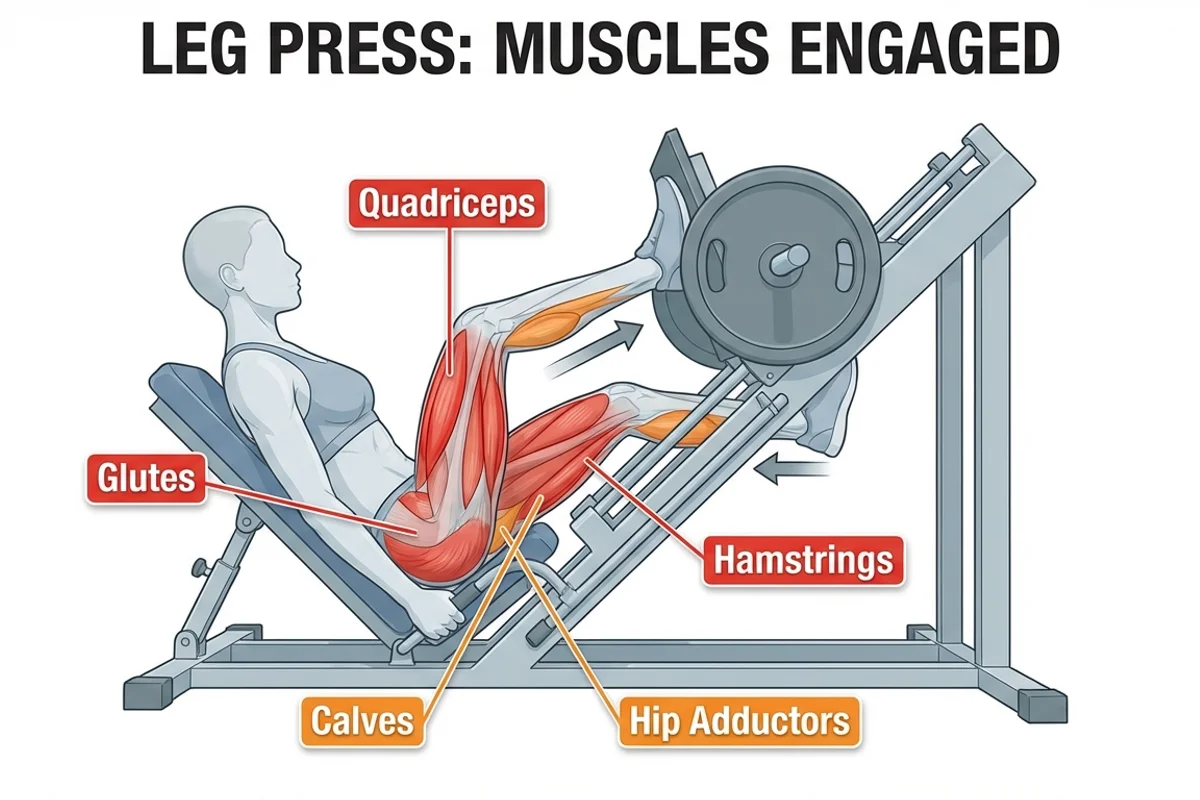
The leg press is one of the most effective machine exercises for building lower body strength and muscle mass. Understanding which muscles are involved helps you optimize your training and choose the right foot placement.
Quick Answer: What Muscles Does the Leg Press Work?
Primary Muscles (70-80% of work):
- Quadriceps (front thighs)
- Gluteus Maximus (glutes)
- Hamstrings (back thighs)
Secondary Muscles (20-30% of work):
- Calves (gastrocnemius and soleus)
- Hip Adductors (inner thighs)
Stabilizer Muscles:
- Core (minimal due to back support)
- Hip stabilizers
Primary Muscles: The Lower Body Powerhouse
Quadriceps
The quads are the primary movers during leg press:
- Rectus femoris
- Vastus lateralis
- Vastus medialis
- Vastus intermedius
Role: Extend the knee as you push the platform away.
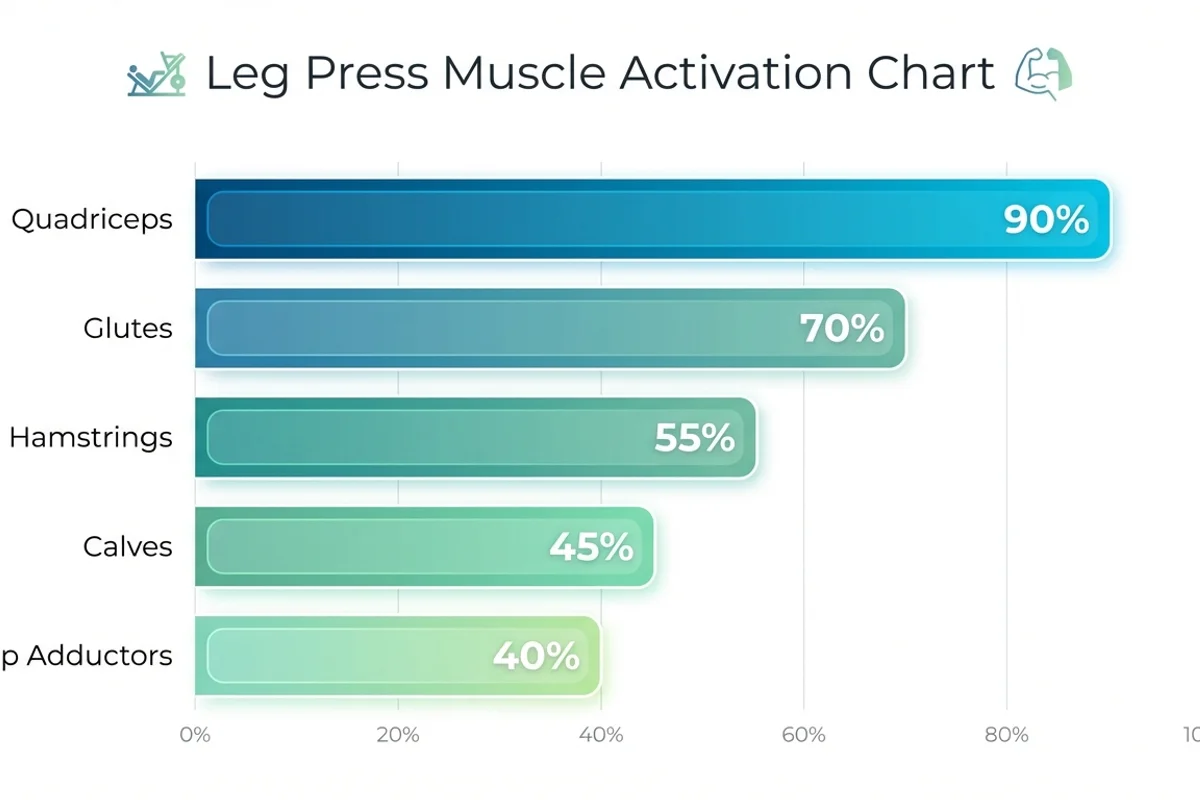
Activation level: Very High (90%)
Gluteus Maximus (Glutes)
Your glutes work significantly during leg press:
- Primary hip extensor
- More activation with deeper range of motion
- Higher foot placement increases glute work
Role: Extend the hip during the pushing phase.
Activation level: High (70%)
Hamstrings
The hamstrings assist throughout the movement:
- Biceps femoris
- Semitendinosus
- Semimembranosus
Role: Assist hip extension and provide knee stability.
Activation level: Moderate-High (55%)
Secondary Muscles
Calves
Your calves engage at the bottom of the movement:
- Gastrocnemius
- Soleus
Role: Provide ankle stability and slight plantar flexion.
Activation level: Moderate (45%)
Hip Adductors
Your inner thigh muscles work to stabilize:
- Adductor magnus
- Adductor longus
- Adductor brevis
Role: Keep knees tracking properly, especially with wider stances.
Activation level: Moderate (40%)
Muscle Activation by Foot Placement
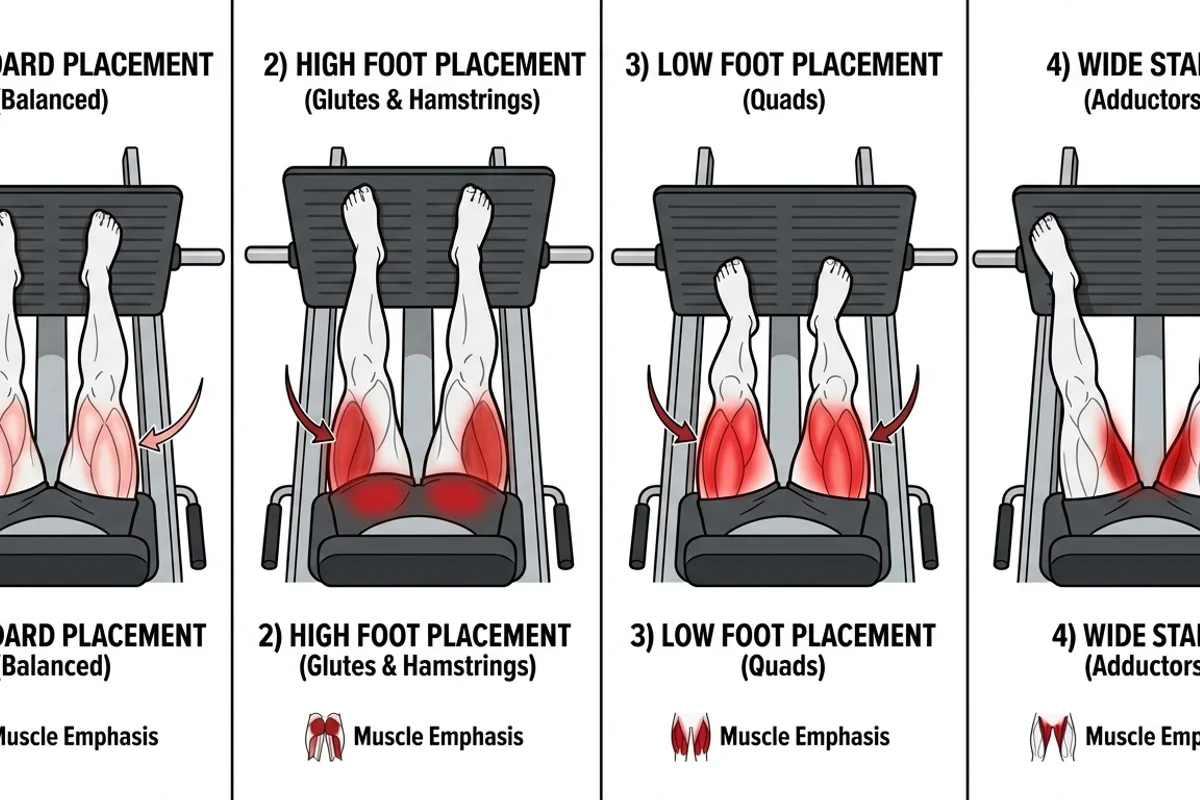
Foot placement dramatically changes which muscles do the most work:
Standard Foot Placement (Middle of Platform)
| Muscle | Activation Level |
|---|---|
| Quadriceps | Very High |
| Glutes | High |
| Hamstrings | Moderate-High |
| Calves | Moderate |
Best for: Overall leg development, balanced activation
High Foot Placement
| Muscle | Activation Level |
|---|---|
| Glutes | Very High |
| Hamstrings | High |
| Quadriceps | High |
| Calves | Low |
Best for: Glute and hamstring emphasis, reduced knee stress
Low Foot Placement
| Muscle | Activation Level |
|---|---|
| Quadriceps | Maximum |
| Glutes | Moderate |
| Hamstrings | Moderate |
| Calves | High |
Best for: Maximum quad activation, vastus medialis development
Wide Stance
| Muscle | Activation Level |
|---|---|
| Hip Adductors | Very High |
| Glutes | Very High |
| Quadriceps | High |
| Hamstrings | Moderate |
Best for: Inner thigh development, hip mobility
Narrow Stance
| Muscle | Activation Level |
|---|---|
| Quadriceps (outer) | Very High |
| Glutes | Moderate |
| Hamstrings | Moderate |
Best for: Outer quad sweep, vastus lateralis emphasis
How to Target Specific Muscles
Maximize Quad Activation
- Use lower foot placement on platform
- Push through the balls of your feet
- Use a narrower stance
- Focus on the lockout phase
- Use pause reps at the bottom
Maximize Glute Activation
- Place feet high on the platform
- Use a wider stance
- Push through your heels
- Go to full depth (90° knee angle or more)
- Focus on hip extension
Maximize Hamstring Activation
- Use high foot placement
- Go deep (full range of motion)
- Control the eccentric phase
- Push through heels
- Combine with Romanian deadlifts
Maximize Adductor Activation
- Use wide sumo-style stance
- Point toes slightly outward
- Focus on keeping knees pushed out
- Go to full depth
Leg Press vs. Squat: Muscle Comparison
| Muscle | Leg Press | Squat |
|---|---|---|
| Quadriceps | ●●●●● | ●●●●● |
| Glutes | ●●●● | ●●●●● |
| Hamstrings | ●●● | ●●●● |
| Core | ● | ●●●●● |
| Calves | ●●● | ●●● |
| Stabilizers | ●● | ●●●●● |
Key takeaway: Leg press isolates leg muscles better, while squats engage more stabilizers and core.
Common Muscle-Related Issues
"I Only Feel It In My Quads"
This usually indicates:
- Feet too low on platform
- Stance too narrow
- Not going deep enough
- Pushing through toes
Fix: Move feet higher, widen stance, go deeper, push through heels.
"My Knees Hurt During Leg Press"
This usually indicates:
- Feet too low on platform
- Knees caving inward
- Going too deep for your mobility
- Too much weight
Fix: Raise foot position, push knees out, reduce depth, lower weight.
"I Can't Feel My Glutes"
This usually indicates:
- Feet too low
- Not going deep enough
- Pushing through toes
- Stance too narrow
Fix: High foot placement, full depth, drive through heels, wider stance.
"My Lower Back Lifts Off the Pad"
This usually indicates:
- Going too deep
- Tight hip flexors
- Seat angle too flat
- Weight too heavy
Fix: Reduce depth, stretch hip flexors, adjust seat angle, lower weight.
Machine Variations
45-Degree Leg Press
- Most common type
- Good balance of quad and glute activation
- Allows heavy loading
Horizontal Leg Press
- More quad-dominant
- Easier on lower back
- Limited range of motion
Vertical Leg Press
- Maximum quad stretch
- Challenging for glutes
- Requires good mobility
Hack Squat Machine
- More squat-like movement
- Better glute activation than leg press
- Reduces spinal load
The Science Behind Muscle Activation
EMG studies show:
- Low foot position increases quad activation by 15-20%
- High foot position increases glute/hamstring activation by 25%
- Wider stances activate adductors 40% more
- Full range of motion maximizes overall muscle activation
- Leg press shows ~10-15% less glute activation than squats
Calculate Your Leg Press Calories
Curious about the energy demands of your leg press training? Use our Leg Press Calorie Calculator to see how many calories you burn during your workouts.
Related Guides
- Squat Muscles Worked - Free weight comparison
- Deadlift Muscles Worked - Posterior chain focus