
Cycling Muscles Worked: Complete Anatomy Guide
Discover exactly which muscles cycling works. Learn about road cycling, mountain biking, and how terrain affects muscle activation throughout the pedal stroke.
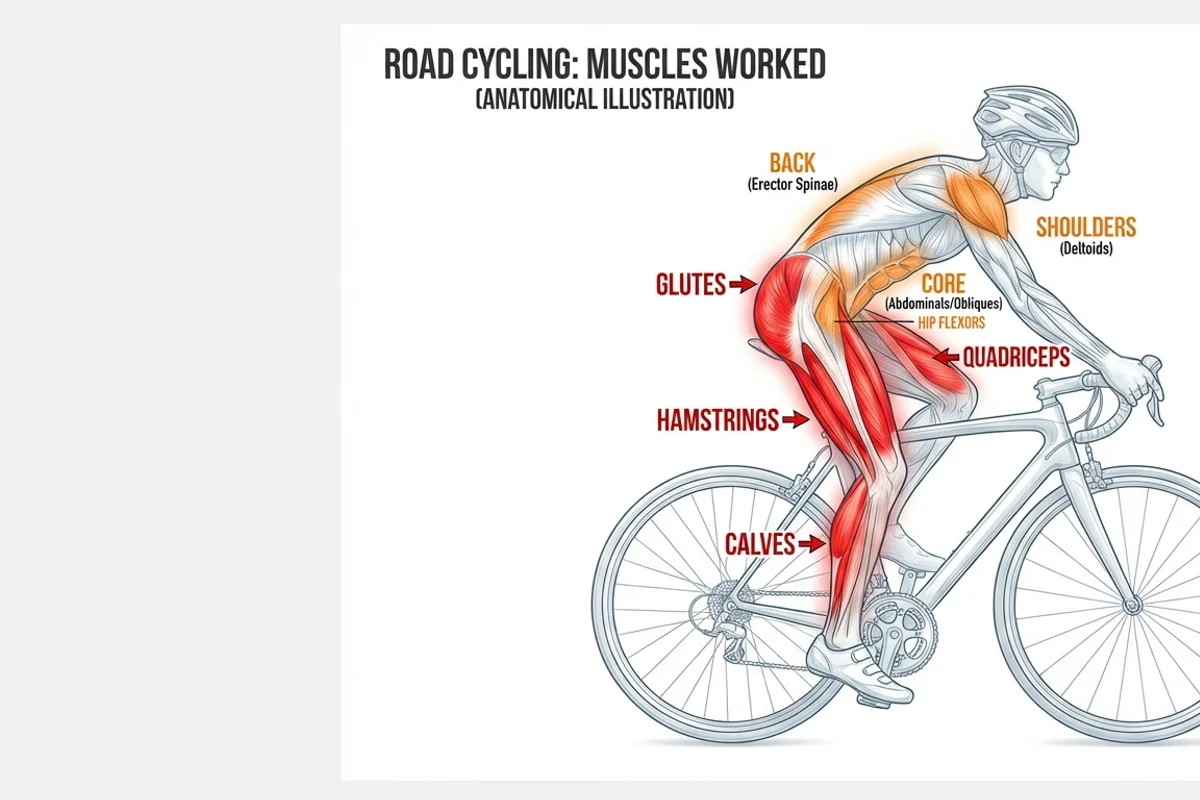
Cycling is one of the most popular endurance sports, offering excellent cardiovascular benefits while building lower body strength. Understanding muscle activation helps you optimize your training and performance.
Quick Answer: What Muscles Does Cycling Work?
Primary Muscles:
- Quadriceps (front thighs) - dominant
- Glutes (buttocks)
- Hamstrings (back thighs)
- Calves
Secondary Muscles:
- Hip flexors
- Core muscles
- Lower back
- Shoulders (for stability)
The Pedal Stroke Phases
Understanding the four phases of the pedal stroke reveals when each muscle activates:
Phase 1: Power Phase (12 to 5 o'clock)
Primary muscles: Quadriceps, glutes Action: Pushing down Contribution: 50% of power
Phase 2: Transition (5 to 7 o'clock)
Primary muscles: Calves, hamstrings Action: Pushing through bottom Contribution: 10% of power
Phase 3: Recovery Phase (7 to 11 o'clock)
Primary muscles: Hip flexors, hamstrings Action: Pulling up (with clipless pedals) Contribution: 30% of power
Phase 4: Transition (11 to 12 o'clock)
Primary muscles: Hip flexors Action: Pushing over top Contribution: 10% of power
Primary Muscles in Detail
Quadriceps
The quads are the powerhouse of cycling:
- Rectus femoris
- Vastus lateralis
- Vastus medialis
- Vastus intermedius
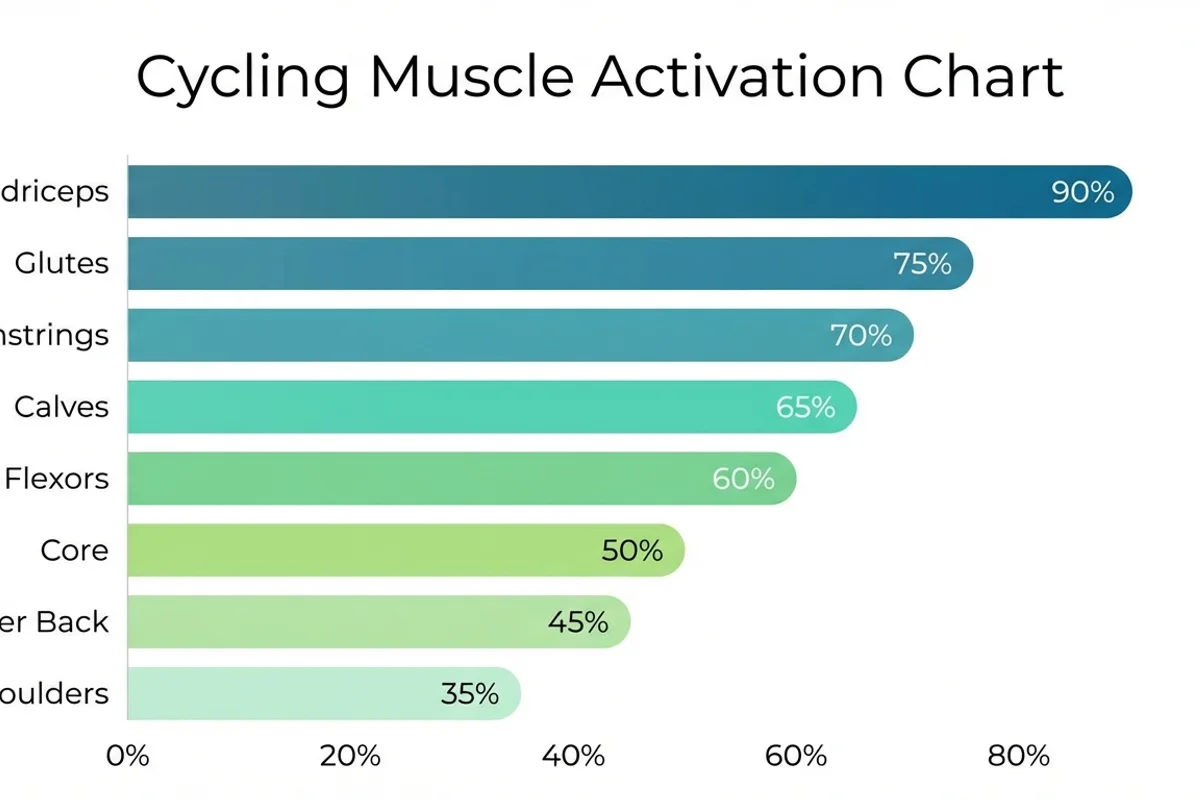
Peak activation: 12-5 o'clock (power phase) Activation level: Very High (90%)
Glutes
Your glutes provide power and stability:
- Gluteus maximus (hip extension)
- Gluteus medius (pelvis stability)
Peak activation: 12-3 o'clock Activation level: High (75%)
Hamstrings
The hamstrings assist in the pull-up phase:
- Biceps femoris
- Semitendinosus
- Semimembranosus
Peak activation: 6-9 o'clock (with clipless pedals) Activation level: Moderate-High (70%)
Calves
Your calves transfer power to the pedals:
- Gastrocnemius
- Soleus
Peak activation: 3-6 o'clock Activation level: Moderate-High (65%)
Muscle Activation by Terrain
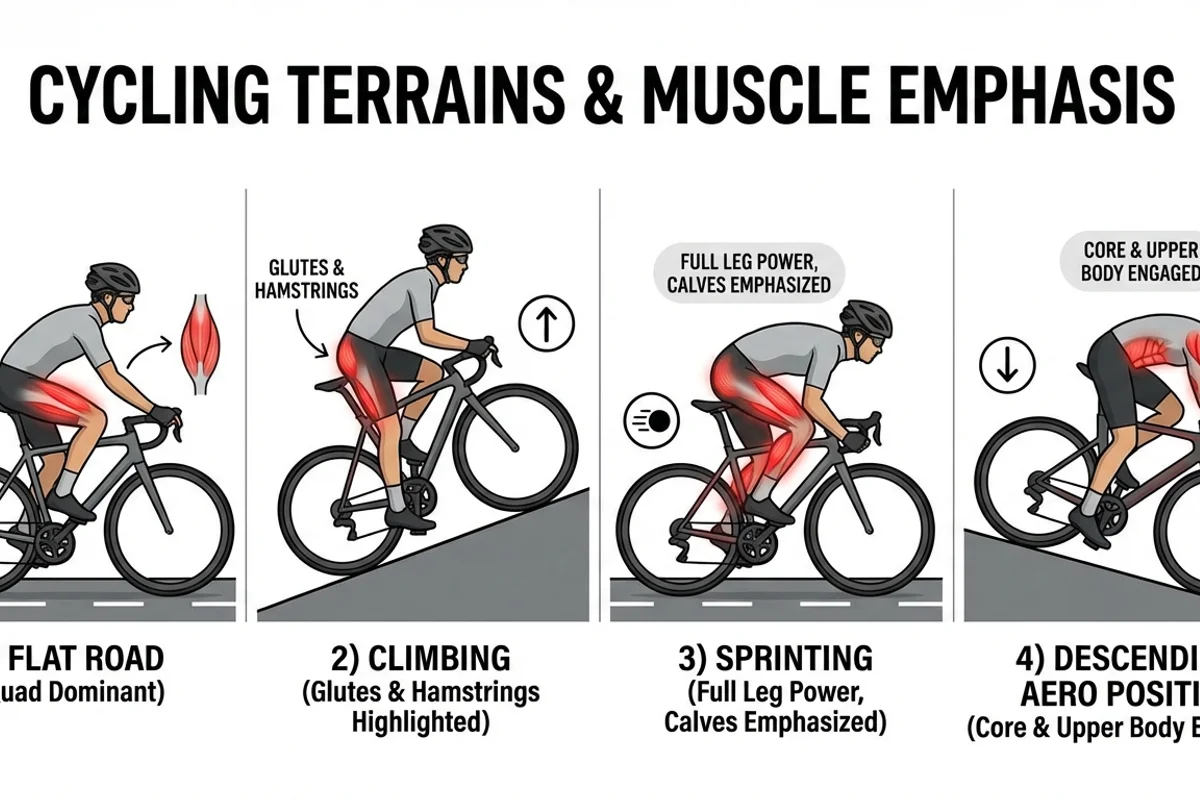
Flat Road Cycling
| Muscle | Activation Level |
|---|---|
| Quadriceps | Very High |
| Glutes | Moderate |
| Hamstrings | Moderate |
| Calves | Moderate |
| Core | Low-Moderate |
Best for: Quad endurance, high cadence work
Climbing
| Muscle | Activation Level |
|---|---|
| Quadriceps | Very High |
| Glutes | Very High |
| Hamstrings | High |
| Calves | High |
| Core | High |
Best for: Maximum lower body activation
Sprinting
| Muscle | Activation Level |
|---|---|
| Quadriceps | Maximum |
| Glutes | Very High |
| Hamstrings | High |
| Calves | Very High |
| Core | Very High |
Best for: Power development
Descending (Aero Position)
| Muscle | Activation Level |
|---|---|
| Quadriceps | Low-Moderate |
| Core | High |
| Upper Back | Moderate |
| Shoulders | Moderate |
Best for: Core engagement, recovery
Impact of Cadence and Resistance
Low Cadence / High Resistance (60-70 RPM)
- Greater muscle force per pedal stroke
- More strength-oriented
- Higher glute activation
- Common in climbing
High Cadence / Low Resistance (90-100+ RPM)
- Lower muscle force per stroke
- More cardiovascular
- Quad-dominant
- Better for endurance
Optimal Training Cadence (85-95 RPM)
- Balanced muscle activation
- Efficient pedaling
- Sustainable for long rides
How to Target Specific Muscles
Maximize Quad Activation
- Use higher gears (lower cadence)
- Focus on the push-down phase
- Seated climbing
- Single-leg drills
- High-intensity intervals
Maximize Glute Activation
- Standing climbs
- Low cadence efforts
- Push through heels
- Hill repeats
- Think "scrape the bottom" of pedal stroke
Maximize Hamstring Activation
- Use clipless pedals
- Focus on pulling up
- Single-leg drills
- High cadence spinning
- Think "circular" pedaling
Maximize Core Engagement
- Ride out of the saddle
- Reduce handlebar support
- Technical terrain (MTB)
- Sprinting
- Aero position holds
Cycling Position Effects
Aggressive (Race) Position
- Lower handlebar, stretched out
- More core engagement
- Aero benefits
- Hip angle more closed
Relaxed (Endurance) Position
- Higher handlebar
- Less core strain
- Better for long rides
- More open hip angle = better power
Standing Position
- Maximum glute activation
- Higher core demand
- Used for climbing/sprinting
- Higher calorie burn
Road Cycling vs. Mountain Biking
| Factor | Road Cycling | Mountain Biking |
|---|---|---|
| Quad Activation | ●●●●● | ●●●●● |
| Glute Activation | ●●●●○ | ●●●●● |
| Hamstring Activation | ●●●○○ | ●●●●○ |
| Core Activation | ●●●○○ | ●●●●● |
| Upper Body | ●●○○○ | ●●●●○ |
| Technical Skill | ●●○○○ | ●●●●● |
Key difference: MTB requires more upper body and core due to terrain handling.
The Science of Cycling Efficiency
Research shows:
- Quadriceps produce 40% of total pedaling power
- Glutes contribute 27% of power
- Optimal seat height maximizes quad activation
- Clipless pedals increase hamstring activation by 20-30%
- Standing adds 10-20% more glute activation
Common Issues and Solutions
"My Quads Burn Before My Cardio Limit"
Cause: Over-gearing, seat too low Fix: Lower gear, higher cadence, check fit
"My Hip Flexors Get Tight"
Cause: Too aggressive position, weak hip flexors Fix: Raise handlebars, hip flexor stretches
"I Can't Feel My Glutes Working"
Cause: Quad dominance, not engaging posterior chain Fix: Standing intervals, low cadence work, glute activation drills
Calculate Your Cycling Calories
Track your riding intensity with our Cycling Calorie Calculator for accurate estimates based on speed, distance, or power.
Related Guides
- Stationary Bike Muscles Worked - Indoor alternative
- Cycling FTP Guide - Power training
- Cycling vs Running - Cross-training comparison
- Cycling Watts Per Kilo - Performance metrics