
Stationary Bike Muscles Worked: Complete Anatomy Guide
Discover exactly which muscles the stationary bike works. Learn about spin bikes, recumbent bikes, and how resistance affects muscle activation.
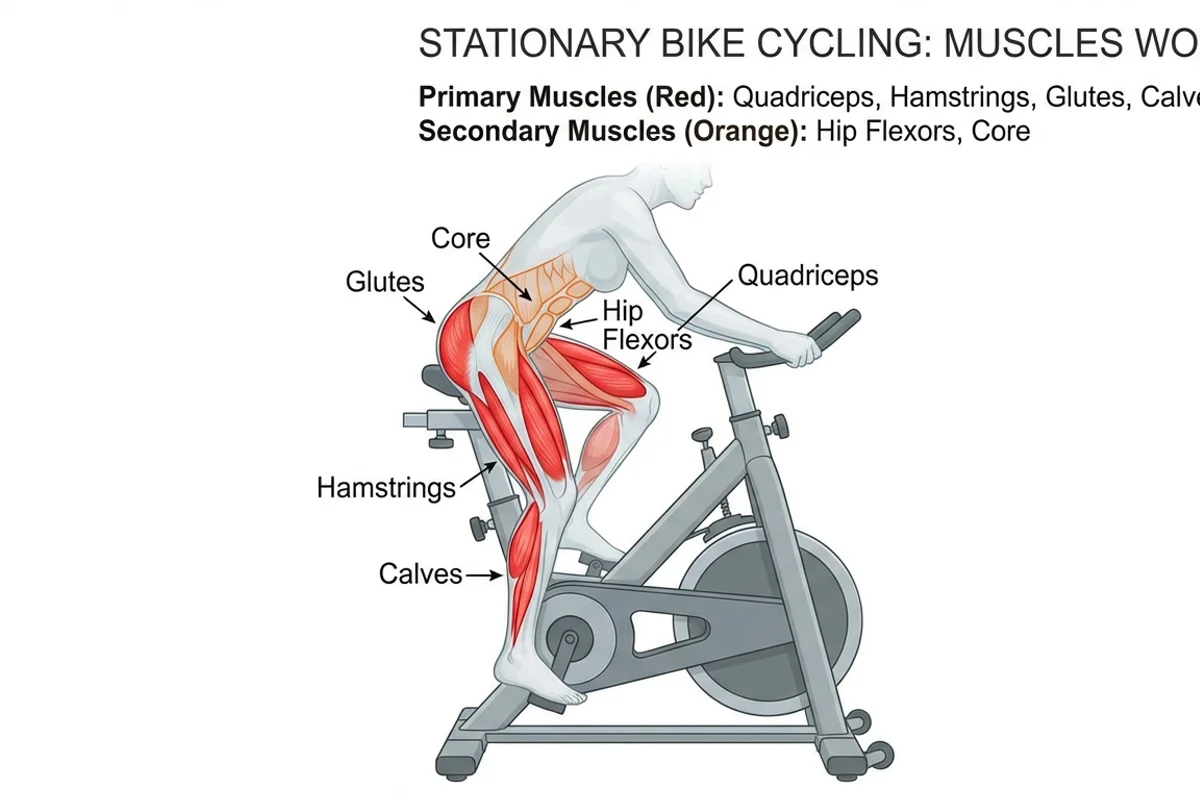
The stationary bike is one of the most joint-friendly cardio options available. Understanding muscle activation helps you maximize your indoor cycling workouts.
Quick Answer: What Muscles Does the Stationary Bike Work?
Primary Muscles:
- Quadriceps (front thighs)
- Glutes (buttocks)
- Hamstrings (back thighs)
- Calves
Secondary Muscles:
- Hip flexors
- Core muscles
Stabilizer Muscles:
- Lower back
- Hip stabilizers
Primary Muscles in Detail
Quadriceps
The quads are the dominant muscle group in cycling:
- Rectus femoris
- Vastus lateralis
- Vastus medialis
- Vastus intermedius
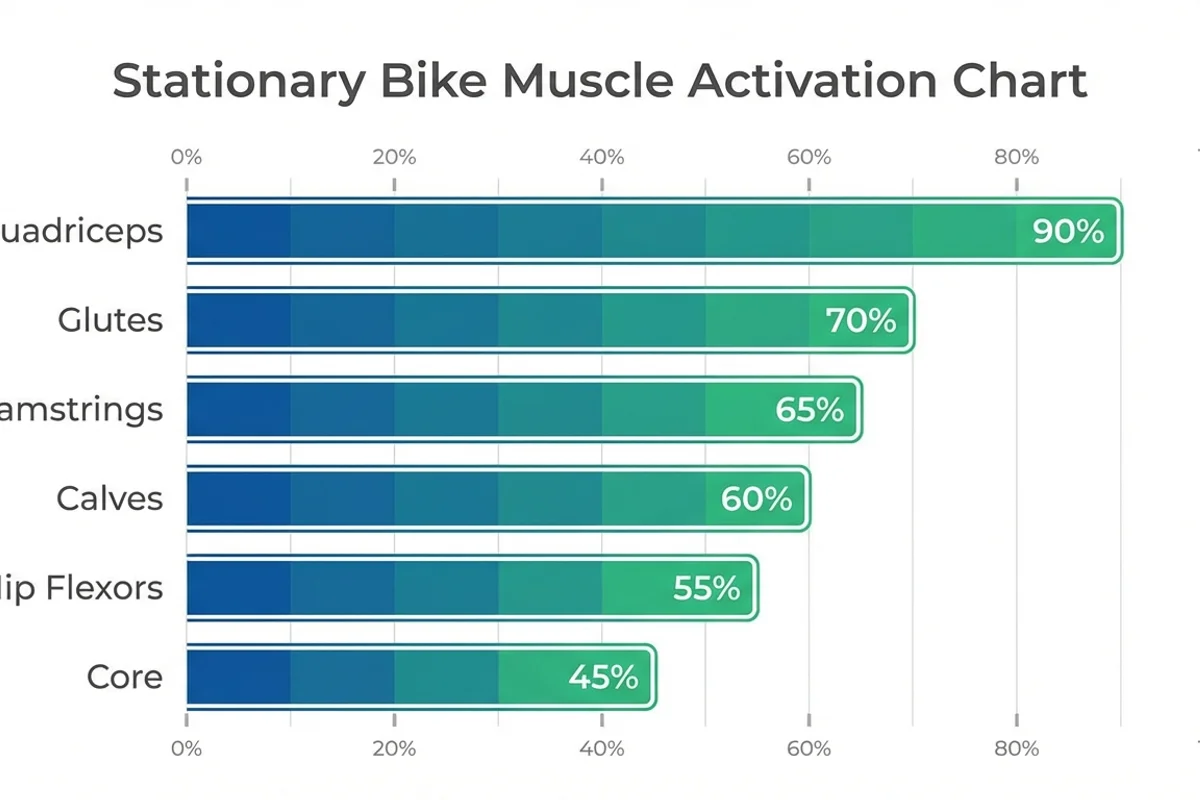
When active: The power phase (pushing down) Activation level: Very High (90%)
Glutes
Your glutes contribute significant power:
- Gluteus maximus (primary)
- Gluteus medius (stability)
When active: Top of pedal stroke and power phase Activation level: High (70%)
Hamstrings
The hamstrings work during the pull-up phase:
- Biceps femoris
- Semitendinosus
- Semimembranosus
When active: Upstroke (especially with clip-in pedals) Activation level: Moderate-High (65%)
Calves
Your calves provide ankle stability and power transfer:
- Gastrocnemius
- Soleus
When active: Throughout the pedal stroke Activation level: Moderate (60%)
Muscle Activation by Technique
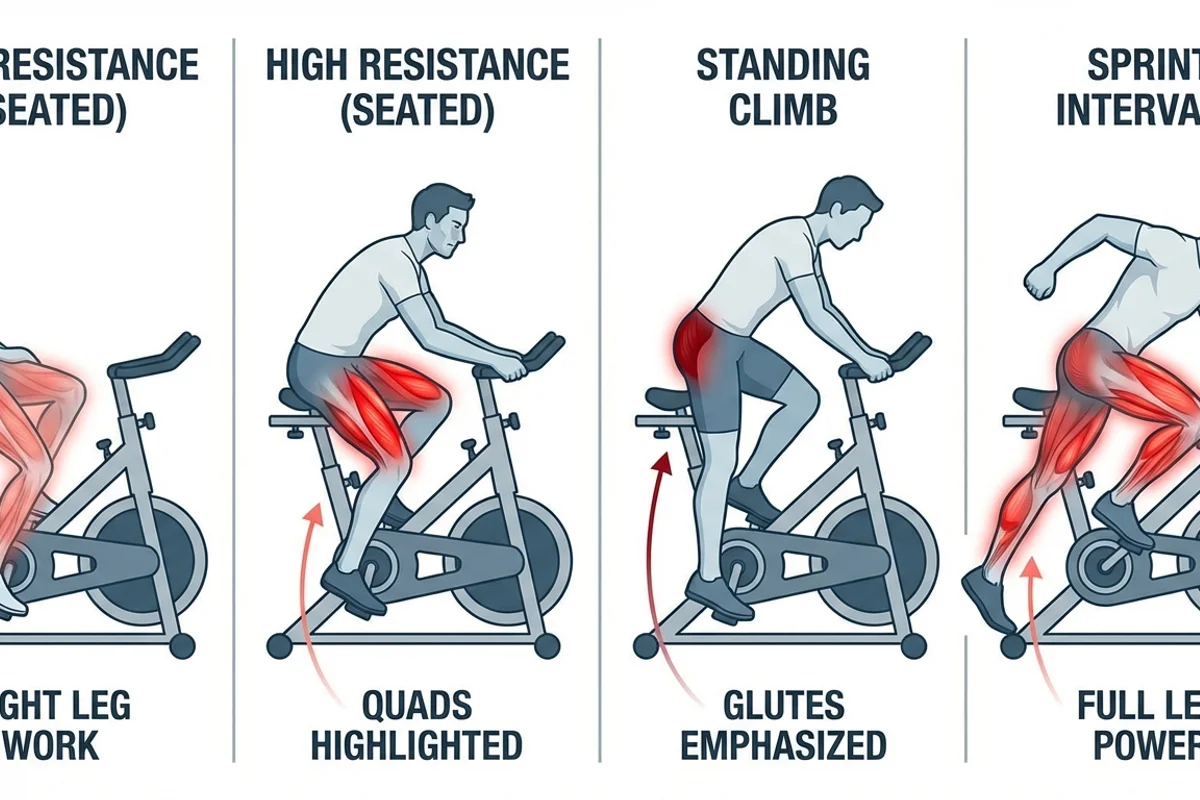
Seated Low Resistance
| Muscle | Activation Level |
|---|---|
| Quadriceps | Moderate |
| Glutes | Low |
| Hamstrings | Low |
| Calves | Moderate |
| Core | Low |
Best for: Warm-up, active recovery
Seated High Resistance
| Muscle | Activation Level |
|---|---|
| Quadriceps | Very High |
| Glutes | Moderate-High |
| Hamstrings | Moderate |
| Calves | Moderate |
| Core | Moderate |
Best for: Strength building, hill simulation
Standing Climb
| Muscle | Activation Level |
|---|---|
| Quadriceps | High |
| Glutes | Very High |
| Hamstrings | High |
| Calves | High |
| Core | High |
Best for: Maximum glute activation, full body engagement
Sprint Intervals
| Muscle | Activation Level |
|---|---|
| Quadriceps | Maximum |
| Glutes | High |
| Hamstrings | High |
| Calves | High |
| Core | Moderate |
Best for: Power development, calorie burn
Impact of Resistance and Cadence
High Resistance / Low Cadence
- Greater force per pedal stroke
- Higher muscle activation per rep
- More strength-oriented
- Simulates climbing
Low Resistance / High Cadence
- Less force per pedal stroke
- Cardiovascular focus
- Endurance-oriented
- Simulates flat road spinning
Optimal Balance
- Moderate resistance
- 80-100 RPM
- Good muscle activation
- Sustainable effort
How to Target Specific Muscles
Maximize Quad Activation
- Use higher resistance
- Focus on pushing down
- Keep seat at proper height
- Use toe clips or clipless pedals
- Seated positions emphasize quads
Maximize Glute Activation
- Stand out of the saddle
- Use high resistance
- Push through heels
- Add climbing intervals
- Lean slightly forward when standing
Maximize Hamstring Activation
- Use clip-in pedals
- Focus on pulling up
- Pedal in circles, not just pushing
- Add recovery spins
- Standing intervals
Maximize Calf Activation
- Push through balls of feet
- Use ankling technique
- Higher cadence
- Proper foot position
Stationary Bike Types Compared
Upright Bike
- Most similar to outdoor cycling
- Higher quad activation
- Moderate core engagement
- Best for overall cycling fitness
Spin/Indoor Cycling Bike
- Most versatile
- Allows standing positions
- Highest glute activation potential
- Best for varied workouts
Recumbent Bike
- Reclined position
- Lower back support
- Reduced quad activation
- Best for rehabilitation or beginners
| Muscle | Upright | Spin | Recumbent |
|---|---|---|---|
| Quadriceps | ●●●●● | ●●●●● | ●●●●○ |
| Glutes | ●●●●○ | ●●●●● | ●●●○○ |
| Hamstrings | ●●●○○ | ●●●●○ | ●●●○○ |
| Core | ●●●○○ | ●●●●○ | ●●○○○ |
| Lower Back | ●●○○○ | ●●●○○ | ○○○○○ |
Common Mistakes That Reduce Activation
Seat Too Low
Problem: Reduces quad engagement, strains knees Fix: Knee should have slight bend at bottom of pedal stroke
Seat Too High
Problem: Causes hip rocking, reduces power Fix: Hips should remain stable, no rocking
Resistance Too Low
Problem: Minimal muscle activation Fix: Use enough resistance to feel effort
Gripping Handlebars Tightly
Problem: Creates upper body tension Fix: Light grip, relaxed shoulders
Stationary Bike vs. Other Cardio
| Factor | Stat Bike | Treadmill | Elliptical | Rowing |
|---|---|---|---|---|
| Quad Activation | ●●●●● | ●●●●● | ●●●●○ | ●●●●● |
| Glute Activation | ●●●●○ | ●●●●○ | ●●●●○ | ●●●●● |
| Upper Body | ○ | ○ | ●●●○ | ●●●●● |
| Impact | None | High | None | None |
| Calorie Burn | ●●●○○ | ●●●●● | ●●●●○ | ●●●●● |
Benefits of Stationary Cycling
Low Impact
- Zero joint impact
- Ideal for injuries
- Suitable for all fitness levels
- Safe for heavier individuals
Quad Development
- Excellent quadricep builder
- Can support leg strength goals
- Complements strength training
Cardiovascular Fitness
- Improves heart health
- Sustainable for long durations
- Precise intensity control
Calculate Your Stationary Bike Calories
Track your workout intensity with our Spinning Calorie Calculator for accurate estimates.
Related Guides
- Cycling Muscles Worked - Outdoor cycling comparison
- Peloton Calorie Calculator - Popular bike brand
- Cycling vs Running Weight Loss - Comparison
- Elliptical Muscles Worked - Alternative machine