
Treadmill Muscles Worked: Complete Anatomy Guide
Discover exactly which muscles treadmill running and walking work. Learn about primary movers, how speed and incline change activation, and optimization tips.
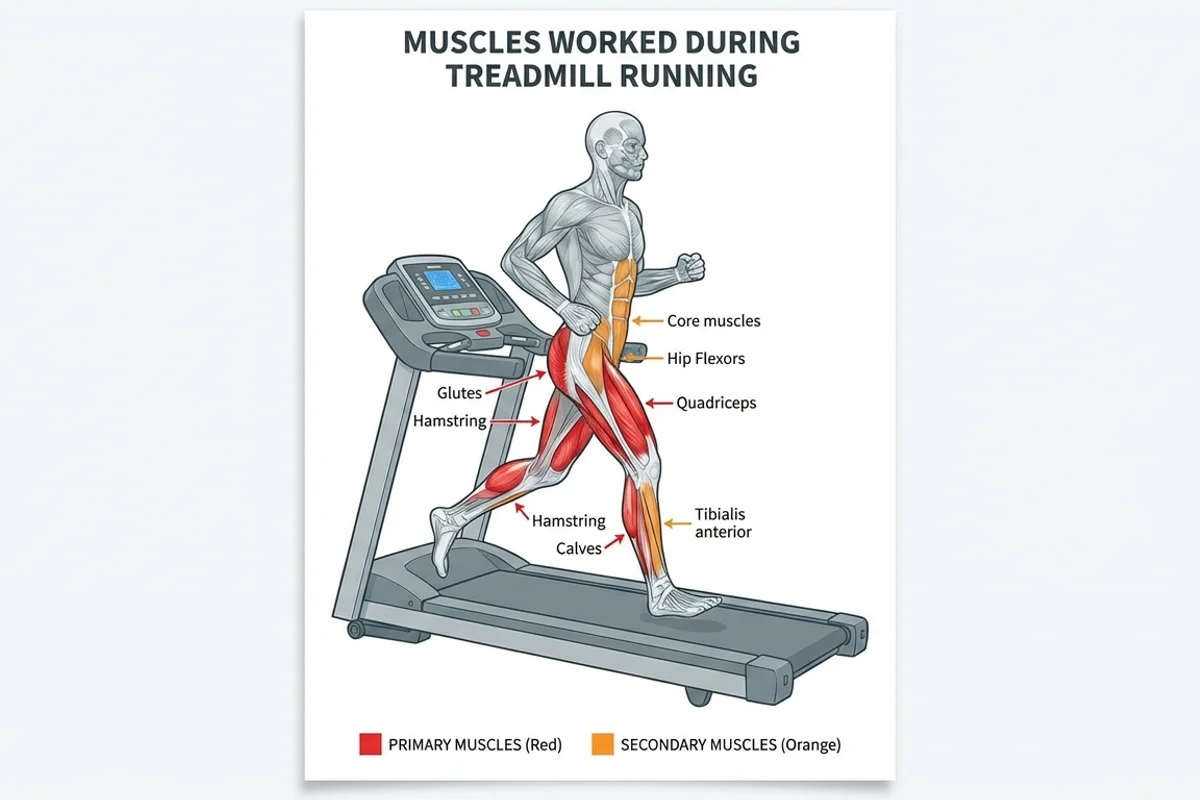
The treadmill is the most popular cardio machine worldwide, offering walking, jogging, and running options. Understanding muscle activation helps you optimize your workouts for specific goals.
Quick Answer: What Muscles Does the Treadmill Work?
Primary Muscles:
- Quadriceps (front thighs)
- Hamstrings (back thighs)
- Calves (gastrocnemius and soleus)
- Glutes (buttocks)
Secondary Muscles:
- Hip flexors
- Core muscles
- Tibialis anterior (shin)
Stabilizer Muscles:
- Ankle stabilizers
- Hip stabilizers
- Lower back
Primary Muscles in Detail
Quadriceps
Your quads work with every step:
- Rectus femoris
- Vastus lateralis
- Vastus medialis
- Vastus intermedius
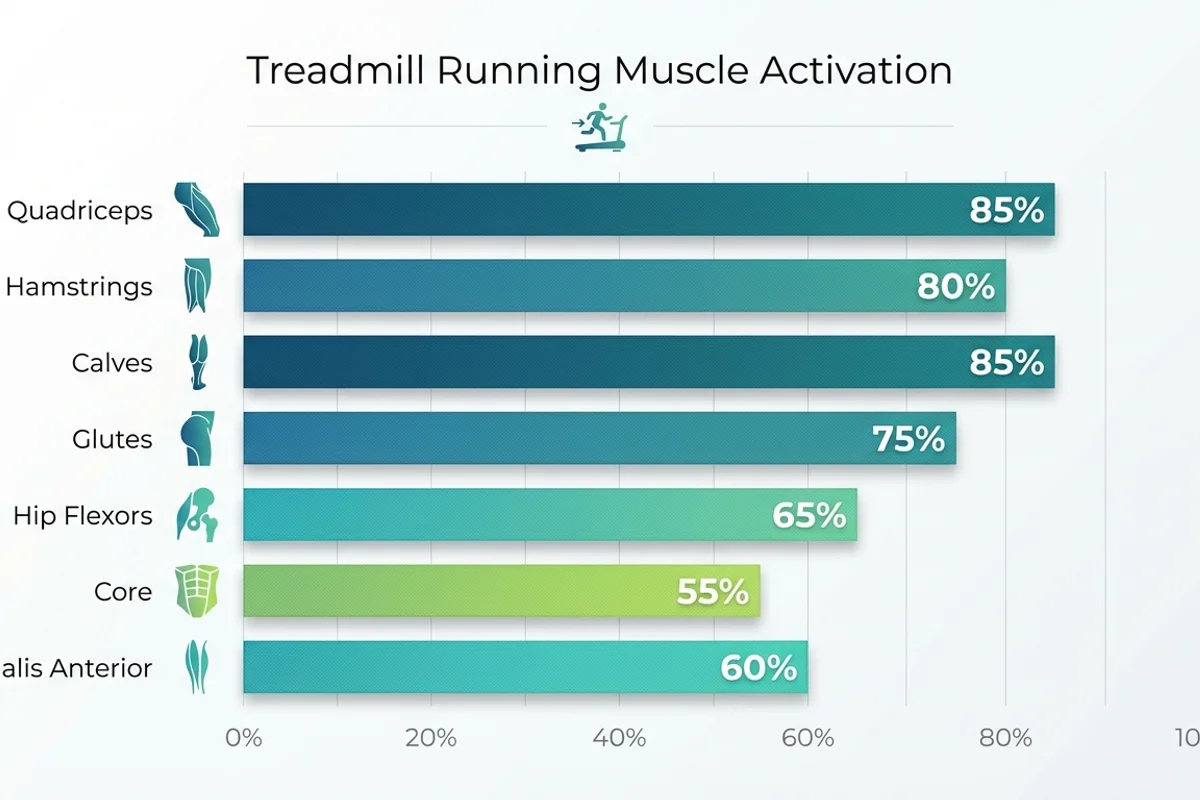
When active: Extending knee during push-off and controlling landing Activation level: Very High (85%)
Hamstrings
The hamstrings work during swing phase and hip extension:
- Biceps femoris
- Semitendinosus
- Semimembranosus
When active: Pulling leg back and bending knee Activation level: High (80%)
Calves
Your calves provide push-off power:
- Gastrocnemius (upper calf)
- Soleus (lower calf)
When active: Toe-off phase of each step Activation level: Very High (85%)
Glutes
The glutes power hip extension:
- Gluteus maximus
- Gluteus medius
- Gluteus minimus
When active: Push-off and hip stabilization Activation level: High (75%)
Muscle Activation by Speed and Incline
Walking (3-4 mph / 5-6 kph)
| Muscle | Activation Level |
|---|---|
| Quadriceps | Moderate |
| Hamstrings | Moderate |
| Calves | Moderate |
| Glutes | Low-Moderate |
| Core | Low |
Jogging (5-6 mph / 8-10 kph)
| Muscle | Activation Level |
|---|---|
| Quadriceps | High |
| Hamstrings | High |
| Calves | High |
| Glutes | Moderate-High |
| Core | Moderate |
Running (7+ mph / 11+ kph)
| Muscle | Activation Level |
|---|---|
| Quadriceps | Very High |
| Hamstrings | Very High |
| Calves | Very High |
| Glutes | High |
| Core | High |
Sprinting (10+ mph / 16+ kph)
| Muscle | Activation Level |
|---|---|
| Quadriceps | Maximum |
| Hamstrings | Maximum |
| Calves | Maximum |
| Glutes | Very High |
| Core | Very High |
Impact of Incline
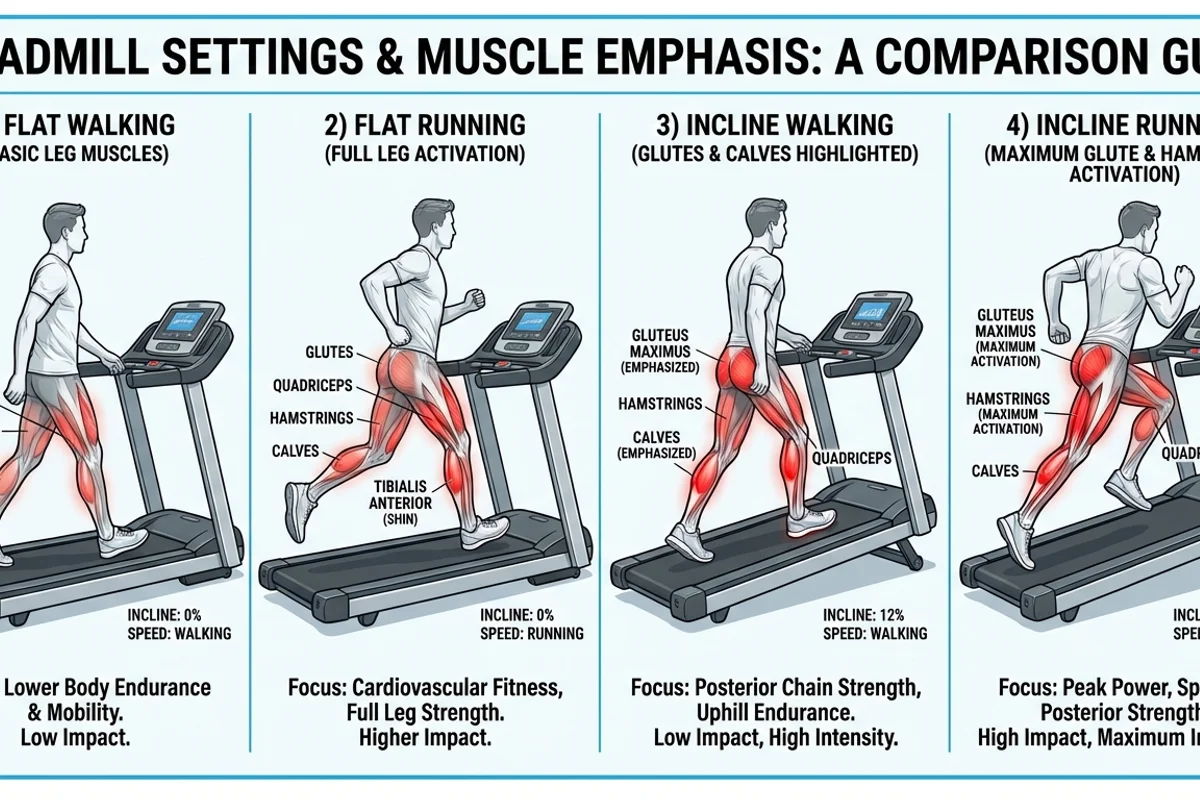
Incline dramatically changes muscle activation:
0% Incline (Flat)
- Standard running muscle activation
- Quad-dominant
- Lower glute engagement
5% Incline
- 15-20% increase in glute activation
- Increased hamstring work
- Higher calf engagement
10% Incline
- 30-40% increase in glute activation
- Significant hamstring increase
- Reduced running impact
15% Incline
- Maximum glute and hamstring activation
- Simulates hill climbing
- Excellent for toning posterior chain
How to Target Specific Muscles
Maximize Quad Activation
- Use flat treadmill (0% incline)
- Increase speed (running vs walking)
- Focus on pushing forward
- Use interval sprints
- Land on forefoot
Maximize Glute Activation
- Use high incline (10-15%)
- Walk at moderate speed with incline
- Focus on hip extension
- Push through heels
- Avoid holding handrails
Maximize Calf Activation
- Increase speed
- Run on toes/forefoot
- Use moderate incline
- Add sprint intervals
- Avoid heel striking
Maximize Hamstring Activation
- Use incline settings
- Focus on pulling leg through
- Add backward walking (carefully)
- Increase stride length
- Use interval training
Walking vs. Running: Muscle Comparison
| Factor | Walking | Running |
|---|---|---|
| Quad Activation | ●●●○○ | ●●●●● |
| Hamstring Activation | ●●●○○ | ●●●●● |
| Calf Activation | ●●●○○ | ●●●●● |
| Glute Activation | ●●○○○ | ●●●●○ |
| Core Activation | ●●○○○ | ●●●●○ |
| Impact | Low | High |
| Calorie Burn | ●●○○○ | ●●●●● |
Treadmill vs. Outdoor Running
| Factor | Treadmill | Outdoor |
|---|---|---|
| Hamstring Activation | Lower | Higher |
| Quad Activation | Similar | Similar |
| Stabilizer Work | Lower | Higher |
| Consistency | High | Variable |
| Impact | Slightly Lower | Higher |
Note: Treadmill running uses ~10-15% less hamstring activation due to the belt assisting leg pull-back.
Common Issues and Solutions
"I Only Feel It In My Quads"
Cause: Flat treadmill, overstriding Fix: Add incline, shorten stride, push through glutes
"My Calves Get Tired Quickly"
Cause: Forefoot striking, tight calves Fix: Heel-to-toe gait, stretch calves, reduce incline initially
"My Shins Hurt (Shin Splints)"
Cause: Overuse, poor footwear, tibialis anterior strain Fix: Reduce intensity, proper shoes, gradual progression
"I Don't Feel Glute Activation"
Cause: Flat treadmill, holding handrails Fix: Add 10-15% incline, let go of rails, focus on hip extension
The Science of Treadmill Running
Research shows:
- Running activates muscles at 70-90% of maximum voluntary contraction
- Incline walking can match running muscle activation with lower impact
- Faster speeds increase muscle fiber recruitment
- Treadmill running has 10-15% less hamstring activation than overground
- A 1% incline approximates outdoor running effort
Calculate Your Treadmill Calories
Track your workout intensity with our Treadmill Calorie Calculator for accurate calorie estimates.
Related Guides
- Incline Treadmill Muscles Worked - Incline specific guide
- Treadmill Pace Speed Calculator - Convert pace and speed
- Calories Burned Running by Duration - Running calorie guide
- Treadmill vs Cycling Weight Loss - Comparison