
Elliptical Muscles Worked: Complete Anatomy Guide
Discover exactly which muscles the elliptical trainer works. Learn about this low-impact full-body cardio machine that targets legs, glutes, arms, and core.
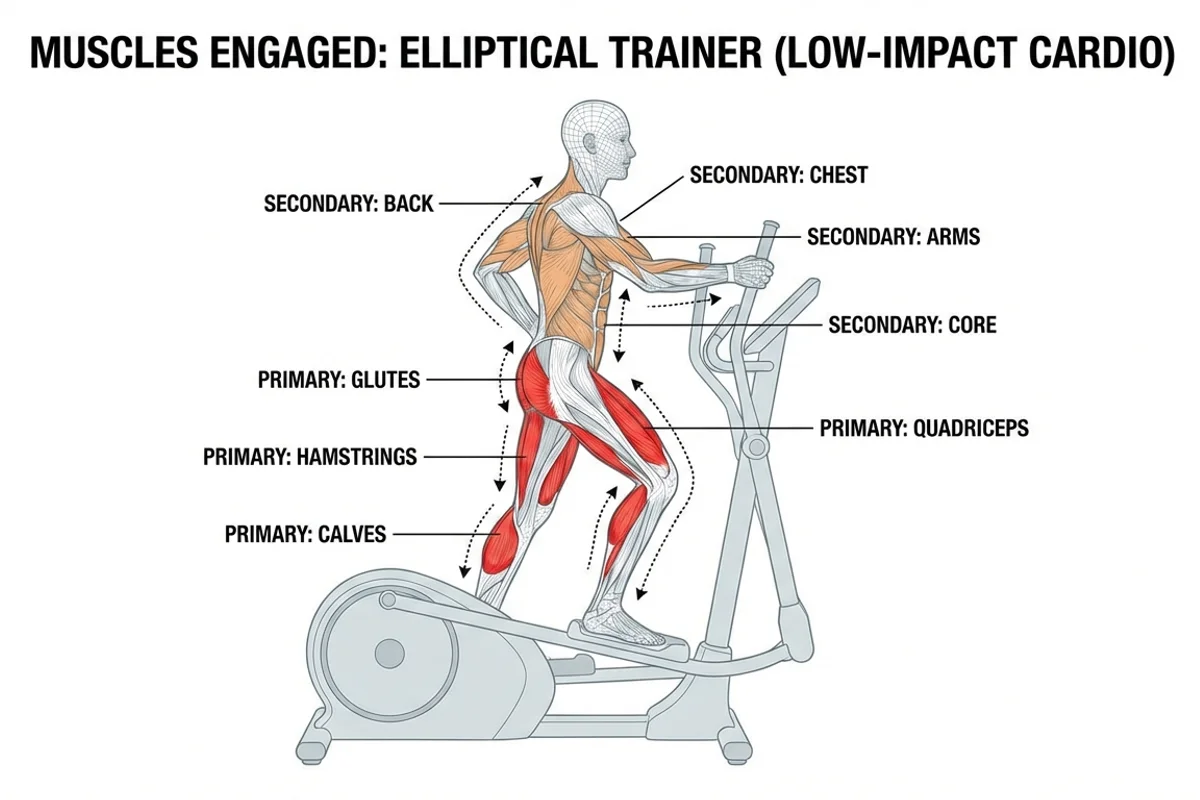
The elliptical trainer (cross-trainer) offers a unique combination of low-impact cardio with optional upper body engagement. Understanding muscle activation helps you maximize your workouts.
Quick Answer: What Muscles Does the Elliptical Work?
Primary Muscles (Lower Body):
- Quadriceps (front thighs)
- Glutes (buttocks)
- Hamstrings (back thighs)
- Calves
Secondary Muscles (Upper Body - with handles):
- Chest (pushing)
- Back (pulling)
- Biceps (pulling handles)
- Triceps (pushing handles)
Stabilizer Muscles:
- Core (balance and posture)
- Hip stabilizers
Primary Muscles: Lower Body
Quadriceps
Your quads power the forward pushing motion:
- Rectus femoris
- Vastus lateralis
- Vastus medialis
- Vastus intermedius
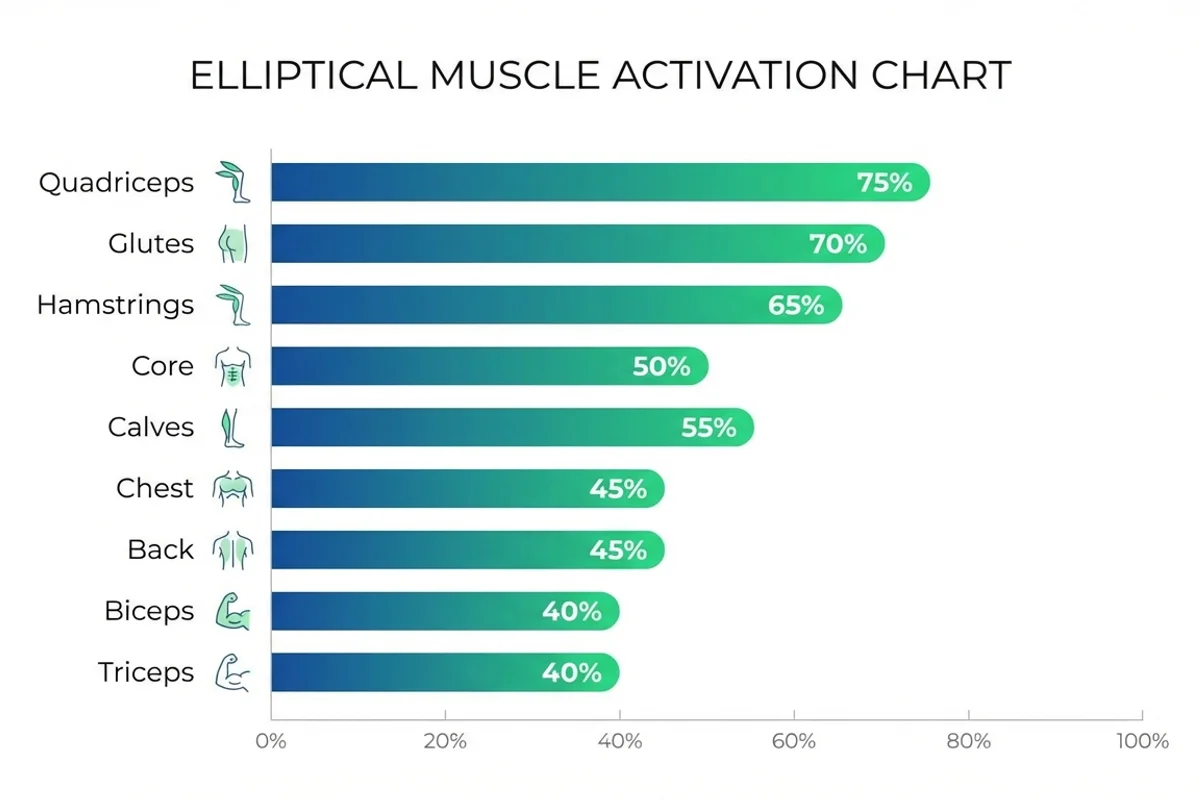
When active: Forward pedaling motion Activation level: High (75%)
Glutes
The glutes extend your hip with each stride:
- Gluteus maximus (primary)
- Gluteus medius (stability)
- Gluteus minimus (stability)
When active: Push-down and back phase Activation level: High (70%)
Hamstrings
Your hamstrings work during the back portion of the ellipse:
- Biceps femoris
- Semitendinosus
- Semimembranosus
When active: Pulling pedal back and up Activation level: Moderate-High (65%)
Calves
Your calves stabilize your ankles throughout:
- Gastrocnemius
- Soleus
When active: Continuous stabilization Activation level: Moderate (55%)
Secondary Muscles: Upper Body
When using the moving handles:
Chest (Pectorals)
When active: Pushing handles forward Activation level: Moderate (45%)
Back (Lats and Rhomboids)
When active: Pulling handles back Activation level: Moderate (45%)
Arms
Biceps: Pulling handles (40%) Triceps: Pushing handles (40%)
Muscle Activation by Technique
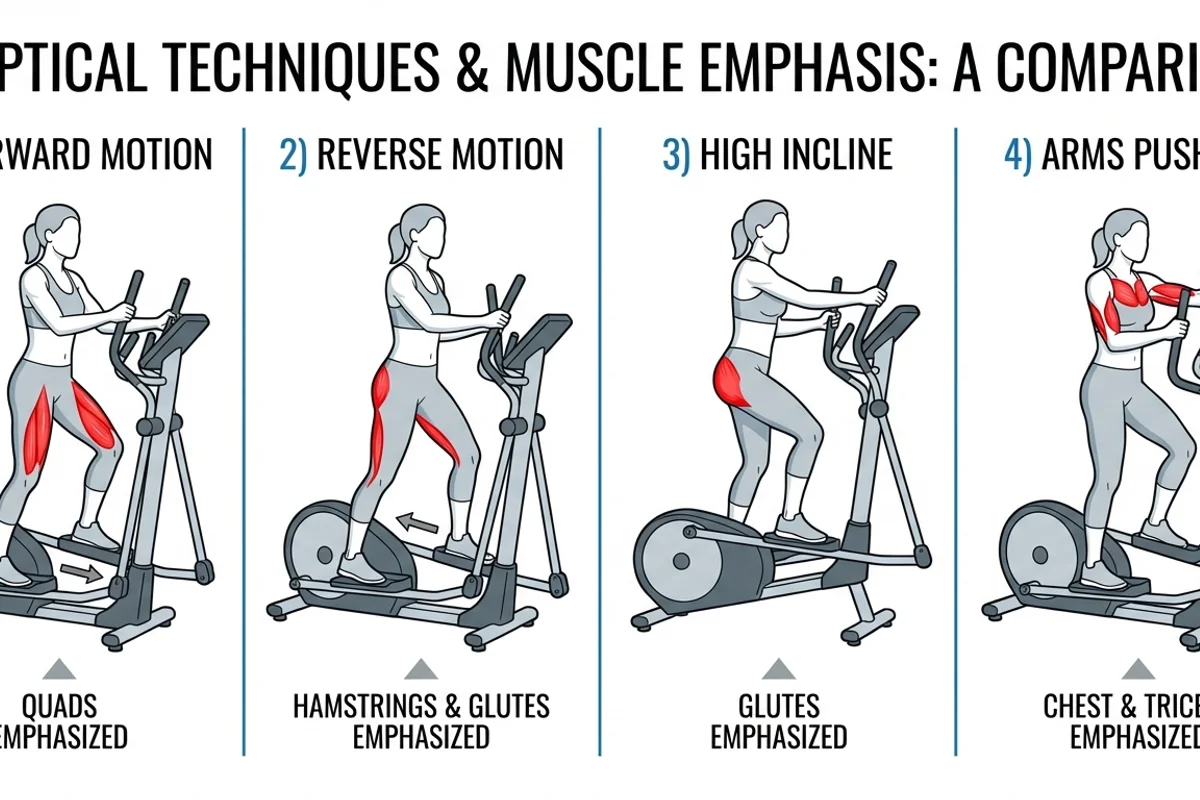
Forward Motion
| Muscle | Activation Level |
|---|---|
| Quadriceps | Very High |
| Glutes | High |
| Hamstrings | Moderate |
| Calves | Moderate |
Best for: Quad emphasis, general cardio
Reverse Motion
| Muscle | Activation Level |
|---|---|
| Hamstrings | Very High |
| Glutes | Very High |
| Quadriceps | Moderate |
| Calves | High |
Best for: Hamstring and glute emphasis
High Incline
| Muscle | Activation Level |
|---|---|
| Glutes | Maximum |
| Hamstrings | Very High |
| Quadriceps | High |
| Calves | High |
Best for: Maximum glute activation
With Moving Handles
| Muscle | Activation Level |
|---|---|
| All leg muscles | High |
| Chest | Moderate |
| Back | Moderate |
| Arms | Moderate |
Best for: Full-body workout, higher calorie burn
How to Target Specific Muscles
Maximize Quad Activation
- Use forward motion
- Lower or no incline
- Higher resistance
- Focus on pushing down
- Use stationary handles
Maximize Glute Activation
- Use reverse motion
- High incline setting
- Push through heels
- Longer stride length
- Higher resistance
Maximize Hamstring Activation
- Use reverse motion
- Focus on pulling pedal back
- Moderate to high incline
- Controlled speed
Maximize Upper Body Work
- Actively use moving handles
- Push and pull with equal effort
- Don't just hold handles passively
- Alternate dominant arm push/pull
Maximize Core Engagement
- Let go of handles occasionally
- Maintain upright posture
- Don't lean on console
- Use interval training
Elliptical vs. Other Cardio Machines
| Factor | Elliptical | Treadmill | Bike | Rowing |
|---|---|---|---|---|
| Quad Activation | ●●●● | ●●●●● | ●●●●● | ●●●●● |
| Glute Activation | ●●●● | ●●●● | ●●●● | ●●●●● |
| Upper Body | ●●●○ | ○ | ○ | ●●●●● |
| Core | ●●●○ | ●●● | ●● | ●●●● |
| Impact | None | High | None | None |
| Calorie Burn | ●●●● | ●●●●● | ●●●○ | ●●●●● |
Benefits of Elliptical Training
Low Impact
- No foot strike impact
- Easy on knees, hips, back
- Good for injury recovery
- Suitable for heavier individuals
Versatility
- Forward and reverse motion
- Adjustable incline
- Optional upper body engagement
- Suitable for all fitness levels
Full-Body Option
- Upper body engagement available
- Burns more calories than bike
- Improves coordination
- More engaging than stationary exercises
Common Mistakes That Reduce Muscle Activation
Leaning on Handles
Problem: Reduces leg and core engagement Fix: Stand upright, light grip only
Moving Too Fast
Problem: Reduces muscle time under tension Fix: Use resistance, controlled speed
Passive Upper Body
Problem: Wastes upper body potential Fix: Actively push and pull handles
Ignoring Reverse Motion
Problem: Only targets quads Fix: Alternate forward and reverse
Calculate Your Elliptical Calories
Track your workout intensity with our Elliptical Calorie Calculator for accurate calorie estimates.
Related Guides
- Elliptical vs Running Calories - Comparison guide
- Elliptical to Running Conversion - Training equivalence
- 30 Minute Elliptical Calories - Specific workout
- Treadmill Muscles Worked - Alternative comparison