
Bench Press Variations: Complete Guide to All Types
Explore every bench press variation from flat to incline, decline to close-grip. Learn when to use each variation and how they target different muscles.
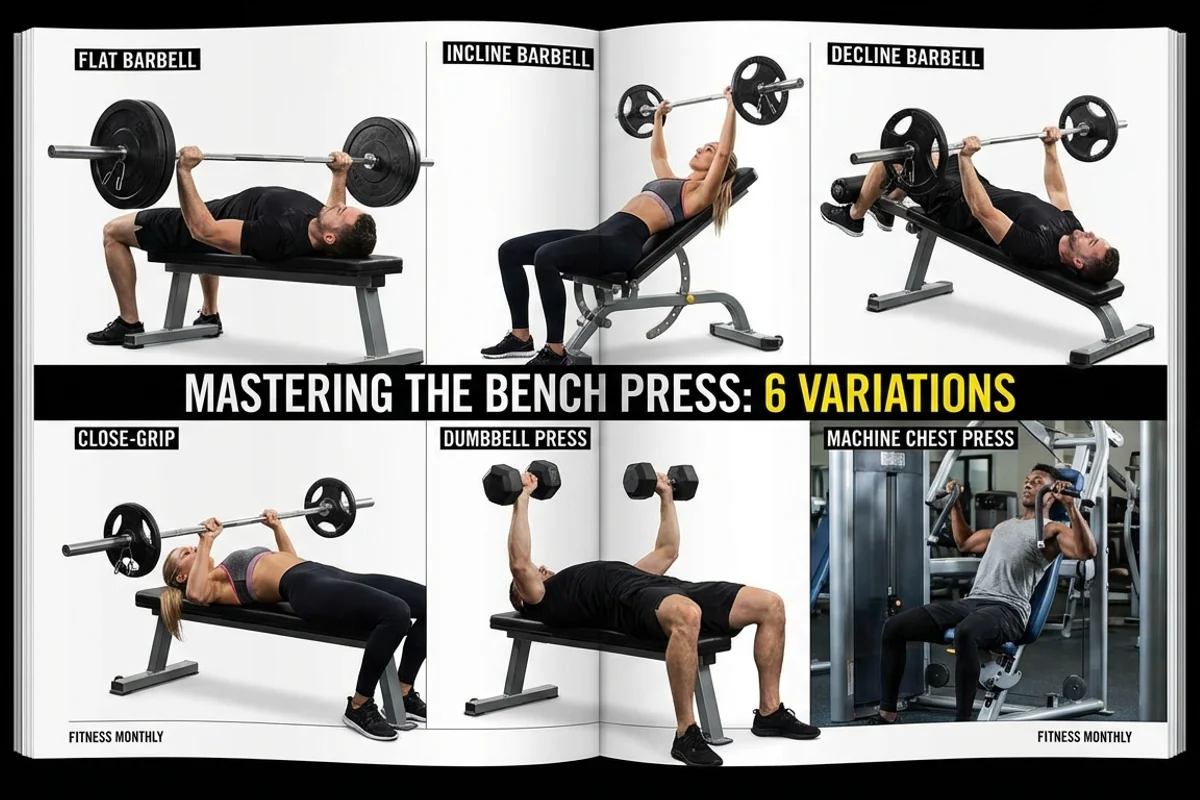
The bench press isn't just one exercise, it's a family of movements. Each variation targets muscles differently and serves unique purposes in your training program.
Overview: Why Variations Matter
Using multiple bench press variations helps you:
- Target muscles from different angles
- Address weak points in your lift
- Prevent overuse injuries
- Break through plateaus
- Keep training interesting
The key is choosing the right variation for your current goals.
Barbell Variations
Flat Barbell Bench Press
The Standard
The classic bench press performed on a flat bench with a barbell. This is the foundation of chest training and the variation tested in powerlifting competitions.
Best for:
- Overall chest development
- Maximum strength
- Competition preparation
Key points:
- Bar touches lower chest
- J-curve bar path
- Full range of motion
Incline Barbell Bench Press
Upper Chest Emphasis
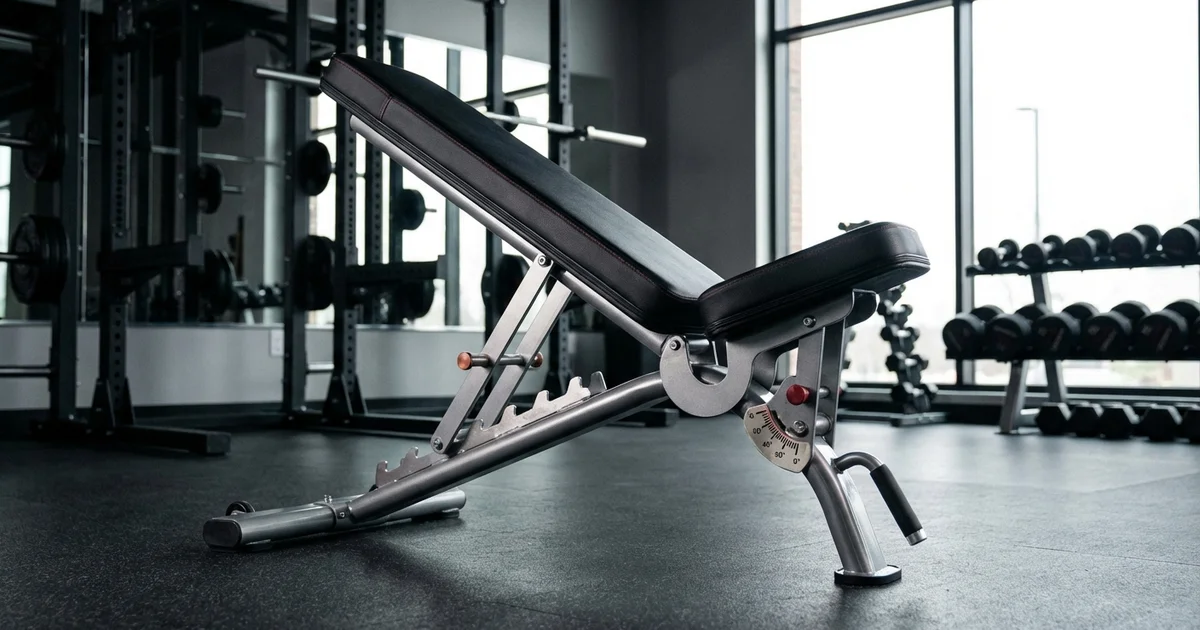
Performed on a bench set to 30-45 degrees. The incline shifts emphasis to the upper (clavicular) portion of the chest and increases anterior deltoid involvement.
Best for:
- Upper chest development
- Shoulder strength
- Balanced chest aesthetics
Key points:
- 30° angle: Balanced chest/shoulder emphasis
- 45° angle: More shoulder dominant
- Lower the bar to upper chest
- Keep elbows at 45-degree angle
Decline Barbell Bench Press
Lower Chest Emphasis
Performed on a decline bench (typically 15-30 degrees). This variation emphasizes the lower (sternal) portion of the pec major and typically allows for heavier weights.
Best for:
- Lower chest development
- Reduced shoulder stress
- Increased strength due to shorter ROM
Key points:
- Secure legs under pads
- Touch bar to lower chest
- Reduced range of motion is normal
Close-Grip Bench Press
Tricep Builder
A flat bench press with hands positioned shoulder-width apart or narrower. This shifts emphasis from chest to triceps.
Best for:
- Tricep development
- Lockout strength improvement
- Elbow-friendly pressing
Key points:
- Hands shoulder-width or slightly narrower
- Keep elbows closer to body
- Touch bar to lower chest/upper abdomen
Wide-Grip Bench Press
Maximum Chest Stretch
A flat bench press with hands positioned wider than standard (outside the knurling rings). Maximizes chest stretch but increases shoulder stress.
Best for:
- Maximum chest activation
- Shorter range of motion
- Advanced lifters only
Key points:
- Index fingers on or outside rings
- Reduced range of motion
- Higher shoulder stress, use caution
Pause Bench Press
Eliminating Momentum
Any bench press variation where you pause the bar on your chest for 1-3 seconds before pressing. Eliminates the stretch reflex and builds strength from a dead stop.
Best for:
- Building strength off the chest
- Competition preparation
- Improving control and technique
Key points:
- 1-3 second pause on chest
- Stay tight during pause
- Explosive press after pause
Spoto Press
Building Bottom-End Strength
Named after powerlifter Eric Spoto. The bar stops 1-2 inches above the chest, pauses, then presses back up. No chest contact.
Best for:
- Building starting strength
- Improving control
- Chest activation without stretch reflex
Key points:
- Stop bar 1-2 inches above chest
- 1-2 second pause in air
- Maintain tension throughout
Dumbbell Variations
Flat Dumbbell Press
Balanced Development
The dumbbell equivalent of the flat barbell bench. Each arm works independently, helping correct imbalances.
Best for:
- Fixing strength imbalances
- Greater range of motion
- Shoulder health
Key points:
- Press dumbbells in an arc
- Can rotate wrists at top
- Full range of motion
Incline Dumbbell Press
Upper Chest with Freedom
Combines incline pressing with the benefits of dumbbells: independent arm work and greater range of motion.
Best for:
- Upper chest development
- Shoulder stability work
- Correcting imbalances
Key points:
- Set bench to 30-45 degrees
- Full stretch at bottom
- Control the descent
Neutral Grip Dumbbell Press
Shoulder-Friendly Option
Palms face each other throughout the movement. This position is often more comfortable for those with shoulder issues.
Best for:
- Those with shoulder problems
- Tricep emphasis
- Long arm lifters
Key points:
- Palms face each other
- Elbows stay closer to body
- Lower to sides of chest
Machine Variations
Smith Machine Bench Press
Guided Movement
The barbell moves on a fixed vertical track, eliminating the need for stabilization.
Best for:
- Beginners learning the movement
- Training alone without a spotter
- Isolating pushing muscles
Key points:
- Bar path is fixed (vertical)
- Less stabilizer work
- Position bench so bar touches lower chest
Chest Press Machine
Isolation Without Stabilization
Seated machine press that eliminates most stability demands. Available in various angles.
Best for:
- Rehabilitation
- Beginners
- Isolation at end of workout
- High-rep pump work
Key points:
- Adjust seat height properly
- Control the entire movement
- Don't lock out aggressively
Comparison Table
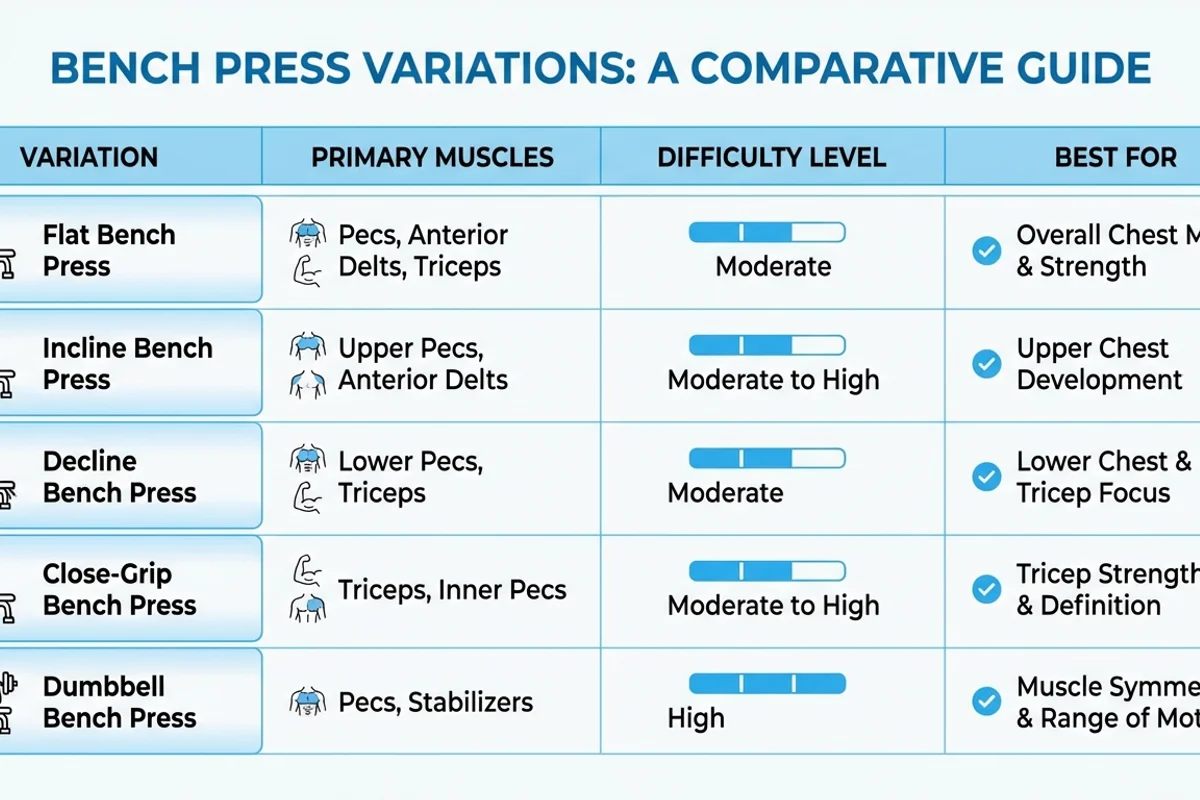
| Variation | Primary Muscles | Difficulty | Best For |
|---|---|---|---|
| Flat Barbell | Full chest, triceps, delts | Moderate | Overall strength |
| Incline Barbell | Upper chest, delts | Moderate | Upper chest development |
| Decline Barbell | Lower chest, triceps | Easy | Lower chest isolation |
| Close-Grip | Triceps, inner chest | Moderate | Tricep strength |
| Wide-Grip | Outer chest | Difficult | Chest emphasis |
| Pause Press | Full chest | Difficult | Competition prep |
| Flat Dumbbell | Full chest | Moderate | Balanced development |
| Incline Dumbbell | Upper chest | Moderate | Upper chest with ROM |
| Smith Machine | Full chest | Easy | Beginners, solo training |
How to Choose the Right Variation
Based on Goals
Maximum Strength: Flat barbell, pause bench, close-grip Chest Mass: Flat barbell, incline dumbbell, wide-grip Upper Chest: Incline barbell, incline dumbbell Tricep Development: Close-grip, decline barbell Shoulder Health: Dumbbell variations, neutral grip
Based on Experience
Beginners: Start with flat barbell and dumbbell variations Intermediate: Add incline, decline, and close-grip Advanced: Incorporate pause press, Spoto press, and specialty variations
Based on Equipment
Home Gym (Minimal): Dumbbell variations, floor press Commercial Gym: Full access to all variations Power Rack Only: Barbell variations with safety pins
Sample Chest Workout Using Multiple Variations
Workout A: Strength Focus
- Flat Barbell Bench Press: 5x5
- Incline Dumbbell Press: 3x8
- Close-Grip Bench Press: 3x8
Workout B: Hypertrophy Focus
- Incline Barbell Press: 4x8
- Flat Dumbbell Press: 3x10
- Decline Barbell Press: 3x12
- Machine Chest Press: 3x15
Calorie Differences Between Variations
Calorie expenditure varies slightly between variations based on:
- Muscle mass involved
- Range of motion
- Stability demands
Generally, barbell variations burn slightly more calories than machines due to greater stabilization demands. Track your workouts with our Bench Press Calorie Calculator.
Related Guides
- How to Bench Press - Master the fundamentals
- Bench Press Muscles Worked - Understand the anatomy
- Bench Press Grip Guide - Optimize your grip
- How to Increase Your Bench Press - Build more strength