
Ironman Bike Split Chart: Race Day Reference Guide
Printable Ironman bike split chart with km-by-km targets, negative split strategy, and checkpoint times. Essential race day reference.
A well-planned split chart is your roadmap to a successful Ironman bike leg. This guide provides checkpoint times, power targets, and pacing strategies you can use on race day to execute a smart 180km ride.
Why You Need a Bike Split Chart
The 180km Ironman bike leg is too long to rely on feel alone. A split chart helps you:
- Stay disciplined in the first half when you feel fresh
- Monitor progress against your target finish time
- Adjust strategy if you're ahead or behind schedule
- Fuel properly by timing nutrition to checkpoints
- Preserve energy for the marathon
Without a plan, most athletes start too fast and pay the price during the run.
Ironman Bike Split Chart (30km Segments)
Here's a detailed split chart for common bike time targets:
5:00 Bike Target (33.0 km/h average)
| Segment | Distance | Target Time | Cumulative | Power Target |
|---|---|---|---|---|
| 1 | 0-30km | 55:00 | 0:55 | Race IF - 0.02 |
| 2 | 30-60km | 54:00 | 1:49 | Race IF |
| 3 | 60-90km | 54:00 | 2:43 | Race IF |
| 4 | 90-120km | 54:00 | 3:37 | Race IF |
| 5 | 120-150km | 54:00 | 4:31 | Race IF + 0.01 |
| 6 | 150-180km | 29:00* | 5:00 | Race IF - 0.02 |
*Final segment shorter for run prep
5:30 Bike Target (32.7 km/h average)
| Segment | Distance | Target Time | Cumulative | Power Target |
|---|---|---|---|---|
| 1 | 0-30km | 57:00 | 0:57 | Race IF - 0.02 |
| 2 | 30-60km | 55:00 | 1:52 | Race IF |
| 3 | 60-90km | 55:00 | 2:47 | Race IF |
| 4 | 90-120km | 55:00 | 3:42 | Race IF |
| 5 | 120-150km | 55:00 | 4:37 | Race IF + 0.01 |
| 6 | 150-180km | 53:00 | 5:30 | Race IF - 0.02 |
6:00 Bike Target (30.0 km/h average)
| Segment | Distance | Target Time | Cumulative | Power Target |
|---|---|---|---|---|
| 1 | 0-30km | 62:00 | 1:02 | Race IF - 0.02 |
| 2 | 30-60km | 60:00 | 2:02 | Race IF |
| 3 | 60-90km | 60:00 | 3:02 | Race IF |
| 4 | 90-120km | 60:00 | 4:02 | Race IF |
| 5 | 120-150km | 59:00 | 5:01 | Race IF + 0.01 |
| 6 | 150-180km | 59:00 | 6:00 | Race IF - 0.02 |
6:30 Bike Target (27.7 km/h average)
| Segment | Distance | Target Time | Cumulative | Power Target |
|---|---|---|---|---|
| 1 | 0-30km | 67:00 | 1:07 | Race IF - 0.02 |
| 2 | 30-60km | 65:00 | 2:12 | Race IF |
| 3 | 60-90km | 65:00 | 3:17 | Race IF |
| 4 | 90-120km | 65:00 | 4:22 | Race IF |
| 5 | 120-150km | 65:00 | 5:27 | Race IF + 0.01 |
| 6 | 150-180km | 63:00 | 6:30 | Race IF - 0.02 |
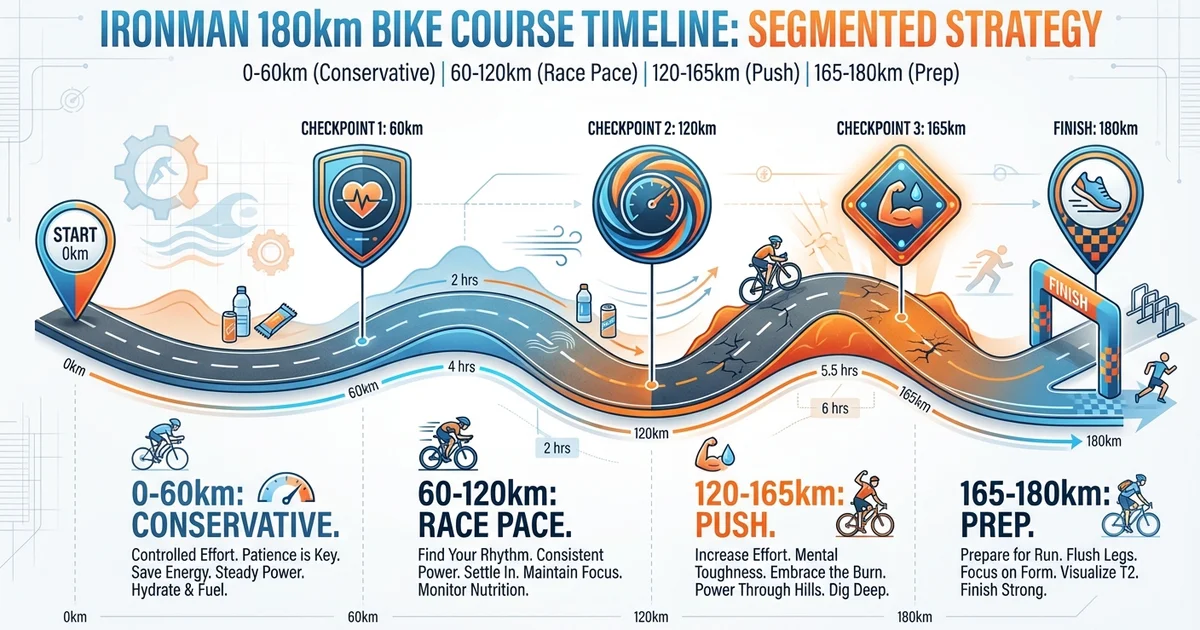
Negative Split Pacing Strategy
The most successful Ironman bike strategies use negative splits—riding the second half slightly faster than the first.
Phase 1: Conservative Start (0-60km)
Goal: Arrive at 60km feeling fresh, not fast
| Metric | Target |
|---|---|
| Power | Race IF minus 0.02 |
| Feel | Too easy |
| HR | Below race zone |
| Mindset | Saving for later |
What to expect:
- Lots of people will pass you
- You'll feel like you should go harder
- This is correct execution
Phase 2: Race Pace (60-150km)
Goal: Settle into sustainable race effort
| Metric | Target |
|---|---|
| Power | Race IF |
| Feel | Comfortable, sustainable |
| HR | Steady in race zone |
| Mindset | Controlled effort |
What to expect:
- Find your rhythm
- Start passing people who went out too fast
- Nutrition becomes critical
Phase 3: Controlled Push (120-165km)
Goal: Slight increase if feeling good
| Metric | Target |
|---|---|
| Power | Race IF plus 0.01 |
| Feel | Working but not suffering |
| HR | Upper race zone |
| Mindset | Building toward finish |
What to expect:
- Legs may feel heavy but respond
- Continue passing struggling riders
- Stay focused on form
Phase 4: Run Prep (165-180km)
Goal: Arrive at T2 ready to run
| Metric | Target |
|---|---|
| Power | Race IF minus 0.02 |
| Feel | Controlled ease |
| HR | Dropping |
| Mindset | Transition focus |
What to expect:
- Easier gearing, higher cadence
- Final nutrition intake
- Mental prep for marathon
Checkpoint Time Calculator
Use this quick reference to calculate your checkpoint times:
| Target Bike Time | 30km | 60km | 90km | 120km | 150km |
|---|---|---|---|---|---|
| 4:45 | 0:50 | 1:36 | 2:23 | 3:10 | 3:58 |
| 5:00 | 0:55 | 1:49 | 2:43 | 3:37 | 4:31 |
| 5:15 | 0:56 | 1:51 | 2:47 | 3:43 | 4:39 |
| 5:30 | 0:57 | 1:52 | 2:47 | 3:42 | 4:37 |
| 5:45 | 1:00 | 1:57 | 2:55 | 3:52 | 4:50 |
| 6:00 | 1:02 | 2:02 | 3:02 | 4:02 | 5:01 |
| 6:15 | 1:04 | 2:07 | 3:10 | 4:12 | 5:15 |
| 6:30 | 1:07 | 2:12 | 3:17 | 4:22 | 5:27 |
| 6:45 | 1:09 | 2:17 | 3:24 | 4:32 | 5:40 |
| 7:00 | 1:12 | 2:22 | 3:32 | 4:42 | 5:52 |
Power Targets by Segment
How to Calculate Your Power Targets
- Know your FTP - Use our FTP Calculator
- Select your race IF - Based on experience (0.65-0.78)
- Calculate base power - FTP × IF = Race Power
Example: 250W FTP, IF 0.72
| Segment | Power Adjustment | Target Watts |
|---|---|---|
| 0-60km | Race IF - 0.02 | 175W |
| 60-120km | Race IF | 180W |
| 120-165km | Race IF + 0.01 | 183W |
| 165-180km | Race IF - 0.02 | 175W |
Power Adjustments for Terrain
| Terrain | Adjustment |
|---|---|
| Flat/tailwind | Target power |
| Headwind | +5-10W (stay aero) |
| Gentle climb (2-4%) | +5-10W |
| Steep climb (5%+) | +10-15W max |
| Descent | Recover, spin easy |
Race Day Split Card
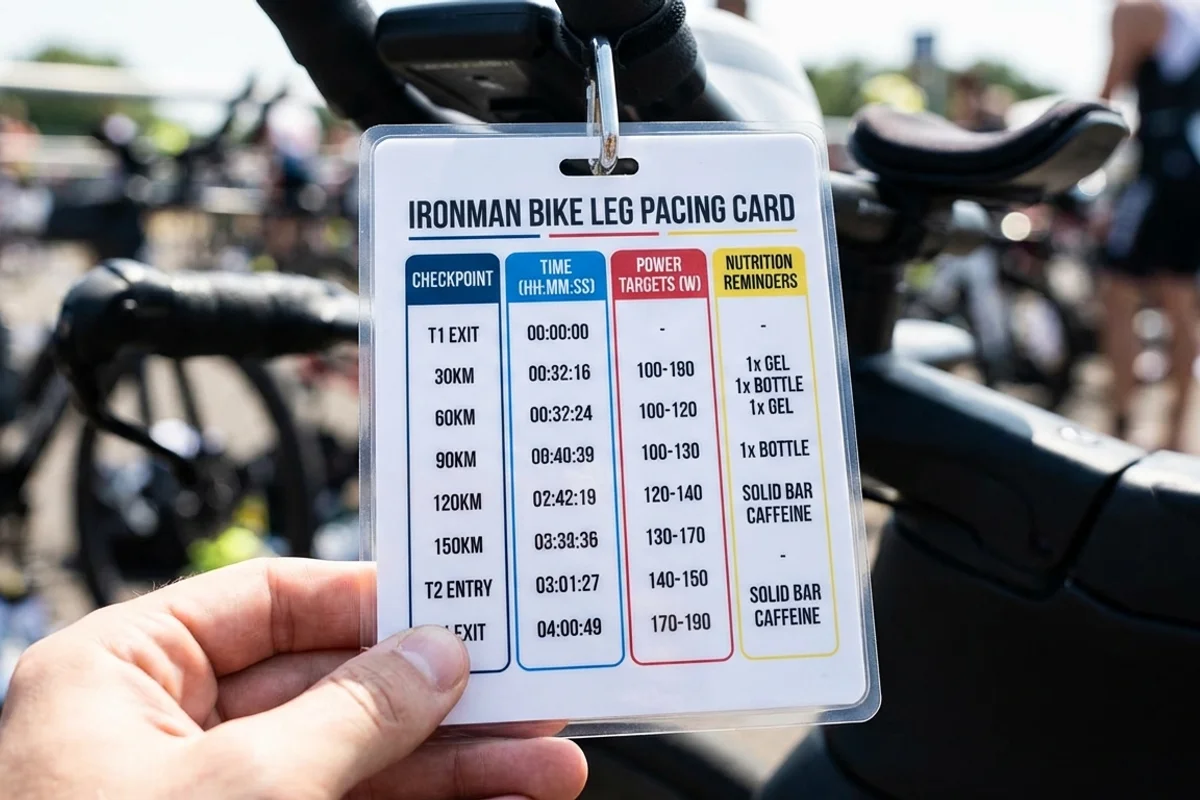
Create a race day card with:
Front Side
- Target bike time
- Checkpoint times (30km intervals)
- Power targets by segment
Back Side
- Nutrition schedule
- Hydration reminders
- Emergency contacts
Tips for Race Day Card
- Laminate it - You'll sweat on it
- Attach to stem or top tube
- Keep it simple - Only essential numbers
- Practice reading in aero position
Sample Race Card Content
TARGET: 5:30 BIKE

CHECKPOINTS:
30km - 0:57
60km - 1:52
90km - 2:47
120km - 3:42
150km - 4:37
180km - 5:30

POWER: 180W avg
Start: 175W | Middle: 180W | Push: 183W | Prep: 175W

FUEL: Every 20 min
Calories: 300/hr | Fluid: 750ml/hr
Using the Calculator for Custom Splits
For course-specific splits that account for elevation, wind, and your exact parameters:
- Get your course GPX from the race website or Strava
- Upload to our Ironman Bike Split Calculator
- Enter your parameters (FTP, weight, CdA)
- Review segment times and adjust for course features
- Create your race card based on the results
The calculator provides:
- Segment-by-segment time predictions
- Power recommendations per section
- Wind impact analysis
- Nutrition timing suggestions
Adjusting Splits on Race Day
If You're Ahead of Schedule
Don't speed up. Bank the time for the run. Maintain your power targets.
If You're Behind Schedule
Analyze why:
- Wind/conditions: Accept it, maintain power
- Mechanical issue: Fix if possible, adjust expectations
- Went too easy: Slight increase (max +5W) if feeling good
- Went too hard early: Back off and recover
If Conditions Change
Wind picks up:
- Maintain power, not speed
- Stay as aero as possible
- Accept slower splits
Heat increases:
- Drop power by 3-5%
- Increase hydration
- Protect the run
Related Resources
Calculators
- Ironman Bike Split Calculator - Course-specific predictions
- Ironman Time Calculator - Overall finish time
- FTP Calculator - Know your threshold
Pace Charts
- Ironman Bike Pace Chart - Speed-based reference
- Ironman Bike Time Chart - FTP-based predictions
Guides
- Ironman Pacing Strategy - Complete race execution
- Ironman Bike Training Guide - How to prepare
- Ironman Nutrition Complete Guide - Fueling strategy