
Bench Press for Beginners: Your First 8 Weeks
New to bench pressing? This beginner guide takes you from your first rep to confident lifting. Learn starting weights, progression, and how to build a foundation.
Starting the bench press can be intimidating. How much weight should you use? How often should you train? What if the bar is too heavy?
This guide answers all those questions and gives you a structured path from your first rep to confident, consistent lifting.
Before Your First Bench Press
Equipment Needed
At minimum, you need:
- A flat bench
- A barbell (standard Olympic bar weighs 45 lbs/20 kg)
- A rack or stands to hold the bar
- Safety pins or a spotter (highly recommended)
Optional but helpful:
- Weight plates (start with lighter ones: 2.5, 5, 10 lb)
- Wrist wraps for additional stability
- Lifting chalk for grip
Recommended Starting Weight
For most beginners, start with just the bar (45 lbs/20 kg).
This might feel easy, and that's okay. The goal of your first few sessions is learning the movement pattern, not testing your strength.
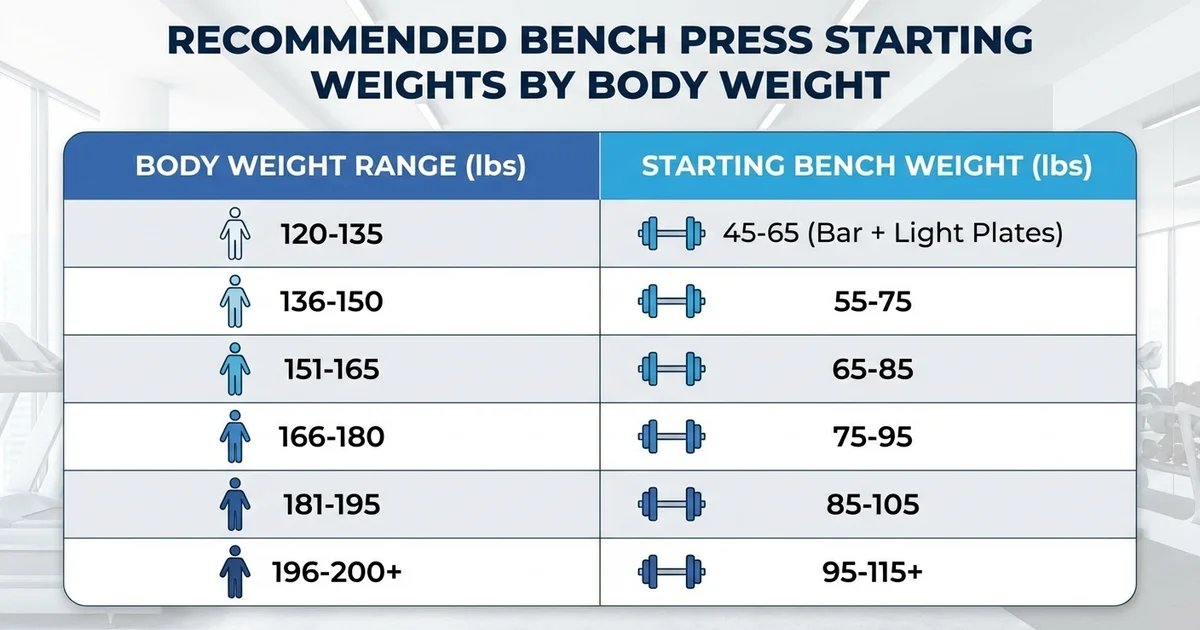
| Your Body Weight | Suggested Starting Weight |
|---|---|
| Under 120 lbs | Empty bar (45 lbs) |
| 120-150 lbs | Empty bar to 55 lbs |
| 150-180 lbs | 55-75 lbs |
| 180-220 lbs | 65-95 lbs |
| Over 220 lbs | 75-115 lbs |
These are just guidelines. If the bar feels too heavy, use a lighter barbell (some gyms have 35 lb bars) or start with dumbbells.
Warming Up Properly
Never jump straight into bench pressing. A proper warmup:
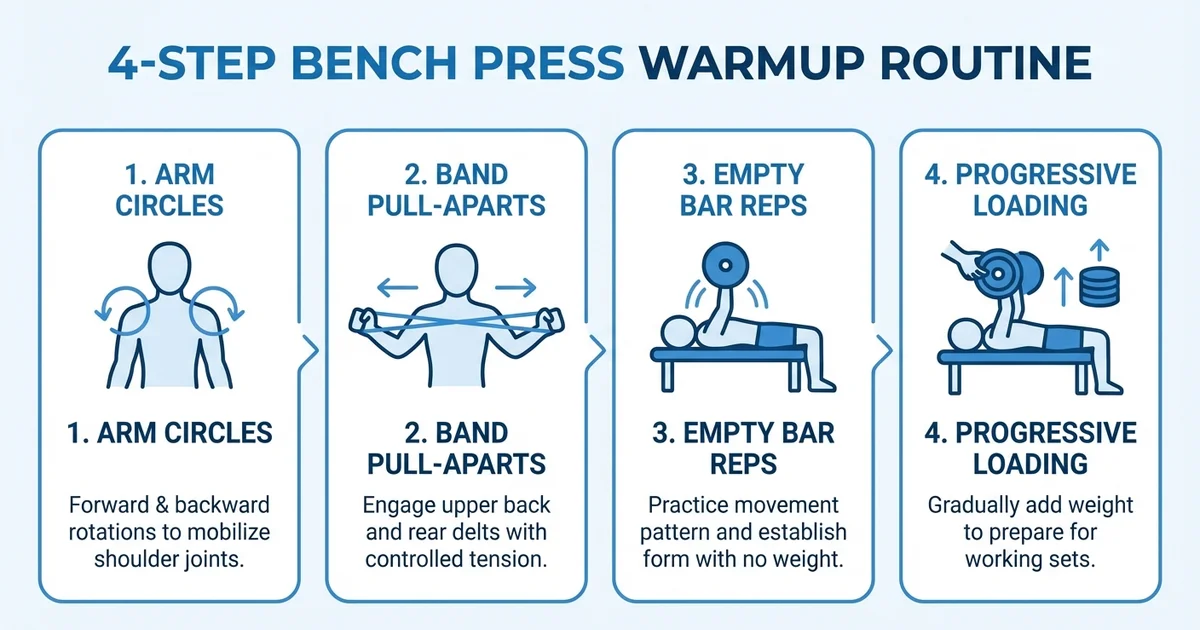
- 5 minutes light cardio - Get blood flowing
- Arm circles - 10 forward, 10 backward
- Band pull-aparts - 15-20 reps
- Pushups - 10-15 reps (modified if needed)
- Empty bar bench press - 10-15 slow reps focusing on form
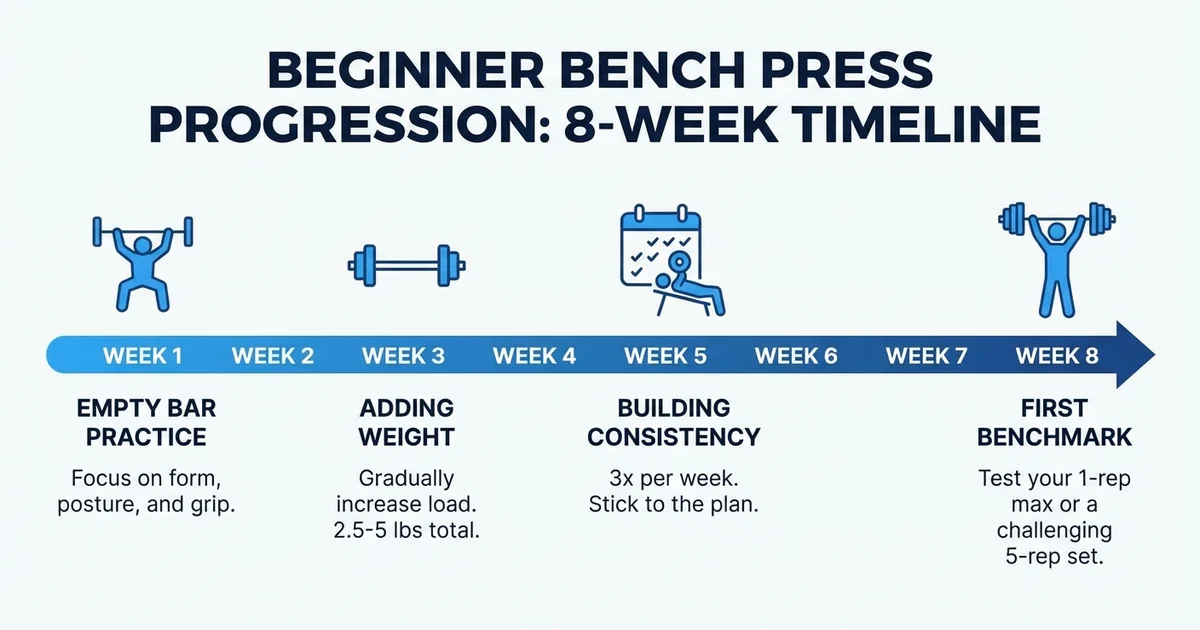
Week 1-2: Learning the Movement
Focus Areas
These first two weeks are about building muscle memory, not lifting heavy.
Key technique points to master:
- Shoulder blade retraction (squeeze them together)
- Proper grip width (approximately 1.5x shoulder width)
- Controlled bar path (down to lower chest, up and back)
- Breathing pattern (breathe at top, brace, descend)
Rep and Set Recommendations
Weeks 1-2 Program:
- Day 1: 3 sets of 10 reps with empty bar
- Day 2 (2-3 days later): 3 sets of 10 reps with empty bar
Focus on:
- Smooth, controlled reps
- Full range of motion
- Perfect technique every rep
If 10 reps feels easy, don't add weight yet. Add a fourth set instead.
What "Good Enough" Looks Like
You're ready to add weight when:
- Every rep looks and feels the same
- You don't have to think about the technique
- The bar path is straight and controlled
- You're not getting shoulder or elbow pain
Week 3-4: Adding Light Weight
How Much to Add
Add 5-10 lbs total to the bar (2.5-5 lbs per side). This might seem small, but consistent progress beats sporadic jumps.
Weeks 3-4 Program:
- Day 1: 3 sets of 8-10 reps
- Day 2: 3 sets of 8-10 reps
If you complete all 3 sets of 10 reps with good form, add another 5 lbs next workout.
Form Checkpoints
As weight increases, watch for these common breakdowns:
- Elbows flaring out too wide
- Bar bouncing off chest
- Hips coming off the bench
- Uneven bar path
If form breaks down, reduce weight and rebuild.
Week 5-6: Building Consistency
Progressive Overload Basics
Progressive overload means gradually increasing the challenge over time. For bench press, this typically means:
- Adding weight (primary method)
- Adding reps
- Adding sets
- Reducing rest time
Simple progression rule: If you hit all your target reps with good form, add 5 lbs next session.
When to Add Weight
Add weight when you complete all prescribed sets and reps with:
- Good technique
- No form breakdown on last rep
- 1-2 reps left "in the tank"
Don't add weight if you barely completed the last rep or your form deteriorated.
Weeks 5-6 Program:
- Day 1: 4 sets of 6-8 reps
- Day 2: 3 sets of 10-12 reps (lighter weight)
This introduces variety: one heavier day, one moderate day.
Week 7-8: First Benchmark
Testing Your Progress
After 7 weeks of consistent training, it's time to see how far you've come.
Week 7 Benchmark Protocol:
- Warm up thoroughly
- Work up to a challenging set of 5 reps (not maximum effort)
- Rest 3-5 minutes
- Attempt a heavier set of 5 if the first felt smooth
- Record your best set of 5
Week 8 Program:
- Continue normal training with your new working weight
- Add weight when you complete all target reps
Setting Realistic Goals
Realistic 8-week progress for beginners:
| Starting Point | Expected Progress |
|---|---|
| Empty bar (45 lbs) | 65-85 lbs |
| 65 lbs | 85-105 lbs |
| 95 lbs | 115-135 lbs |
Individual results vary based on:
- Training consistency
- Sleep and recovery
- Nutrition
- Natural strength levels
- Age and gender
Don't compare yourself to others. Compare yourself to where you started.
Beginner FAQ
How much should a beginner bench?
There's no "should." Start where you are. A 135 lb bench press (one plate per side) is often considered a beginner milestone for men, but many people take 6-12 months to reach it.
How often should beginners bench?
2 times per week is ideal for most beginners. This provides enough stimulus for adaptation while allowing adequate recovery.
What if the bar is too heavy?
Options if 45 lbs is too much:
- Use a lighter barbell (35 lb women's bar, or EZ curl bar)
- Start with dumbbells (10-25 lbs each)
- Do pushups until you're strong enough for the bar
There's no shame in starting light. Everyone starts somewhere.
Should I use a spotter?
Yes, whenever possible. If training alone, use safety pins set at the correct height. Read our Bench Press Safety Guide for detailed instructions.
When should I switch to an intermediate program?
Consider yourself intermediate when:
- You've been consistently training for 6+ months
- Progress has slowed significantly
- You can bench press your body weight for reps
Sample Week for Beginners (After Week 4)
Monday - Bench Press Day A
- Warmup (arm circles, band work, pushups)
- Bench Press: 4 sets of 6-8 reps
- Incline Dumbbell Press: 3 sets of 10
- Pushups: 2 sets to near failure
Thursday - Bench Press Day B
- Warmup
- Bench Press: 3 sets of 10-12 reps (lighter than Day A)
- Dumbbell Flyes: 3 sets of 12
- Tricep Pushdowns: 3 sets of 12
Track Your Progress
Keeping a training log is essential for consistent progress. Record:
- Date
- Weight used
- Sets and reps completed
- How it felt (easy, moderate, hard)
Use our Bench Press Calorie Calculator to understand the energy demands of your training.
Moving Beyond Beginner
After completing this 8-week foundation, you're ready to explore:
- How to Increase Your Bench Press - Break plateaus
- Bench Press Variations - Add variety
- Bench Press Muscles Worked - Understand the anatomy
- How to Bench Press - Advanced technique refinements
Your bench press journey has just begun. Stay consistent, prioritize technique, and the strength will come.