
What Muscles Does the StairMaster Work? Complete Anatomy Guide
Learn exactly which muscles the StairMaster targets including glutes, quads, hamstrings, calves, and core. Complete muscle activation breakdown.
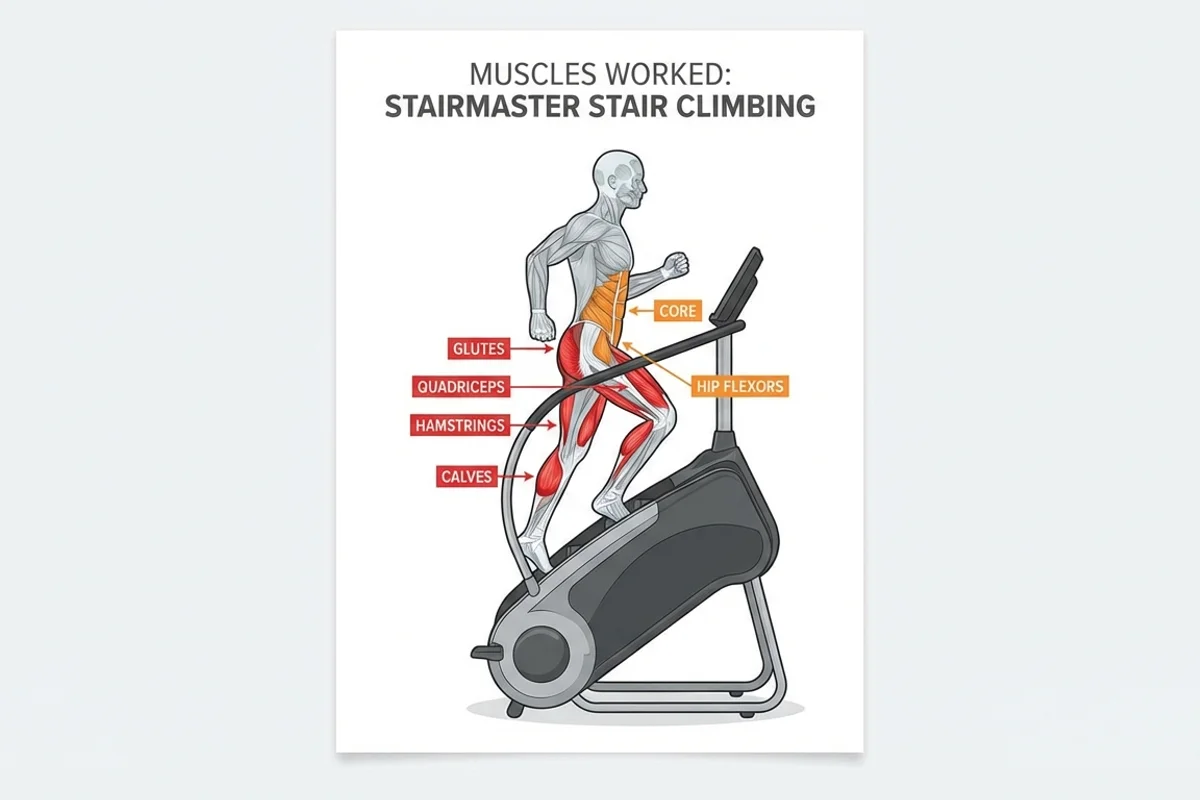
The StairMaster primarily works your glutes, quadriceps, hamstrings, and calves, while also engaging your core, hip flexors, and lower back for stabilization.
Want the number for your own session? The StairMaster calorie calculator estimates calories from your body weight, step rate and workout length.
Understanding which muscles are activated during StairMaster workouts helps you maximize results and ensure proper form. Here's a complete breakdown of every muscle group involved.
Primary Muscles Worked
Gluteus Maximus (Glutes)
The glutes are the star of the StairMaster workout. Your gluteus maximus is the largest muscle in your body and powers hip extension with every step.
Activation level: Maximum (5/5)
Why it works: Each step requires you to push your body weight upward by extending your hip. This is the exact motion that maximally activates the gluteus maximus.
Result: Stronger, more defined, lifted glutes with consistent training.
Quadriceps
Your quadriceps (front of thigh) work continuously throughout the climbing motion.
Activation level: Very High (5/5)
Muscles involved:
- Rectus femoris
- Vastus lateralis
- Vastus medialis
- Vastus intermedius
Why it works: The quads extend your knee as you step up, then control the descent as you place your other foot.
Hamstrings
The hamstrings work alongside your glutes during hip extension.
Activation level: High (4/5)
Muscles involved:
- Biceps femoris
- Semitendinosus
- Semimembranosus
Why it works: Your hamstrings assist the glutes in powering each step and help stabilize your knee joint.
Calves
Your calf muscles engage with every step to push off and stabilize your ankle.
Activation level: High (4/5)
Muscles involved:
- Gastrocnemius
- Soleus
Why it works: The calves plantarflex (point) your foot as you push off each step and stabilize your ankle throughout the motion.
Secondary Muscles Worked
Hip Flexors
Your hip flexors lift your leg to take each step.
Activation level: Moderate (3/5)
Muscles involved:
- Iliopsoas
- Rectus femoris
Why it works: Each step begins by flexing your hip to lift your foot onto the next step.
Core Muscles
Your core engages throughout to maintain posture and balance.
Activation level: Moderate (3/5)
Muscles involved:
- Rectus abdominis (abs)
- Obliques
- Transverse abdominis
- Erector spinae (lower back)
Why it works: Without handrail support, your core constantly works to keep you balanced and upright.
Does the StairMaster Work Abs?
Yes, the StairMaster does work your abs, though indirectly. Your abdominal muscles engage to stabilize your torso and maintain balance during the climbing motion.
How to maximize ab engagement:
- Minimize handrail use
- Stand upright with good posture
- Engage your core consciously
- Try single-step or skip-step variations
For direct ab work, the StairMaster is supplementary rather than primary. Combine it with dedicated core exercises for best results.
Complete Muscle Activation Chart
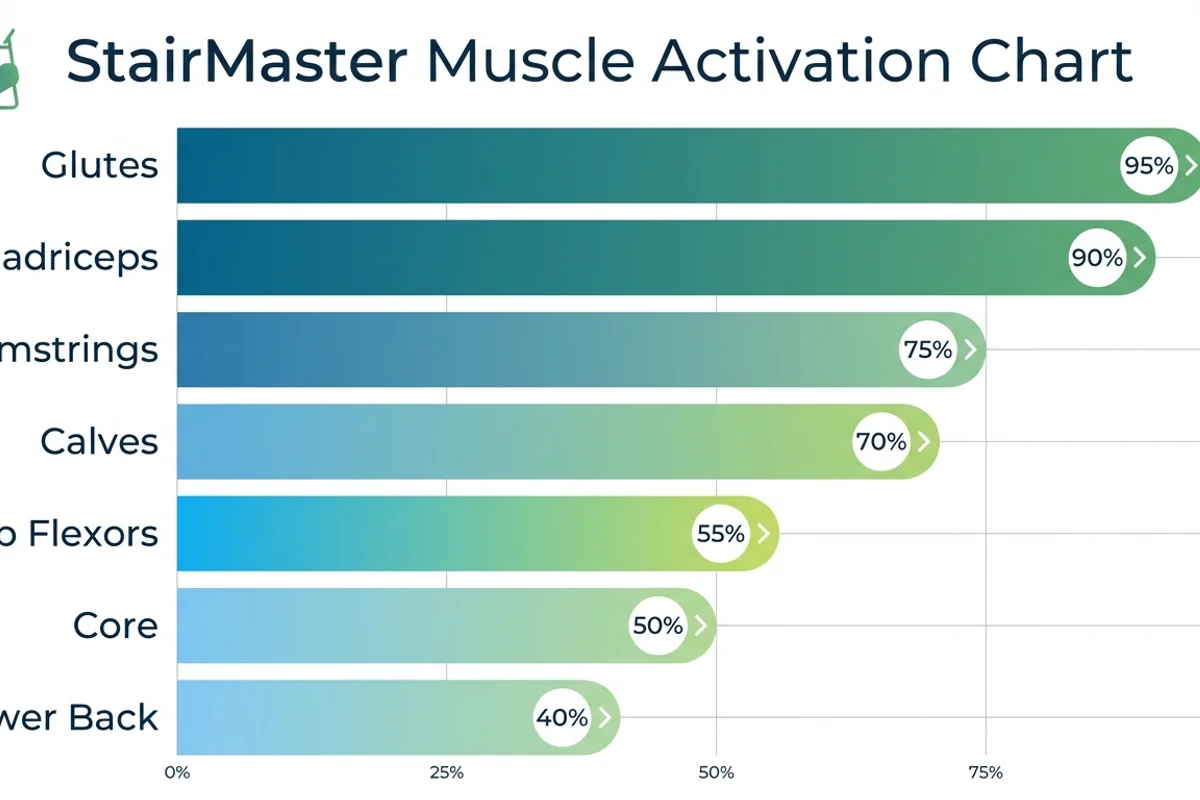
| Muscle Group | Activation Level | Primary Function |
|---|---|---|
| Glutes | ●●●●● (Maximum) | Hip extension, power |
| Quadriceps | ●●●●● (Maximum) | Knee extension |
| Hamstrings | ●●●●○ (High) | Hip extension assist |
| Calves | ●●●●○ (High) | Ankle push-off |
| Hip Flexors | ●●●○○ (Moderate) | Leg lift |
| Core/Abs | ●●●○○ (Moderate) | Stabilization |
| Lower Back | ●●○○○ (Low-Moderate) | Posture |
StairMaster vs Other Machines: Muscle Comparison
| Muscle | StairMaster | Treadmill | Elliptical | Bike |
|---|---|---|---|---|
| Glutes | ●●●●● | ●●●● | ●●●● | ●●● |
| Quads | ●●●●● | ●●●●● | ●●●● | ●●●●● |
| Hamstrings | ●●●● | ●●●● | ●●●● | ●●●● |
| Calves | ●●●● | ●●●●● | ●●● | ●●● |
| Core | ●●● | ●●● | ●●● | ●● |
| Upper Body | ○ | ○ | ●●● | ○ |
Key takeaway: The StairMaster provides superior glute activation compared to most cardio machines.
How to Target Specific Muscles
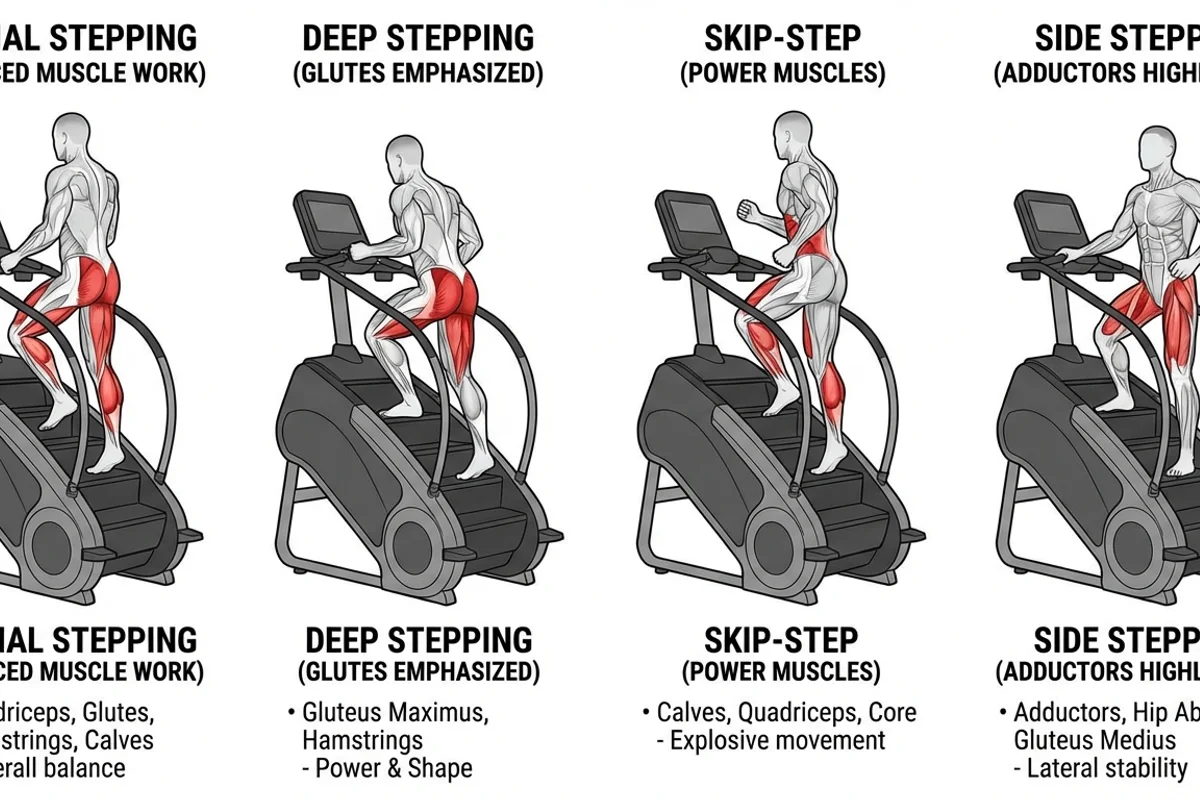
For Maximum Glute Activation
- Take deeper steps
- Drive through your heels
- Lean slightly forward from hips (not waist)
- Skip steps occasionally
- Avoid holding handrails
For More Quad Focus
- Take quicker, shorter steps
- Stay more upright
- Increase speed rather than depth
For Calf Development
- Push off through your toes
- Focus on full ankle extension
- Use a moderate pace
For Core Engagement
- Release handrails completely
- Maintain upright posture
- Add side-stepping variations
Common Form Mistakes That Reduce Muscle Activation
Leaning on Handrails
Problem: Reduces glute and core activation by 20-40% Fix: Use fingertip touch for balance only
Hunching Forward
Problem: Reduces glute engagement, strains lower back Fix: Stand tall, engage core, slight forward lean from hips only
Taking Tiny Steps
Problem: Reduces range of motion and muscle activation Fix: Take full, deliberate steps
Locking Knees
Problem: Reduces quad engagement, increases joint stress Fix: Keep slight knee bend throughout
Workout Tips for Muscle Building
Tempo Variations
- Slow and controlled: 2 seconds up, 2 seconds down for maximum muscle tension
- Quick bursts: Faster stepping for cardiovascular focus with moderate muscle work
Level Selection
- Levels 4-6: Endurance focus, moderate muscle activation
- Levels 7-9: Balanced strength and cardio
- Levels 10+: Maximum muscle engagement, strength focus
Workout Duration
- 15-20 minutes: Maintain intensity for muscle building
- 30+ minutes: More endurance-focused, less muscle building
Calculate Your Workout
Use our StairMaster Calories Burned Calculator to plan your workouts based on duration and intensity.