
Treadmill Running Form and Technique Guide
Optimize your treadmill running form for injury prevention and efficiency. Learn proper body position, foot strike, arm swing, breathing, and incline adjustments.

Running on a treadmill isn't quite the same as running outdoors. The belt moves beneath you, which changes the biomechanics slightly. Understanding proper treadmill form helps you run more efficiently, burn more calories, and avoid injury.
Why Form Matters on Treadmills
Good running form on a treadmill:
- Prevents injury: Poor form leads to shin splints, knee pain, and hip issues
- Increases efficiency: You'll run faster with less effort
- Burns more calories: Efficient movement uses more muscles
- Reduces fatigue: Good posture delays exhaustion
- Transfers to outdoor running: Skills you learn apply everywhere
The treadmill's consistent surface makes it an ideal place to work on form.
Optimal Body Position
Head and Eyes
- Look forward, not down at your feet or the console
- Keep your chin parallel to the ground
- Relax your jaw and facial muscles
- Focus on a spot at eye level ahead of you
Why it matters: Looking down throws off your balance and causes neck strain. The belt will keep moving; you don't need to watch it.
Shoulders
- Keep shoulders relaxed and down (not hunched up to your ears)
- Maintain a slight backward pull in your shoulder blades
- Avoid letting shoulders round forward
Why it matters: Hunched shoulders restrict breathing and cause upper back fatigue.
Core Engagement
- Keep your core gently engaged (like bracing for a light punch)
- Maintain a slight forward lean from the ankles (not the waist)
- Don't arch your lower back excessively
Why it matters: A strong core stabilizes your entire kinetic chain and protects your lower back.
Hips
- Keep hips level and stable
- Avoid excessive side-to-side movement
- Maintain a slight forward tilt of the pelvis (neutral spine)
Why it matters: Hip stability affects everything below, including knee and ankle alignment.
Foot Strike and Cadence
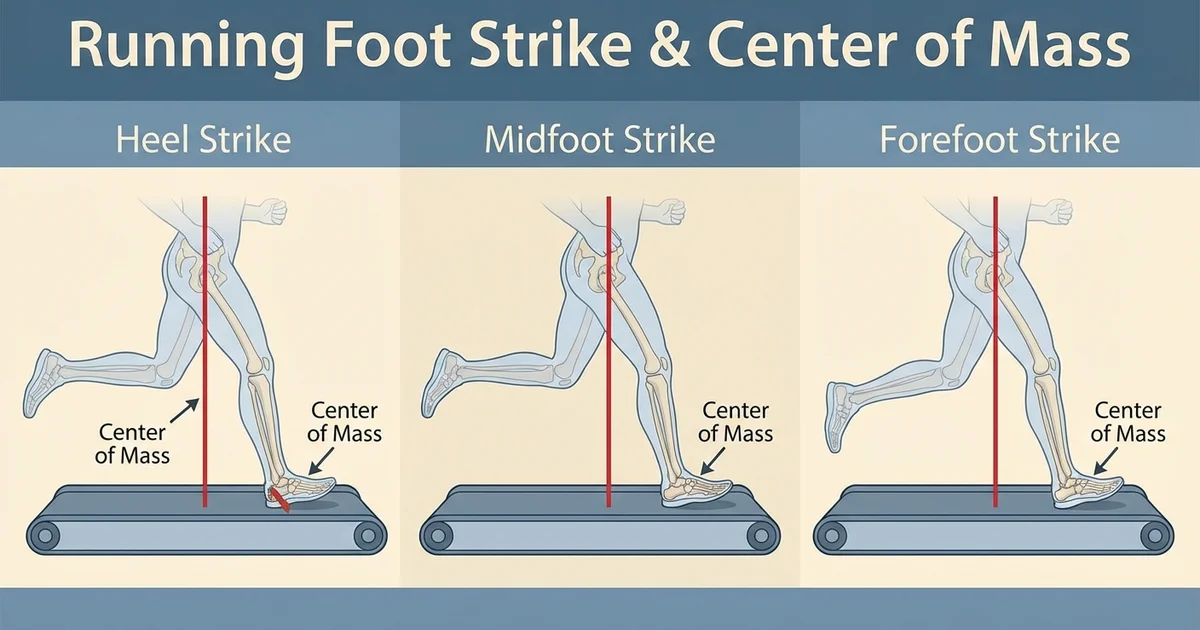
Landing Position
Your foot should land under your center of mass, not in front of it. On a treadmill, this feels slightly different than outdoors because the belt is moving beneath you.
Key cue: Land with your foot striking the belt directly under your hip, not reaching forward.
Foot Strike Types
| Type | Description | Best For |
|---|---|---|
| Heel strike | Heel touches first, rolls to toe | Walking, slower jogging |
| Midfoot strike | Middle of foot lands first | Moderate to fast running |
| Forefoot strike | Ball of foot lands first | Fast running, sprinting |
Most recreational runners naturally heel strike at slower speeds and transition to midfoot as speed increases. This is normal and safe.
Overstriding
Overstriding is when your foot lands too far in front of your body. This:
- Creates a braking force with each step
- Increases impact on knees and hips
- Wastes energy
Fix: Increase your cadence (steps per minute) to encourage shorter, quicker steps.
Optimal Cadence
- Walking: 100-120 steps per minute
- Jogging: 150-170 steps per minute
- Running: 170-180 steps per minute
- Elite runners: 180-190+ steps per minute
To check your cadence, count your steps for 30 seconds and multiply by 2. Many treadmills and fitness watches track cadence automatically.
Arm Swing Mechanics
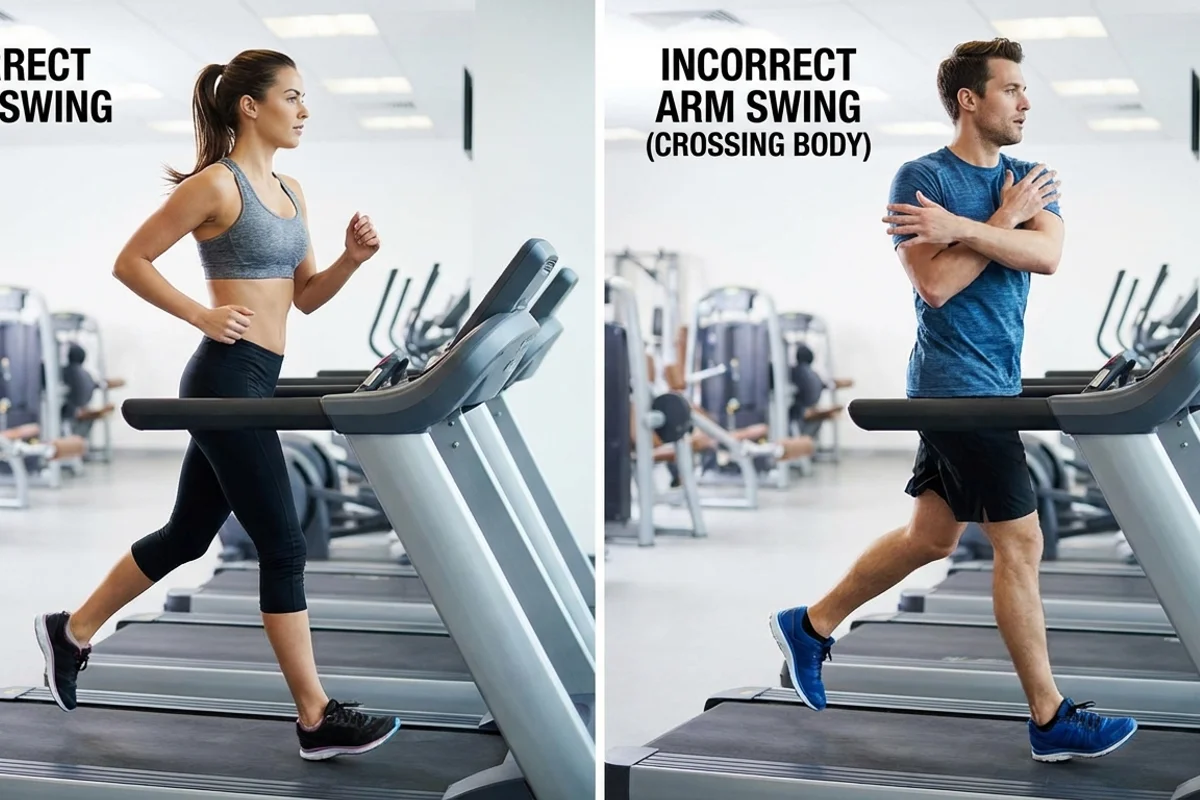
Proper Arm Position
- Elbows bent at approximately 90 degrees
- Arms swing forward and back, not across your body
- Hands relaxed (imagine holding a potato chip without breaking it)
- Wrists neutral, not bent up or down
Common Arm Mistakes
| Mistake | Problem | Fix |
|---|---|---|
| Crossing arms across body | Wastes energy, causes rotation | Keep arms parallel to direction of travel |
| Clenched fists | Creates tension in arms and shoulders | Relax hands, loose fist |
| Arms too high | Shoulder fatigue | Keep hands around hip to chest level |
| No arm swing | Reduces momentum and balance | Let arms move naturally |
Arm Swing and Speed
- Walking: Minimal arm swing, arms may hang naturally
- Jogging: Moderate arm swing, elbows at 90 degrees
- Running: Active arm swing, driving forward and back
- Sprinting: Powerful arm drive, hands moving from hip to chin level
Breathing Technique
Rhythmic Breathing
Match your breathing to your steps for consistency:
| Intensity | Pattern | Example |
|---|---|---|
| Easy | 3:3 or 4:4 | Inhale 3 steps, exhale 3 steps |
| Moderate | 2:2 | Inhale 2 steps, exhale 2 steps |
| Hard | 2:1 or 1:1 | Inhale 2, exhale 1; or breath every step |
Nose vs Mouth Breathing
- Easy pace: Breathe through your nose
- Moderate pace: Breathe through nose and mouth
- Hard pace: Breathe through your mouth
If you can't breathe through your nose, you might be going too fast for your current fitness level.
Belly Breathing
Breathe from your diaphragm (belly), not just your chest:
- Inhale: Your belly expands
- Exhale: Your belly contracts
- Your chest should move minimally
This provides more oxygen and reduces side stitches.
Form Adjustments for Incline
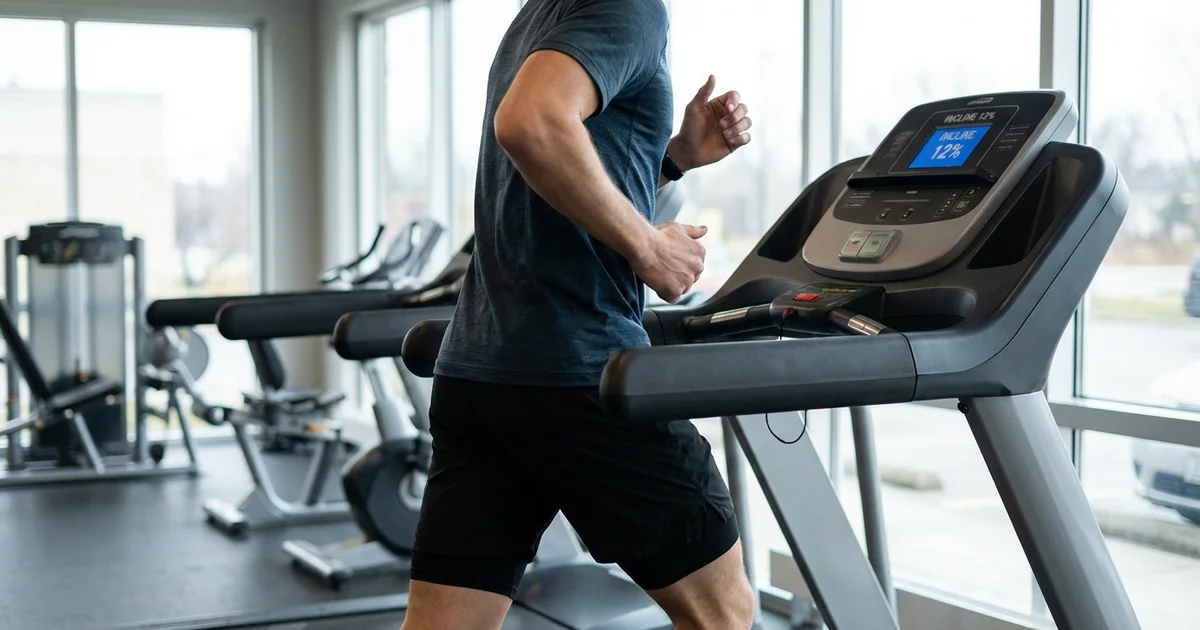
Running uphill on a treadmill requires form adjustments:
Incline Running Technique
- Shorten your stride: Take smaller, quicker steps
- Increase forward lean: Lean from ankles, not waist
- Engage glutes more: Drive hips forward
- Pump arms actively: Use arms to maintain momentum
- Land on midfoot or forefoot: Heel striking is harder on inclines
Incline by Grade
| Incline | Adjustments |
|---|---|
| 1-3% | Minimal changes, slightly shorter stride |
| 4-6% | Notable lean, shorter stride, increased arm swing |
| 7-10% | Significant lean, much shorter stride, very active arms |
| 10%+ | Power hiking may be more effective than running |
Form Drills to Practice
Drill 1: High Knees (Cadence Work)
- Set speed to 3.0-4.0 mph
- Lift knees higher than normal for 30 seconds
- Focus on quick, light steps
- Return to normal running for 60 seconds
- Repeat 4-6 times
Drill 2: Butt Kicks (Hamstring Activation)
- Set speed to 3.0-4.0 mph
- Kick heels toward glutes for 30 seconds
- Keep upper body stable
- Return to normal for 60 seconds
- Repeat 4-6 times
Drill 3: Arm Swing Focus
- Set speed to your normal pace
- Close your eyes briefly (use safety clip!)
- Focus only on arm movement for 30 seconds
- Feel how arm swing affects balance and pace
Drill 4: Cadence Ladder
- Start at your normal cadence
- Increase by 5 steps per minute every 30 seconds
- Notice how stride length changes
- Return to comfortable cadence
How Form Affects Calorie Burn
Better form = more efficient muscle use = more calories burned:
- Good posture engages more core muscles
- Active arm swing burns more upper body calories
- Proper foot strike uses leg muscles efficiently
- Not holding handrails burns 20-25% more calories
Track your improvement with our Treadmill Calorie Calculator.
Common Form Issues by Symptom
| Symptom | Likely Cause | Form Fix |
|---|---|---|
| Shin splints | Overstriding, heel striking hard | Shorten stride, increase cadence |
| Knee pain | Overstriding, poor hip stability | Land under hips, strengthen glutes |
| Lower back pain | Excessive arch, weak core | Engage core, neutral pelvis |
| Shoulder tension | Hunched shoulders, clenched fists | Relax shoulders, loosen hands |
| Side stitch | Erratic breathing, weak core | Rhythmic breathing, core work |
Form Video Self-Assessment
Record yourself on the treadmill from the side and front:
From the side, check:
- Head is up, eyes forward
- Slight forward lean from ankles
- Foot lands under hip, not in front
- Arms swing forward and back
From the front, check:
- Shoulders are level and relaxed
- Arms don't cross the body
- Hips stay level, minimal side-to-side
- Feet land hip-width apart