
How to Play Basketball: Complete Beginner's Guide
Learn basketball basics: rules, positions, essential skills, and your first game checklist. Everything you need to start playing basketball.
Basketball is one of the most accessible team sports in the world. All you need is a ball, a hoop, and the willingness to learn. This guide covers everything you need to know to start playing.
Basic Rules of Basketball
The Objective
Score more points than the opposing team by shooting the ball through their hoop while preventing them from scoring on yours.
Scoring
| Shot Type | Points | Description |
|---|---|---|
| Field goal (inside arc) | 2 points | Any shot from inside the three-point line |
| Three-pointer | 3 points | Shot from beyond the three-point line |
| Free throw | 1 point | Awarded after certain fouls |
Game Structure
- Professional (NBA): 4 quarters × 12 minutes = 48 minutes
- College: 2 halves × 20 minutes = 40 minutes
- High school: 4 quarters × 8 minutes = 32 minutes
- Pickup games: Usually play to 11, 15, or 21 points
Basic Violations
Traveling: Moving without dribbling the ball Double dribble: Dribbling with both hands or dribbling, stopping, then dribbling again Out of bounds: Ball or player with ball touches the boundary line Shot clock: Must attempt a shot within 24 seconds (NBA) or 30 seconds (college)
Fouls
- Personal foul: Illegal physical contact
- 5 fouls (college) or 6 fouls (NBA): Player fouls out
- Team fouls: After a certain number, opposing team shoots free throws
The Five Positions
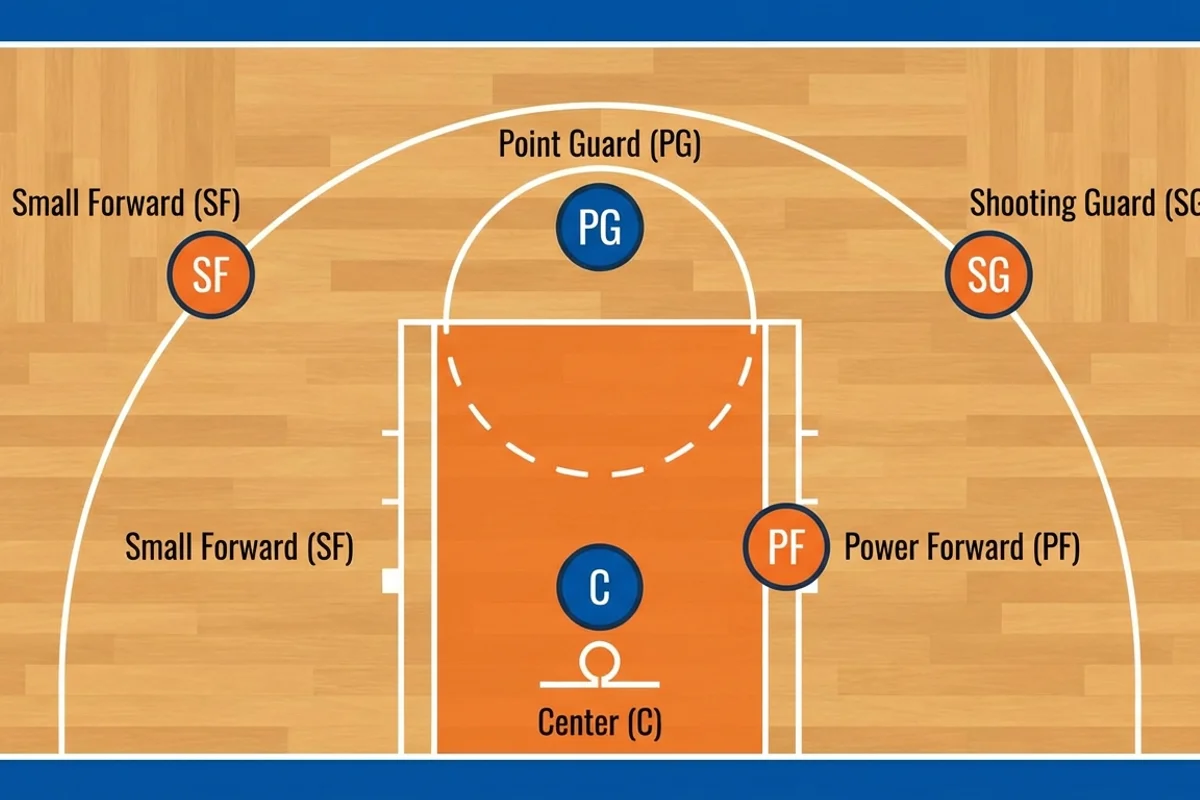
1. Point Guard (PG)
Role: Floor general, primary ball handler Key skills: Dribbling, passing, court vision Location: Usually brings ball up the court Think of them as: The quarterback of basketball
2. Shooting Guard (SG)
Role: Primary perimeter scorer Key skills: Shooting, scoring off screens Location: Wings and corners Think of them as: The sniper
3. Small Forward (SF)
Role: Versatile scorer and defender Key skills: All-around game, driving, defense Location: Wings, can play inside and outside Think of them as: The Swiss Army knife
4. Power Forward (PF)
Role: Physical presence, rebounding, mid-range Key skills: Rebounding, post play, screening Location: High post, paint area Think of them as: The enforcer
5. Center (C)
Role: Rim protector, inside scoring Key skills: Rebounding, shot blocking, post moves Location: Low post, near the basket Think of them as: The anchor
For beginners: Don't worry too much about positions in pickup games. Focus on moving without the ball, playing defense, and taking open shots.
Essential Skills to Learn
1. Dribbling
Basic dribbling tips:
- Keep your head up (don't watch the ball)
- Use fingertips, not your palm
- Keep the ball at waist height or lower
- Protect the ball with your body
Drills to practice:
- Stationary dribbling (each hand)
- Walking while dribbling
- Figure-8 between legs
- Crossover dribbling
2. Shooting
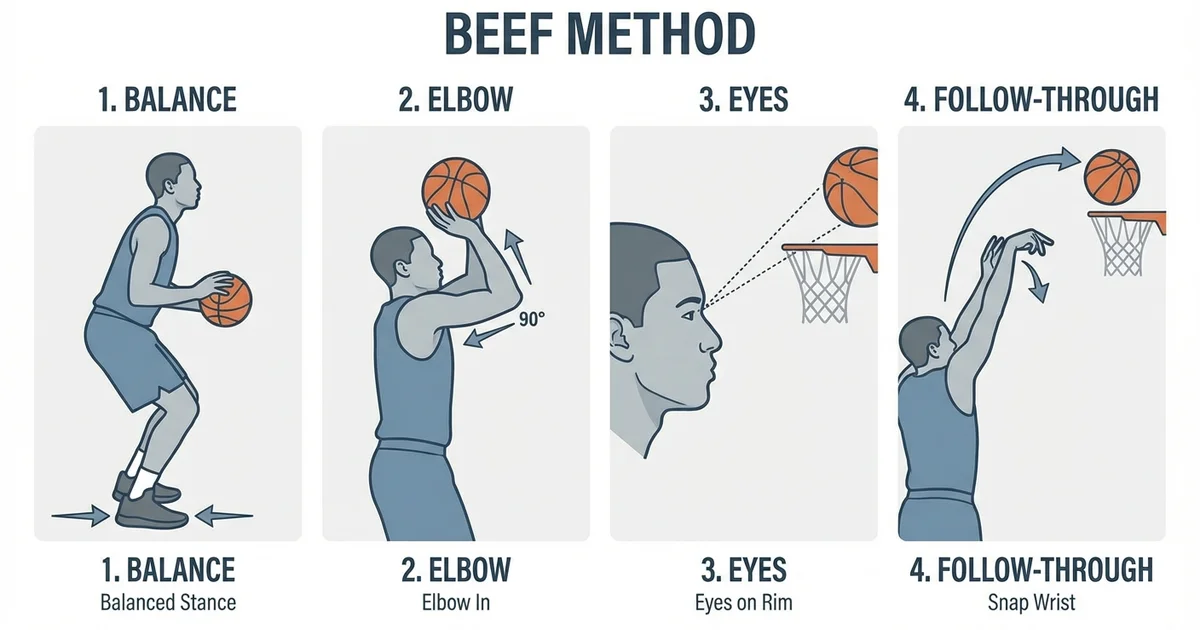
BEEF Method for shooting form:
- Balance: Square feet to the basket, shoulder-width apart
- Elbow: Keep shooting elbow under the ball, aligned with basket
- Eyes: Focus on the rim (front or back)
- Follow through: Snap wrist, finish with "gooseneck"
Practice progression:
- Start close (3-5 feet from basket)
- Master form before adding distance
- Practice from different spots
- Add movement (catch and shoot)
3. Passing
Basic pass types:
| Pass | When to Use | Technique |
|---|---|---|
| Chest pass | Open teammate, medium range | Push from chest, thumbs out |
| Bounce pass | Defender between you | Bounce 2/3 of the way |
| Overhead pass | Over defender, outlet | Two hands above head |
Passing principles:
- Pass to where your teammate will be
- Make eye contact or use fakes
- Pass away from the defender
- Don't telegraph your passes
4. Defense
Defensive stance:
- Feet wider than shoulder-width
- Knees bent, low center of gravity
- Arms active, one up, one out
- Stay on balls of feet
Defensive rules:
- Stay between your player and the basket
- See both ball and your man
- Communicate with teammates
- Contest every shot without fouling
Your First Game Checklist
What to Wear
| Item | Recommendation |
|---|---|
| Shoes | Basketball or cross-training shoes with ankle support |
| Shorts | Athletic shorts (not too long) |
| Shirt | T-shirt or jersey (moisture-wicking preferred) |
| Socks | Athletic socks, crew or mid-height |
What to Bring
- Water bottle
- Towel
- Change of clothes (optional)
- Positive attitude
Gym Etiquette
- Call "next" — Say you have next game when one finishes
- Pick teams fairly — Usually done by shooting or captains picking
- Call your own fouls — But don't call everything
- Rotate if winning — Winners often stay on in pickup
- Play your role — Don't try to do everything
Common Beginner Mistakes
| Mistake | Why It Happens | How to Fix |
|---|---|---|
| Looking at ball while dribbling | Lack of confidence | Practice stationary dribbling daily |
| Standing still on offense | Don't know where to go | Cut to the basket, set screens, move |
| Reaching on defense | Trying to steal too much | Focus on positioning, not steals |
| Shooting too quickly | Excitement, lack of confidence | Take a breath, use proper form |
| Not communicating | Shy or unfamiliar | Call out screens, call for ball |
| Holding ball too long | Unsure what to do | Make a quick decision: shoot, pass, drive |
Basketball Fitness Requirements
Basketball requires multiple fitness components:
Cardiovascular Endurance
- Games involve 4-6 km of running
- Mix of jogging and sprinting
- Build endurance with running or cycling
Explosive Power
- Jumping for rebounds and shots
- Quick sprints and changes of direction
- Develop with jump squats, box jumps
Agility
- Lateral movement on defense
- Quick cuts on offense
- Practice ladder drills, defensive slides
Core Strength
- Balance during contact
- Shooting stability
- Build with planks, Russian twists
Track your basketball calories: Use our Basketball Calorie Calculator to see how many calories you burn.
Finding Places to Play
Gym Courts
- Local YMCA, community centers
- University recreation centers
- Commercial gyms (LA Fitness, etc.)
- Usually have regular pickup games
Outdoor Courts
- Public parks
- School playgrounds (after hours)
- Community basketball courts
- Check local parks department
Organized Leagues
- Adult recreational leagues
- Church leagues
- City recreation leagues
- Work or corporate leagues
Tips for Finding Games
- Ask gym staff when pickup games happen
- Show up consistently at the same time
- Be friendly and introduce yourself
- Start with less competitive runs to build confidence
Beginner's 4-Week Progression
Week 1: Foundation
| Day | Activity | Duration |
|---|---|---|
| 1 | Dribbling drills (each hand) | 20 min |
| 2 | Rest | - |
| 3 | Form shooting (close to basket) | 20 min |
| 4 | Rest | - |
| 5 | Dribbling + shooting combined | 30 min |
Week 2: Building
| Day | Activity | Duration |
|---|---|---|
| 1 | Dribbling drills + layups | 30 min |
| 2 | Rest | - |
| 3 | Shooting (extend range) | 30 min |
| 4 | Rest | - |
| 5 | Game situations (1v1 if possible) | 45 min |
Week 3: Applying
| Day | Activity | Duration |
|---|---|---|
| 1 | Skills practice | 30 min |
| 2 | Light pickup game or 3v3 | 45 min |
| 3 | Rest | - |
| 4 | Shooting practice | 30 min |
| 5 | Pickup game | 60 min |
Week 4: Playing
| Day | Activity | Duration |
|---|---|---|
| 1 | Skills warmup + game | 60 min |
| 2 | Rest | - |
| 3 | Pickup game | 60 min |
| 4 | Rest | - |
| 5 | Pickup game | 60 min |
Equipment Guide
Basketball Shoes (Essential)
Key features:
- Ankle support (especially for beginners)
- Good traction for quick stops
- Cushioning for jumping impact
- Proper fit (snug but not tight)
Budget options: $60-100 Mid-range: $100-150 Premium: $150+
Basketball (Optional for Gyms)
| Size | Who Uses It |
|---|---|
| Size 7 (29.5") | Men's official, ages 13+ |
| Size 6 (28.5") | Women's official, boys 12-14 |
| Size 5 (27.5") | Youth ages 9-11 |
Optional Gear
- Knee sleeves (joint support)
- Compression shorts (comfort)
- Sweatbands (wrist/head)
- Mouthguard (competitive play)
Next Steps
Once you're comfortable with the basics:
- Work on weaknesses — Identify and improve your weakest skills
- Watch basketball — Learn from professionals
- Join a league — Structured competition accelerates learning
- Find better competition — Playing with better players improves your game
- Get coaching — Consider lessons or clinics
Related Guides
- How Many Calories Does Basketball Burn? — Track your workout
- Basketball Fitness Benefits & Conditioning — Health benefits
- Basketball for Weight Loss — Using basketball to lose weight
- Basketball Calorie Calculator — Calculate your burn