
Basketball for Weight Loss: Complete Guide to Losing Weight Playing Basketball
Can basketball help you lose weight? Yes! Learn how to use basketball for fat loss with weekly schedules, calorie targets, and nutrition tips.
Playing basketball 3 times per week can burn 1,500-2,000 calories—enough to lose 0.5 kg of fat every 2-3 weeks from exercise alone. Combined with a moderate calorie deficit from diet, basketball becomes a powerful weight loss tool.
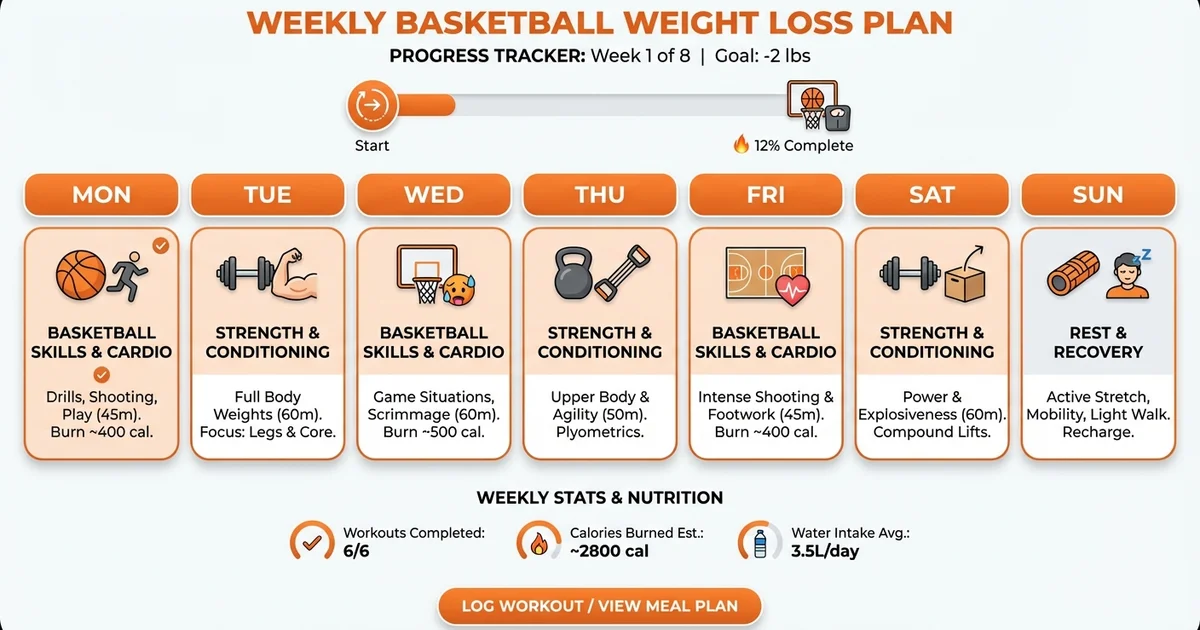
Can Basketball Help You Lose Weight?
Yes, absolutely. Here's why basketball is effective for weight loss:
| Factor | How It Helps |
|---|---|
| High calorie burn | 400-700 calories per hour |
| HIIT-like intervals | Burns fat efficiently |
| Full-body workout | Builds calorie-burning muscle |
| Enjoyment factor | Higher adherence than gym workouts |
| Social accountability | Regular games with others |
| Varied intensity | Prevents metabolic adaptation |
Weekly Calorie Burn Potential
By Frequency (70 kg person, 60-minute sessions)
| Sessions/Week | Game Type | Weekly Burn | Monthly Burn |
|---|---|---|---|
| 2 | Competitive | 1,120 kcal | 4,480 kcal |
| 2 | Pickup | 1,050 kcal | 4,200 kcal |
| 3 | Competitive | 1,680 kcal | 6,720 kcal |
| 3 | Pickup | 1,575 kcal | 6,300 kcal |
| 4 | Mix | 2,100 kcal | 8,400 kcal |
| 5 | Mix | 2,625 kcal | 10,500 kcal |
Weight Loss Context
To lose 1 kg of body fat, you need a deficit of approximately 7,700 calories.
| Weekly Basketball Burn | Monthly Fat Loss (exercise only) |
|---|---|
| 1,000 kcal | ~0.5 kg |
| 1,500 kcal | ~0.8 kg |
| 2,000 kcal | ~1.0 kg |
| 2,500 kcal | ~1.3 kg |
Calculate your personal burn with our Basketball Calorie Calculator.
Basketball vs Gym for Weight Loss
| Factor | Basketball | Traditional Gym |
|---|---|---|
| Calories per hour | 500-700 | 300-500 (varies) |
| Enjoyment | High (for most) | Variable |
| Consistency | Easier (scheduled games) | Requires discipline |
| Social element | Built-in | Limited |
| Skill development | Yes | Limited to sport |
| Time efficiency | Good | Can be better |
| Cost | Often free | Membership required |
When Basketball is Better
- You struggle with gym motivation
- You enjoy team sports
- You have access to courts and players
- You want social exercise
When Gym is Better
- Specific muscle group targeting needed
- Weather/court availability issues
- Prefer solo workouts
- Need more controlled intensity
Best approach: Combine both—basketball for cardio/enjoyment, gym for supplemental strength training.
Optimal Basketball Schedule for Fat Loss
Beginner Schedule (Weeks 1-4)
| Day | Activity | Duration | Est. Calories |
|---|---|---|---|
| Monday | Skills practice | 30 min | 200 |
| Tuesday | Rest | - | - |
| Wednesday | Pickup game | 45 min | 390 |
| Thursday | Rest | - | - |
| Friday | Rest | - | - |
| Saturday | Pickup game | 60 min | 520 |
| Sunday | Rest | - | - |
Weekly burn: ~1,100 calories
Intermediate Schedule (Weeks 5-8)
| Day | Activity | Duration | Est. Calories |
|---|---|---|---|
| Monday | Conditioning + drills | 45 min | 340 |
| Tuesday | Pickup games | 60 min | 520 |
| Wednesday | Rest or light activity | - | - |
| Thursday | Skills practice | 30 min | 200 |
| Friday | Pickup games | 75 min | 650 |
| Saturday | Rest | - | - |
| Sunday | Pickup games | 60 min | 520 |
Weekly burn: ~2,230 calories
Advanced Schedule (Weeks 9+)
| Day | Activity | Duration | Est. Calories |
|---|---|---|---|
| Monday | Conditioning | 45 min | 380 |
| Tuesday | Competitive game | 90 min | 840 |
| Wednesday | Strength training | 45 min | 250 |
| Thursday | Skills + shooting | 45 min | 280 |
| Friday | Competitive game | 90 min | 840 |
| Saturday | Rest | - | - |
| Sunday | Pickup games | 75 min | 650 |
Weekly burn: ~3,240 calories
Combining Basketball with Nutrition
Calorie Deficit Strategy
For sustainable weight loss, aim for a total weekly deficit of 3,500-7,000 calories:
| Source | Weekly Deficit |
|---|---|
| Basketball (3x/week) | 1,500 kcal |
| Diet (250 kcal/day) | 1,750 kcal |
| Total | 3,250 kcal |
| Estimated fat loss | ~0.4 kg/week |
Pre-Game Nutrition
2-3 hours before:
- Complex carbohydrates (oatmeal, rice, pasta)
- Moderate protein
- Low fat
- Example: Chicken with rice and vegetables
30-60 minutes before:
- Light snack if needed
- Easily digestible
- Example: Banana, energy bar
Post-Game Nutrition
Within 30 minutes:
- Protein for muscle recovery (20-30g)
- Carbohydrates to replenish glycogen
- Example: Protein shake with fruit
Main meal (1-2 hours after):
- Balanced plate
- Lean protein, complex carbs, vegetables
- Example: Grilled fish, sweet potato, salad
Hydration
| When | Amount |
|---|---|
| Before game | 500 ml (2 hours prior) |
| During game | 150-250 ml every 15-20 min |
| After game | 500-750 ml per hour of play |
Maximize Fat Burning During Basketball
Play Strategies
-
Stay active off-ball
- Don't stand and watch
- Cut, screen, move constantly
- Increases calorie burn 20-30%
-
Play defense aggressively
- More movement than offense
- Higher heart rate
- Contest every shot
-
Push the pace
- Call for fast breaks
- Sprint in transition
- Maximize running time
-
Minimize rest
- Quick substitutions
- Stay engaged during breaks
- Active recovery, not sitting
Training Additions
| Activity | When | Why |
|---|---|---|
| Conditioning | Before games | Increases capacity |
| Strength training | Non-game days | Builds muscle, boosts metabolism |
| Extra shooting | After games | Additional calorie burn |
| Mobility work | Daily | Prevents injury, enables more play |
Realistic Weight Loss Timeline
Conservative Estimate (Moderate Effort)
- Basketball: 2-3 sessions/week
- Diet: Small deficit (300 kcal/day)
- Expected loss: 0.3-0.5 kg/week
- 10 kg goal: 20-33 weeks
Aggressive Estimate (High Effort)
- Basketball: 4-5 sessions/week
- Diet: Moderate deficit (500 kcal/day)
- Expected loss: 0.5-0.8 kg/week
- 10 kg goal: 13-20 weeks
What Affects Your Results
| Factor | Impact |
|---|---|
| Starting weight | Higher = faster initial loss |
| Consistency | Most important factor |
| Intensity level | Higher effort = more burn |
| Diet adherence | Can't out-exercise bad diet |
| Sleep quality | Poor sleep hurts fat loss |
| Stress levels | High stress = harder loss |
Common Mistakes That Limit Results
1. Overestimating Calorie Burn
Mistake: Thinking you burned 1,000 calories Reality: Probably 500-600 calories Fix: Use accurate calculations, don't overcompensate with food
2. Rewarding with Food
Mistake: "I played basketball, I can eat whatever" Reality: One meal can exceed entire game's calorie burn Fix: Stick to your nutrition plan regardless of exercise
3. Inconsistent Schedule
Mistake: Playing only when convenient Reality: Sporadic exercise = sporadic results Fix: Schedule games like appointments
4. Not Playing Hard Enough
Mistake: Coasting through games Reality: Low intensity = low calorie burn Fix: Push yourself, play defense, stay active
5. Skipping Recovery
Mistake: Playing every day, no rest Reality: Overtraining leads to injury and burnout Fix: 1-2 rest days per week minimum
6. Ignoring Nutrition
Mistake: Relying only on exercise Reality: Diet is 70-80% of weight loss Fix: Track food intake, create moderate deficit
Tracking Your Progress
Metrics to Monitor
| Metric | Frequency | Why |
|---|---|---|
| Body weight | Weekly (same time) | Overall progress |
| Waist circumference | Bi-weekly | Fat loss indicator |
| Game performance | Each session | Fitness improvement |
| Energy levels | Daily | Recovery status |
| Photos | Monthly | Visual progress |
Using the Calculator
Track your calorie burn consistently:
Basketball Calorie Calculator →
Success Factors
What Successful Basketball Weight Loss Looks Like
- Consistent play schedule — 3+ times per week
- Moderate calorie deficit — Not extreme
- Patient approach — Focus on weekly trends
- Social support — Regular playing partners
- Enjoyment — Actually liking basketball
- Strength training — 1-2 sessions per week
- Adequate sleep — 7-9 hours per night
- Hydration — Throughout the day
Sample 12-Week Plan
Phase 1: Foundation (Weeks 1-4)
- 2 basketball sessions per week
- 300 calorie daily deficit
- Focus on building consistency
- Expected loss: 2-3 kg
Phase 2: Building (Weeks 5-8)
- 3 basketball sessions per week
- Add 1 strength session
- Maintain 300-400 calorie deficit
- Expected loss: 2-3 kg
Phase 3: Acceleration (Weeks 9-12)
- 3-4 basketball sessions per week
- 2 strength sessions
- 400-500 calorie deficit
- Expected loss: 2-4 kg
12-Week Total: 6-10 kg
Related Guides
- How Many Calories Does Basketball Burn? — Complete calorie guide
- Basketball Calorie Burn Chart — Quick reference
- Basketball Fitness Benefits — All the health benefits
- How to Play Basketball: Beginner's Guide — Getting started
- Basketball Calorie Calculator — Calculate your burn