
How to Calculate Running Pace for Any Race or Training Run
Learn how to calculate running pace with our guide. Master manual formulas, use pace calculators, and apply your pace data to improve your running.
To calculate your running pace, you simply divide your total run time by the distance you covered. For example, if you run 5 kilometers in 25 minutes, your pace is 5 minutes per kilometer (25 minutes / 5 km). This fundamental calculation is the key to tracking your fitness, setting realistic race goals, and structuring your training effectively.
Run 5 kilometers in 25 minutes? That's a 5-minute per kilometer pace, plain and simple. This single number is the bedrock of smart training, helping you track your progress and set goals you can actually hit.
Want to skip the math? Use our free Running Pace Calculator to instantly calculate your pace, predict race times, and plan your splits.
Why Understanding Your Pace Is a Game Changer
Knowing your pace is what separates aimless jogging from purposeful training. It’s the metric that tells you how hard you’re working and gives you a clear benchmark to see how your fitness is improving over time.
While many people use "pace" and "speed" as if they're the same thing, they’re actually two sides of the same coin.
- Pace is time per distance (like minutes per mile). This is what runners live by for setting race targets.
- Speed is distance per time (like miles per hour). This is what you see on a treadmill display.
Getting comfortable with both helps you translate your effort seamlessly between the road and the gym.
The Foundation for Training and Race Predictions
For millions of runners, pace isn't just a number—it's a powerful predictive tool. You can take a recent race result, plug it into an established calculator, and get surprisingly accurate predictions for other distances.
This all stems from that same basic formula: time divided by distance. For example, the popular McMillan pace calculator, trusted by over 20 million runners, uses this principle combined with physiological models to turn one race result into a complete set of training paces for everything from easy runs to all-out intervals.
Pace is the language of running. It lets you communicate your effort, set realistic goals, and stick to a race plan with confidence. If you want to improve, you have to learn to speak it fluently.
When you get a handle on your pace, you unlock the ability to train smarter, not just harder. It allows you to:
- See your progress in black and white as your pace gets faster.
- Set achievable race goals based on what your body can actually do right now.
- Structure every workout with specific targets for easy runs, tempo efforts, and interval sessions.
This is foundational stuff. For a deeper look into what it all means, check out our complete guide on what running pace truly means.
Calculating Your Pace Manually (No GPS Watch Needed)
GPS watches and running apps are incredible training partners, but every seasoned runner knows you can't always rely on them. Batteries die, signals drop, and sometimes, it's just empowering to understand the raw numbers behind your effort.
Knowing how to calculate your running pace manually is a fundamental skill. It helps you gut-check your tech and gives you true ownership over your performance. The process boils down to a simple formula: Total Time ÷ Total Distance = Pace.
The only tricky part isn't the division itself; it's getting your time ready for a calculator. You can't just punch in 27 minutes and 45 seconds and divide by 5 kilometers. First, we need to convert your time into a single unit, like minutes.
The First Step: Time Conversion
This might sound complicated, but it's really just one quick division. To get your time into a decimal format that a calculator can work with, you just need to turn the seconds into a fraction of a minute.
Simply take the seconds from your finish time and divide by 60.
Let's walk through a real-world example. Say you just crushed a 5K and your official time is 27 minutes and 45 seconds.
- First, convert the seconds: 45 seconds ÷ 60 = 0.75
- Then, add this decimal back to your minutes: 27 + 0.75 = 27.75 minutes
And that's it. You now have a single number—27.75—that you can easily use to figure out your pace.
Calculating Your Pace Per Kilometer
With your total time in decimal form, finding your pace is just one division away.
Let's stick with our 5K example:
- Your Time: 27.75 minutes
- Your Distance: 5 kilometers
The math is straightforward: 27.75 minutes ÷ 5 km = 5.55 minutes per kilometer.
This gives us the answer, but nobody ever says their pace is "five point five-five minutes per kilometer." So, our last step is to convert that decimal back into the familiar minutes-and-seconds format.
Being able to do this quick math in your head is a game-changer. It means you're not just a passenger relying on a device; you're the pilot who truly understands the mechanics of your own performance.
Converting Back to Minutes and Seconds
To finish the job, we take the decimal part of our pace and multiply it by 60 to turn it back into seconds.
Using our result of 5.55 minutes per kilometer:
- The whole number, 5, is your full minutes.
- The decimal part, 0.55, is what we need to convert.
- Here’s the calculation: 0.55 × 60 = 33 seconds.
Put it all together, and your final pace is 5 minutes and 33 seconds per kilometer, which you'll usually see written as 5:33/km. Now you know exactly how to figure out your pace for any run, armed with nothing more than your finish time and a basic calculator.
Converting Between Miles, Kilometers, And Speed
As a runner, you’re constantly juggling different units. Your watch might track pace in minutes per kilometer, your treadmill shows speed in miles per hour, and your next race could be a 10-miler. Getting comfortable with these conversions is a huge advantage.
There's one magic number you need to remember: one mile is roughly 1.609 kilometers. That's it. This single number is the key that unlocks all the other conversions, letting you translate your effort no matter how it's measured.
Basically, to go from a kilometer pace to a mile pace, you multiply by 1.609. To go from a mile pace back to a kilometer pace, you just divide by 1.609. Simple as that.
From Kilometers to Miles
Let's walk through a real-world example. Say you just ran a 5K and your watch shows a steady pace of 5:00 minutes per kilometer. What does that translate to in minutes per mile?
- Just take your kilometer pace and multiply it by 1.609.
- 5.00 min/km × 1.609 = 8.045 minutes per mile.
To handle that decimal, you just need to turn it into seconds. Multiply the decimal part by 60 (0.045 × 60 ≈ 2.7 seconds). This gives you a final pace of about 8:03 per mile. Knowing this quick trick is a lifesaver when you're planning for a race that uses a different system than you're used to.
Turning Pace Into Speed
Another classic problem is translating your road pace to the treadmill. Treadmills don't work in pace; they work in speed (km/h or mph). Luckily, the math is just as easy: simply divide 60 by your pace in minutes.
So, if you want to hold an 8-minute per mile pace indoors:
- Speed (mph) = 60 ÷ 8 minutes
- Speed (mph) = 7.5 mph
To match your 8:00/mile effort, you’d just set the treadmill to 7.5 mph. It's crucial for keeping your training consistent when you have to run inside. For a full list of conversions, check out our treadmill speed to pace conversion chart to find your numbers in seconds.
This visual breaks down how time and distance come together to give you your final pace.
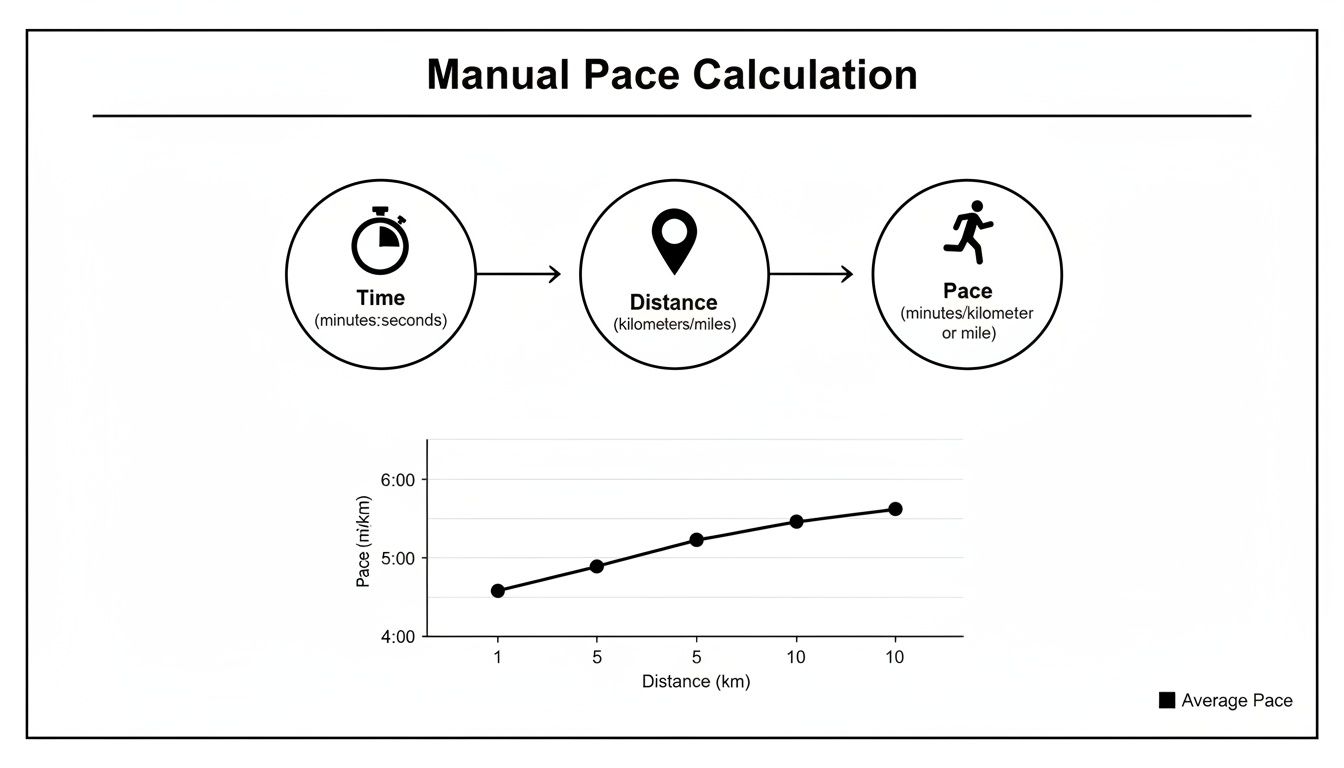
As you can see, the core formula always starts with your total time divided by the distance you covered.
Getting a feel for these conversions makes you a much more adaptable runner. You’ll be just as confident on a track measured in meters, a race measured in miles, or a treadmill that uses kilometers per hour.
Being able to switch between these units gives you the freedom to train effectively anywhere, anytime, without having to second-guess your effort.
To help you get familiar with some common benchmarks, here's a quick reference chart for converting between different paces and speeds.
Common Pace and Speed Conversion Chart
| Pace (min/km) | Pace (min/mile) | Speed (km/h) | Speed (mph) |
|---|---|---|---|
| 4:00 | 6:26 | 15.00 | 9.32 |
| 4:30 | 7:14 | 13.33 | 8.28 |
| 5:00 | 8:03 | 12.00 | 7.46 |
| 5:30 | 8:51 | 10.91 | 6.78 |
| 6:00 | 9:39 | 10.00 | 6.21 |
| 6:30 | 10:28 | 9.23 | 5.74 |
| 7:00 | 11:16 | 8.57 | 5.33 |
This table is great for getting a quick sense of how your efforts translate across the board, removing the guesswork and helping you keep every workout perfectly aligned with your goals.
Using Pace Calculators for Effortless Race Planning
While it's a great skill to be able to crunch the numbers yourself, sometimes you just need a fast, accurate answer without the headache. This is where online pace calculators come in—they are a runner's secret weapon for turning messy race planning into a simple, two-minute job.
Think of these tools as more than just a way to find your average pace. A good calculator can predict your finish time for a new distance, tell you the exact pace needed to hit that dream goal, and even map out a perfect split plan for your next big race. They take all the guesswork out of the equation, letting you focus on what really matters: the training.
Predicting Your Race Potential
One of the coolest things you can do with a pace calculator is predict your potential finish time for a new distance based on a recent race. This is huge for setting goals that are ambitious but still grounded in reality.
Let’s say you just ran a 10K in 50 minutes and you're thinking about tackling a half marathon. A common formula suggests you can get a solid prediction by multiplying your 10K time (in minutes) by 2.2.
- 50 minutes × 2.2 = 110 minutes, which is 1 hour and 50 minutes.
Suddenly, you have a data-driven target to build your training plan around. Your goal shifts from a hopeful guess to a calculated objective based on your actual fitness.
How a Pace Calculator Simplifies the Process
Using a dedicated tool like our Running Pace Calculator cuts out all the manual math. You just plug in what you know—like a recent race time and distance—and it instantly spits out a wealth of information.
Here’s a look at how you could use it to plan for a specific goal, like breaking two hours in the half marathon.
As the screenshot shows, hitting a 1:59:59 half marathon requires you to hold a steady pace of 5:41 per kilometer or 9:09 per mile. No calculator, no pen, no paper—just the numbers you need.
Think of a pace calculator not just as a tool for finding your pace, but as a strategic partner. It helps you understand what's required to hit your goals, turning abstract ambitions into a concrete, actionable race plan.
Planning Your Race-Day Splits
Beyond just the finish time, calculators are absolutely invaluable for mapping out how you'll execute your race. A solid split plan is the key to avoiding that classic runner’s mistake: starting out way too fast and hitting the wall before the finish line.
By entering your goal time and the race distance, the calculator can generate a detailed split chart. This tells you the exact time you should be hitting at each kilometer or mile marker. For that sub-2-hour half marathon goal, your plan might look something like this:
- 5K Split: 28 minutes, 27 seconds
- 10K Split: 56 minutes, 54 seconds
- 15K Split: 1 hour, 25 minutes, 21 seconds
Having these checkpoints helps you stay in control. You can make small adjustments on the fly, ensuring you're perfectly on track to crush your goal without blowing up. Honestly, this level of planning gives you a massive mental advantage when you're standing on the starting line.
Applying Your Pace Data to Smarter Training
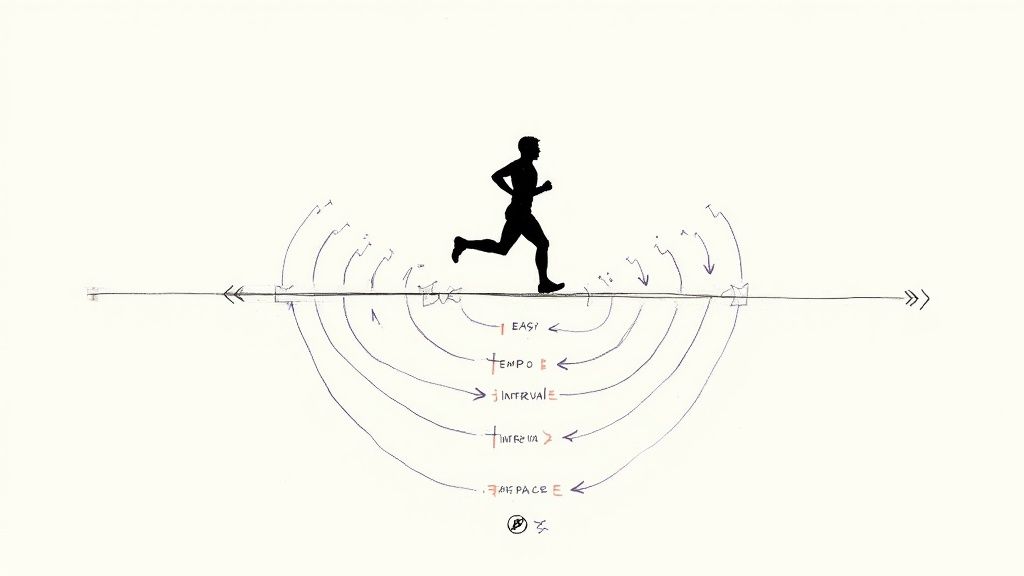 Figuring out your running pace is a great start, but the real magic happens when you use that information to give your workouts a clear purpose. Your current pace data is the key to setting up effective training zones for every kind of run you do—from slow recovery jogs to gut-busting tempo efforts. This is how you bridge the gap between just looking at numbers on your watch and actually building a smarter, more effective training plan.
Instead of falling into the trap of running at the same intensity every single day, you can assign a specific goal to each session. This is how you build a well-rounded fitness base, boost your endurance, and get faster without burning out. Suddenly, every run has a job to do.
Establishing Your Training Zones
A great way to define your personal training zones is to use a recent race result or perform a time trial. A time trial is just what it sounds like: an all-out effort over a set distance, like one mile or a 5K. From that single performance, you can calculate the right paces for all your other training runs.
- Easy Pace: This is your bread and butter—the pace for recovery days and long runs that make up most of your weekly mileage. It should feel comfortable enough to hold a conversation, typically 90-120 seconds slower per mile than your 5K race pace.
- Tempo Pace: Often described as "comfortably hard," this is a pace you could sustain for about an hour. It's a fantastic workout for building your lactate threshold and usually falls around 20-30 seconds slower per mile than your 5K pace.
- Interval Pace: This is for your speed work sessions. You'll run at or even faster than your 5K race pace, but for much shorter bursts. The goal here is to improve your V02 max and make your running form more efficient.
Using a maximal effort to figure out training targets is a cornerstone of running coaching that's been around for decades. Long before GPS watches, runners would use time trials to get a baseline, then figure out paces for longer distances using proven formulas. You can dive deeper into this method in our detailed guide on how to set training paces from race results.
Using Pace to Perfect Race Execution
Your pace data is also your most valuable tool on race day. It helps you avoid the single most common mistake runners make: starting out way too fast. By calculating your goal race pace beforehand, you can create a split plan—a set of target times for each mile or kilometer marker you'll pass.
A race plan without pace targets is just a wish. Knowing your splits turns your goal into an executable strategy, giving you the confidence and control to run your best race from start to finish.
Let's say your goal is a four-hour marathon. A quick calculation tells you that you need to average a 9:09 per mile pace. With that number, your split plan might look something like this:
- Mile 1: 9:09
- Mile 5: 45:45
- Halfway (13.1 miles): 2:00:00
Seeing these numbers pop up on your watch keeps you honest. It stops the start-line adrenaline from tricking you into running an 8:30 first mile that you'll pay for later. This strategic approach breaks a daunting distance down into a series of smaller, manageable goals, putting you in complete control and ensuring you have enough left in the tank for a strong finish.
Common Questions About Calculating Running Pace
Once you get the hang of the basic formulas, you start running into real-world questions. It's one thing to calculate pace on paper, but it's another to apply it to your actual training.
Let's dig into some of the most common questions runners have, from figuring out what a "good" pace even is to dealing with those frustrating moments when your watch and the official race clock don't agree.
What Is a Good Running Pace for a Beginner?
This is easily the question I hear the most, and the honest answer is: it’s completely personal. A "good" pace depends on your age, fitness level, and how long you've been running.
For most people just starting out, a comfortable pace usually lands somewhere between 6:30 to 8:30 per kilometer (that’s about 10:30 to 13:40 per mile). But don't get hung up on that number. The best way to find your perfect beginner pace is to use the "talk test." Can you hold a conversation without gasping for breath? If so, you're running at the right effort to build a solid aerobic base. Focus on consistency first, and the speed will come.
How Does Terrain Affect My Pace Calculation?
Hills and trails are going to slow you down. That's a guarantee. Your basic Time ÷ Distance formula is great for the track or a flat road, but it doesn't know you just climbed a monster hill or navigated a technical, rocky trail.
This is where learning to run by effort is way more valuable than chasing a specific pace on your watch.
- On hills: Your pace will naturally drop on the way up and quicken on the way down. The goal isn't to hold the same pace, but to maintain a consistent effort.
- On trails: Roots, rocks, and uneven ground all demand more from your body. Expect your trail pace to be noticeably slower than your road pace.
Many GPS watches now have a "grade-adjusted pace" feature, which tries to estimate what your pace would be on flat ground. It can be a helpful metric, but nothing beats listening to your body. On hilly or technical days, train by perceived exertion or heart rate.
Your watch is a guide, not a judge. A slower pace on a tough day doesn't mean you're losing fitness—it means you're putting in the work.
Why Does My Watch Pace Differ from My Official Race Pace?
Ah, the classic post-race frustration. You crush a race, check your watch, and feel amazing about your pace—only to see the official results show a slightly different time. What gives?
The difference almost always comes down to GPS accuracy. Your running watch is an incredible piece of technology, but it isn't flawless. GPS signals can drift when you're around tall buildings or in dense forest, causing your watch to log a slightly longer (or shorter) distance than the officially measured course.
Plus, very few of us run the perfect "tangents" in a race—the absolute shortest path through every turn. Those extra few meters you run on each corner add up over the course of a 5K or a marathon.
Always treat the official chip time and the certified race distance as the final word. Your watch is perfect for in-the-moment feedback, but use the official results to calculate your true race pace.
Ready to stop crunching numbers and start training smarter? Our Running Pace Calculator takes all the guesswork out of your training and race planning. Calculate your pace, predict finish times, and build perfect split plans instantly.